
Ear Correction Surgery (Otoplasty) in Mumbai — Natural Shape, Honestly Explained
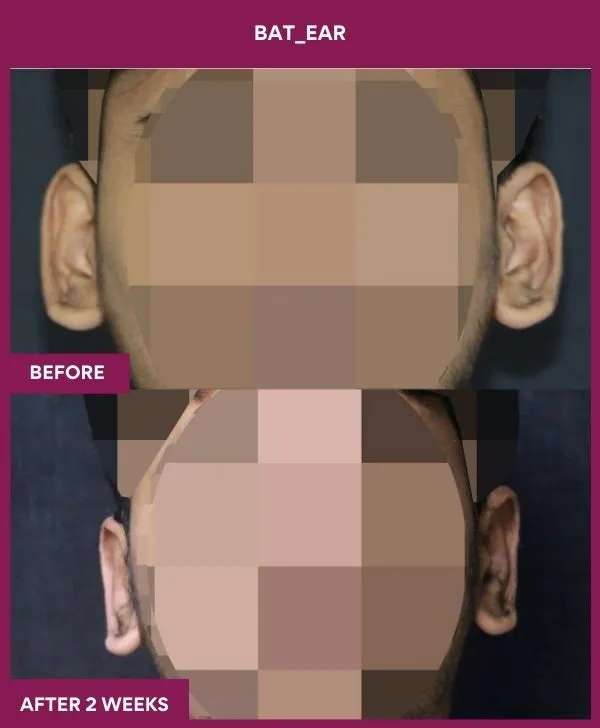
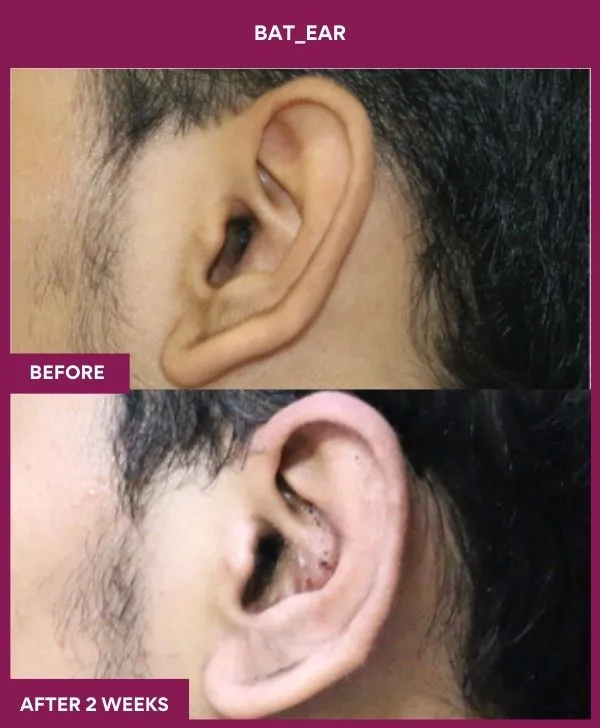
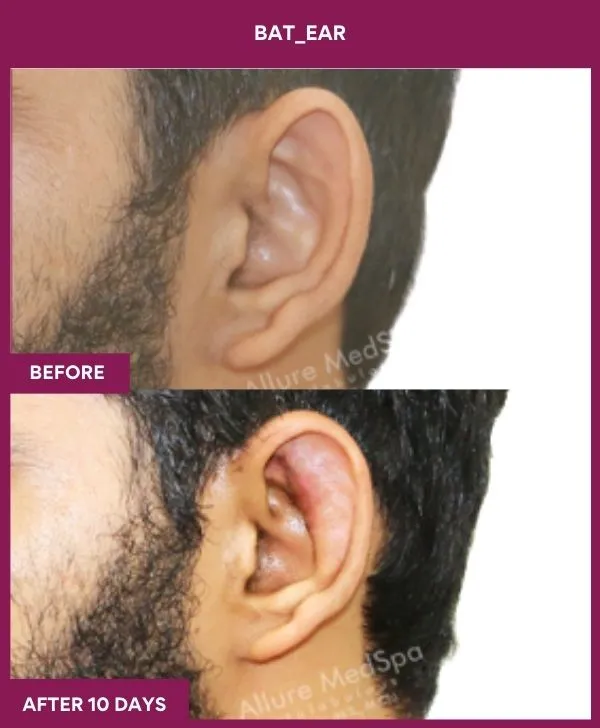
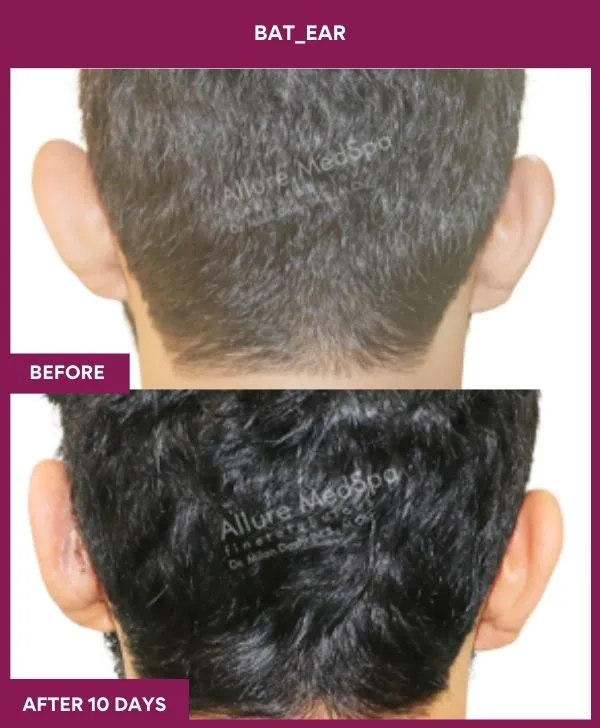
Ear correction surgery (otoplasty) reshapes, resizes or repositions the ears — most often pinning back prominent ears — for a natural, balanced appearance. It’s one of the few cosmetic procedures suitable for children (usually from about age 5–6, once the ears are near adult size) as well as adults, with results that are long-lasting, though the corrected shape can occasionally relax a little over time.
What Is Ear Correction Surgery (Otoplasty)?
Ear correction surgery (otoplasty) is a cosmetic procedure that reshapes, resizes or repositions the ears — most commonly to set prominent ears closer to the head — for a natural, balanced look.
What it treats — protruding (‘bat’) ears, missing or weak ear folds, asymmetry, and deformities from genetics, injury or previous surgery
How — the ear cartilage is reshaped with permanent sutures and/or scoring, usually through an incision hidden behind the ear
Who — children (usually from about age 5–6) and adults; a common, well-established procedure
How long it lasts — long-lasting and usually permanent, though the shape can occasionally relax a little (see results)
Also called — otoplasty, ear reshaping, ear pinning, pinnaplasty, aesthetic ear surgery, ear reconstruction
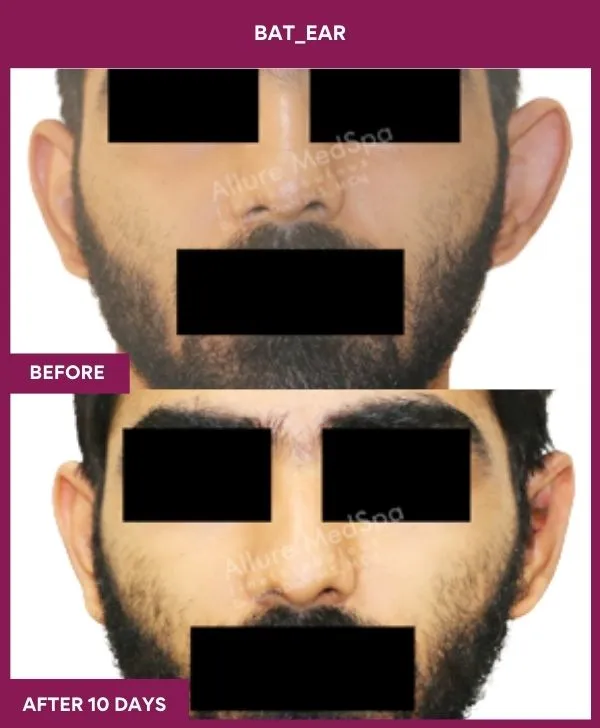
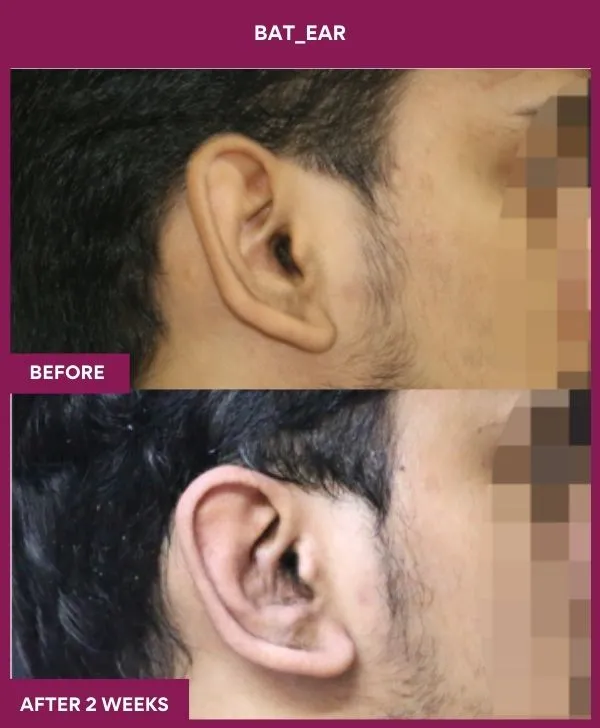
Ear Correction Surgery Before & After Images
“Liked the results? Let's plan yours.”
Ear Correction Surgery Testimonials: Fine To Fabulous Journeys

Awarded by Google.com
Rating: 4.7
Reviews: 485+
Awarded by WhatClinic.com
Rating: 4.8
Reviews: 119+
Awarded by Realself
Rating: 4.9
Reviews:453+
Awarded by Facebook
Rating: 4.6
Reviews:105+
Dr Milan Doshi and his staff are very professional and committed as the centre is highly equipped with advanced technology. I had closed rhinoplasty 4 months back and I’m seeing the results as to how it becomes successful.
Deepika Shetty
The doctor explained everything clearly and the surgery was smooth. Recovery was faster than I expected and the team was very supportive.
Rahul Mehta
Very natural results and excellent staff. From consultation to follow-up, the experience was outstanding and boosted my confidence.
Sneha Kapoor
“Inspired by their journey? Start yours”
Do Prominent Ears Make You Consider Ear Correction Surgery?
If prominent or misshapen ears affect your confidence — or your child’s — ear correction surgery (otoplasty) can reshape them for a natural, balanced result and lasting relief from self-consciousness.
Do your ears stick out more than you’d like, drawing attention in photos or gatherings?
Have you felt self-conscious wearing your hair up, or hats?
Is your child being teased at school because of prominent or misshapen ears?
For many people, prominent or irregularly shaped ears aren’t a minor issue — they can lead to years of self-consciousness, and for children, teasing that affects confidence. Everyday situations like photos, school or meetings can feel uncomfortable when you’re aware of how your ears look.
Ear correction surgery — otoplasty — offers a safe, well-established and long-lasting solution. By reshaping, repositioning or resizing the ears, it restores natural proportion and balance, whether the concern is ‘lop-ear’, ‘cup-ear’ or general asymmetry. Recovery is usually quick, and the results are long-lasting — helping you or your child feel more confident.
Global & Indian trends (2024)
315,997 otoplasty procedures were performed worldwide in 2023, a steady rise in aesthetic ear correction.
India is a growing destination for cosmetic ear reshaping, with rising volumes in Mumbai, Delhi and Bangalore.
Source: ISAPS Global Survey 2024
“Ready to reshape your body?”
Quick Facts About Ear Correction Surgery
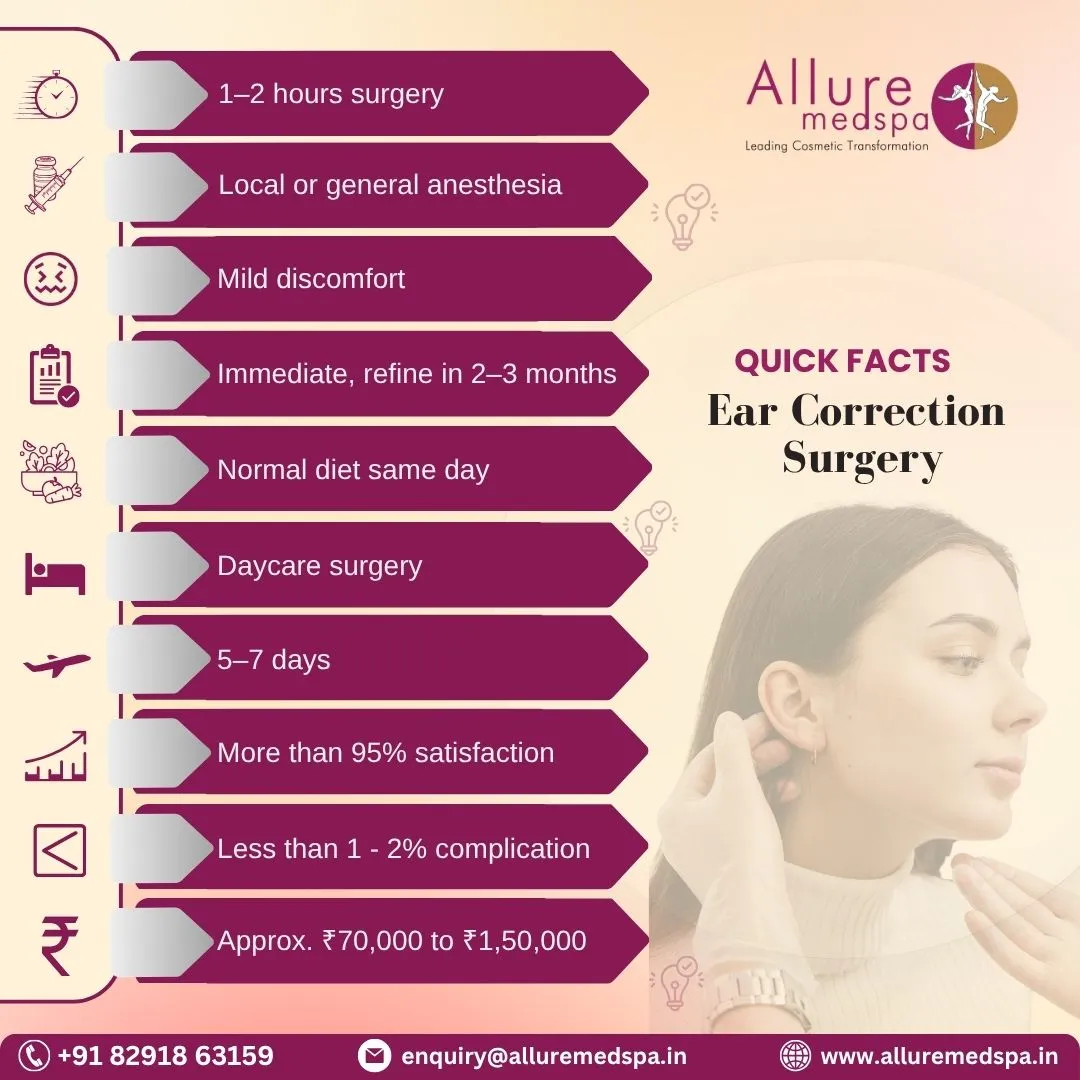
| Time Required | 1–2 hours surgery |
| Anesthesia | Local or general anesthesia |
| Pain Level | Mild discomfort |
| Result | Immediate improvement; refines over 2–3 months |
| Diet | Normal diet on the same day |
| Hospital Stay | Daycare surgery |
| Recovery Time | 5–7 days |
| Satisfaction Rate | More than 95% patient satisfaction |
| Complication Rate | Less than 1–2% |
| Approximate Cost | ₹70,000 – ₹1,50,000 |
What Are the Benefits of Otoplasty (Ear Surgery)?
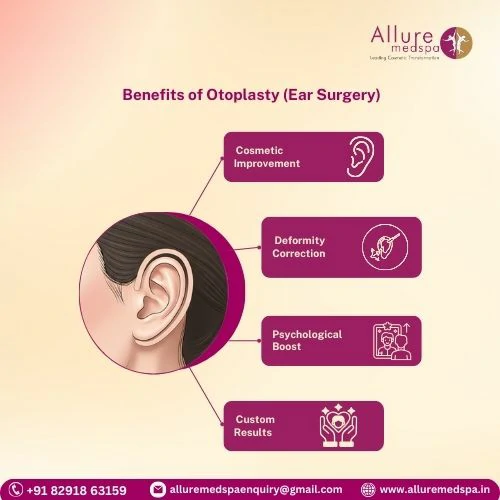
Otoplasty improves ear shape, size and symmetry and, for many people, brings a real boost in confidence — with natural, balanced results.
Cosmetic improvement — sets prominent ears back, reduces size, improves symmetry
Deformity correction — addresses congenital or injury-related ear deformities
Psychological benefit — documented improvement in self-image, especially in children previously teased
Custom results — tailored to your (or your child’s) anatomy for a natural look
Source: Otoplasty provides significant cosmetic and psychosocial benefits
Who Is a Good Candidate for Ear Correction Surgery?
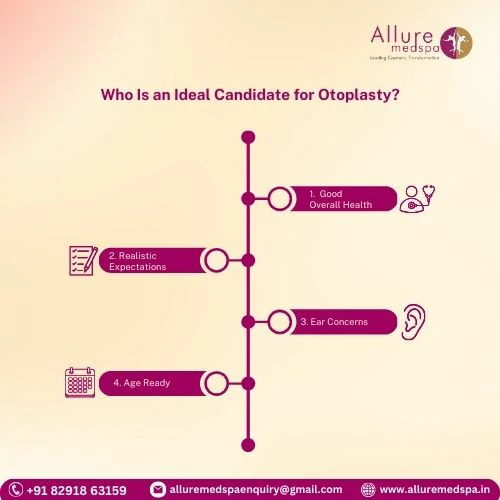
Good candidates for otoplasty are healthy children (usually from about age 5–6) and adults with prominent, asymmetric or misshapen ears and realistic expectations.
Children from about 5–6 years — by this age the ears are close to adult size but the cartilage is still workable — the classic timing for ear pinning
Adults of any age — otoplasty is safe and effective in adulthood too
Healthy — no untreated ear infection or uncontrolled medical condition
Realistic expectations — about achievable symmetry and recovery
For infants — non-surgical ear moulding can work in the first few months of life; after that, surgery is the reliable option
What Are the Different Types and Techniques of Ear Correction Surgery?
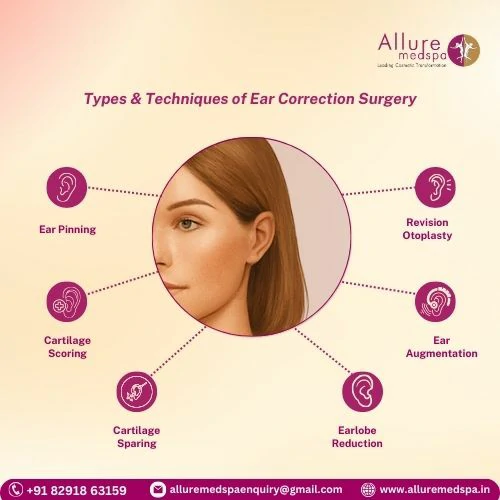
Otoplasty techniques are chosen to match the ear’s shape and the deformity — from suture-based pinning to cartilage-reshaping and reconstruction — for a customised result.
Ear pinning (setback otoplasty) — brings protruding ears closer to the head using cartilage reshaping and/or permanent sutures
Cartilage-scoring technique — small cuts create or strengthen a natural fold for better contour
Cartilage-sparing (suture) technique — reshapes with permanent sutures without cutting cartilage — gentler, though suture-only methods have a slightly higher chance of partial relapse
Earlobe reduction — reduces an elongated or oversized earlobe
Ear augmentation / reconstruction — adds cartilage (e.g. from the rib) for underdeveloped ears, such as in microtia
Revision otoplasty — corrects asymmetry or relapse from a previous ear surgery
Technique matters — cartilage-sparing and hybrid (suture + flap) methods have the lowest recurrence; your surgeon matches the method to your ears
Source: Cartilage-sparing / hybrid techniques give lowest recurrence and revision
What Are the Limitations of Ear Correction Surgery?
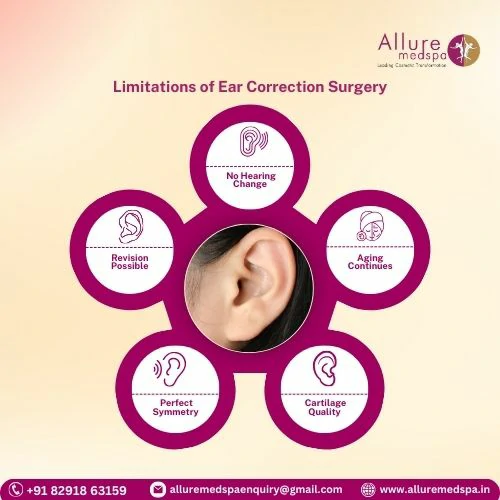
Otoplasty gives lasting aesthetic improvement, but it has limits worth understanding before surgery.
No effect on hearing — it’s purely cosmetic and doesn’t change hearing
Doesn’t stop ageing — the ears and skin still change slowly over the years
Depends on cartilage & skin — very stiff cartilage or less elastic skin can affect the result
Symmetry isn’t perfect — ears are improved and balanced, but perfect symmetry can’t be guaranteed
Small chance of revision — occasionally a touch-up is needed for the best result
What Are the Pre-Operative Requirements for Otoplasty?
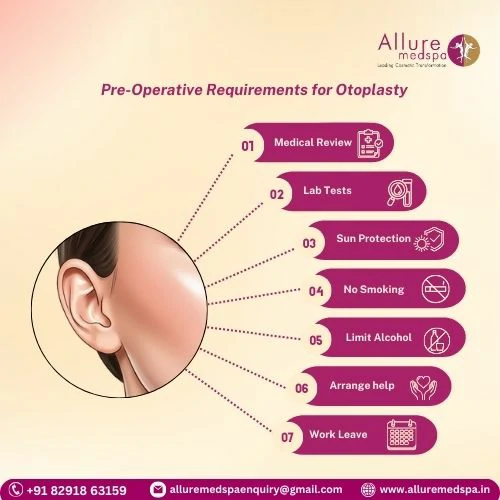
Preparing for otoplasty means a medical review, stopping smoking, and arranging help — all to support a safe procedure and smooth recovery.
Medical review — full health history, medications and allergies (and, for children, an assessment suited to their age)
Any needed tests — routine blood work if required
Stop smoking — at least 2 weeks before and 1 week after (adults)
Limit alcohol — avoid excess for 2 weeks before and 1 week after
Arrange support — someone to accompany you home and help for 1–2 days; plan 1–2 weeks off
How Is the Ear Correction (Otoplasty) Procedure Performed?
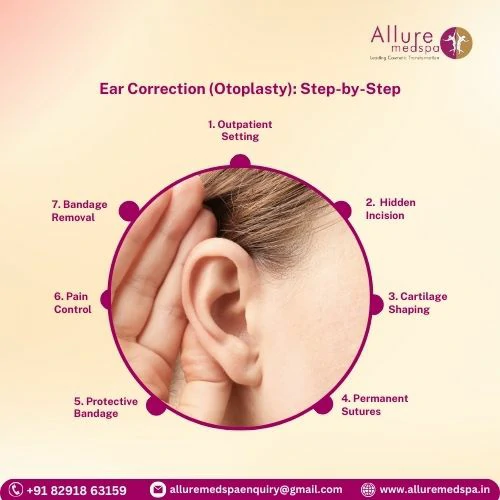
Otoplasty reshapes and repositions the ears in about 1–2 hours, through a discreet incision usually hidden behind the ear, as a day-care procedure.
Setting — an outpatient (day-care) surgical facility
Incision — usually behind the ear, in the natural crease, for minimal visibility
Cartilage reshaping — the cartilage is sculpted, folded and/or partially removed to the desired contour
Sutures — permanent stitches hold the new ear position
Dressing — a supportive head bandage protects the ears; removed after a few days
What Results Can You Expect After Ear Correction Surgery, and How Long Do They Last?
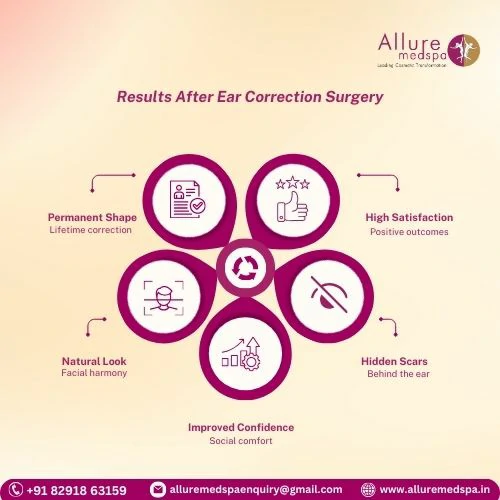
Otoplasty gives a natural, better-proportioned ear shape that is long-lasting and usually permanent — though, honestly, the corrected shape can occasionally relax a little over time, especially with suture-only techniques, which is why technique choice and aftercare matter.
Natural reshaping — prominent, asymmetric or misshapen ears set into a balanced position
Usually long-lasting — for most people the correction holds well for life
But not always ‘forever’ — partial relapse (the ear drifting back toward its old position) is the most relevant long-term issue; it’s uncommon overall (pooled ~2.8%) but more likely with suture-only methods and if aftercare is disrupted
Hidden scars — incisions behind the ear are well concealed
High satisfaction — most patients report a lasting improvement in appearance and confidence
Sources: Pooled recurrence ~2.8%, revision ~2.1%; suture extrusion commonest, Recurrence the most clinically relevant complication; suture-only higher relapse
What Is the Recovery Timeline for Ear Correction Surgery?
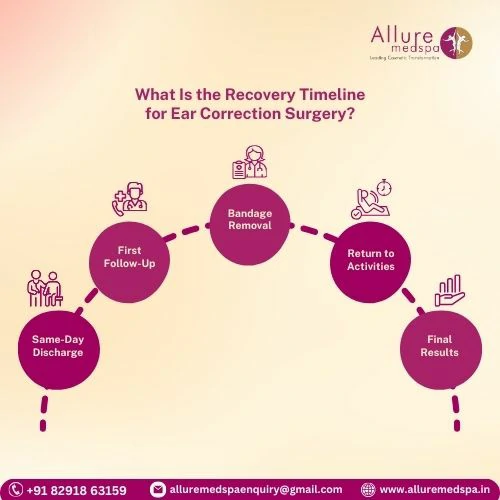
Recovery from otoplasty is generally mild — most people go home the same day and return to light activity within about a week.
Same-day discharge — it’s an outpatient procedure
First check-up — usually the next day
Dressing removal — the supportive bandage comes off within a few days, often replaced by a headband
Back to activity — light work/school in 5–7 days; avoid strenuous activity and contact sports for 3–4 weeks
Protect the result — wear the headband as advised (especially at night), avoid pressure on the ears, and don’t rest glasses directly on the ears while healing
What Are the Risks and Complications of Ear Correction Surgery?
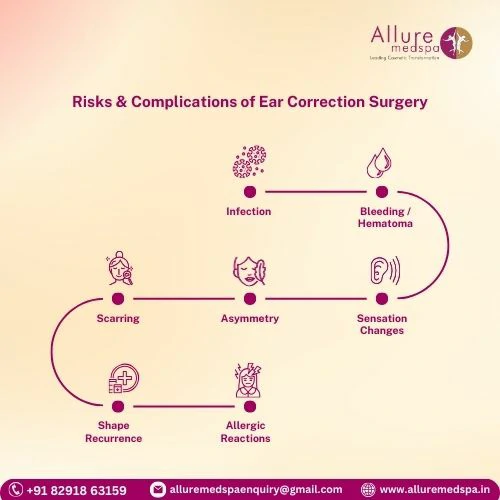
Otoplasty is generally safe in experienced hands, and serious complications are rare — but minor ones, mostly suture-related, are not uncommon, and honest awareness helps you choose well.
Uncommon, usually minor
Suture problems — a permanent stitch can occasionally become palpable, visible or work its way out (extrusion) — the commonest otoplasty complication (~5%); usually managed with a minor procedure
Swelling, bruising & numbness — temporary; sensation returns over weeks
Asymmetry — small differences between the ears can remain or need adjustment
Less common
Recurrence (relapse) — the ear can partly drift back toward its old position (~2.8% pooled; higher with suture-only techniques) — the most relevant long-term issue
Infection or hematoma — uncommon; a hematoma (blood collection) needs prompt attention to protect the cartilage
Scarring — usually hidden behind the ear; rarely, thickened or keloid scars, especially in prone individuals
Allergic reaction — to sutures, dressings or anaesthesia (rare)
Minimised by expertise — cartilage-sparing/hybrid technique, careful suture placement and good aftercare keep recurrence and suture problems low; choose a board-certified plastic surgeon
Sources: Overall complication ~14.4%; suture extrusion 5.4% commonest; recurrence 2.8%, Suture extrusion & late complications; asymmetry ~10%, extrusion ~10% in one series
🩺 Dr. Milan Doshi’s note: “In otoplasty, I prefer a careful cartilage-sparing or hybrid approach depending on the ear shape. Precise suture placement, balanced correction, and proper aftercare help reduce relapse, asymmetry, and suture-related problems. For children, timing and parental counselling are discussed carefully before surgery.”
What Is the Cost of Ear Correction Surgery in Mumbai?
In Mumbai, ear correction surgery (otoplasty) typically costs ₹70,000 to ₹1,50,000, depending on complexity, technique, whether one or both ears are treated, and anaesthesia. EMI options are on our payment process page.
What changes the price — one ear vs both, simple pinning vs reconstruction, technique and anaesthesia
Usually included — surgeon’s fee, day-care facility, consumables and immediate follow-ups
Not included — pre-op tests, take-home medicines, and 18% GST; cosmetic otoplasty isn’t insured (though some reconstructive/congenital cases may be — check)
Exact quote — after assessment; book a consultation
“Want to know the exact cost for you?”
Who Is the Best Surgeon for Ear Correction Surgery in Mumbai?
Dr. Milan Doshi is an Indian board-certified plastic surgeon in Mumbai, trusted for natural otoplasty results in both children and adults, with 27+ years’ experience in facial and ear surgery.
Board-certified plastic surgeon — M.Ch (Plastic Surgery); 27+ years’ experience
Ear-surgery experience — 300+ ear correction surgeries
Natural technique — sets ears back in balanced proportion, avoiding an over-pinned look
Child-friendly care — experienced with young patients and parent counselling
“Ready to meet the expert?”
Which Is the Best Centre for Ear Correction Surgery in Mumbai?
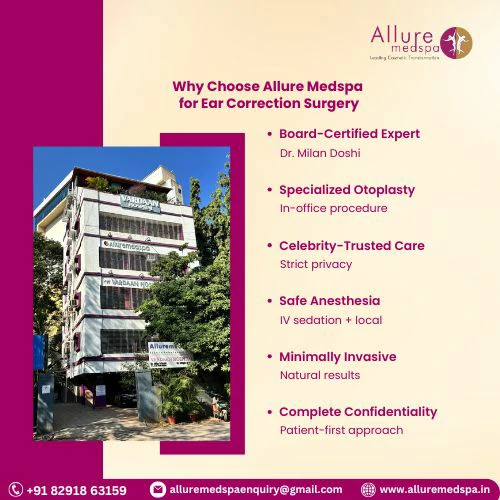
Allure Medspa, led by board-certified plastic surgeon Dr. Milan Doshi, offers safe, private and expert ear correction surgery in Mumbai, with modern facilities and end-to-end care.
Expertise — led by plastic surgeon Dr. Milan Doshi; otoplasty for children and adults
Appropriate anaesthesia — local with IV sedation, or general (often general for young children)
Accredited facility — modern, safe surgical environment
Privacy & comfort — high confidentiality standards
Outstation & overseas — travel and coordination support via our outstation patients guide
“Trust Mumbai’s leading aesthetic centre.”
Medical Code for Ear Correction Surgery
ICD-10 Codes for Ear Correction Surgery
| ICD-10 Code | Description |
|---|---|
| Q17.5 | Prominent ear (congenital) |
| Q17.2 | Microtia (underdeveloped external ear) |
| Q17.8 | Other specified congenital malformations of ear |
| M95.2 | Acquired deformity of head and face (post-trauma ear deformity) |
| Z41.1 | Encounter for cosmetic procedure (elective ear reshaping) |
CPT Codes for Ear Correction Surgery
| CPT Code | Description |
|---|---|
| 69300 | Otoplasty, protruding ear, with or without size reduction |
| 69310 | Reconstruction of external ear (partial) |
| 69315 | Total reconstruction of external ear |
| 21235 | Ear cartilage graft (harvesting for reconstruction) |
| 14060 | Adjacent tissue transfer or rearrangement, ear |
| 14061 | Adjacent tissue transfer or rearrangement, ear, more than 10 sq cm |
(FAQs) Frequently Asked Question for Ear Correction Surgery
Q1. How long does ear correction surgery take?
Ans. Usually 1–2 hours, depending on complexity and whether both ears are treated. It’s typically a day-care procedure.
Q2. Is ear correction surgery permanent?
Ans. It’s long-lasting and, for most people, permanent — the reshaped cartilage holds its new position. Honestly, though, partial relapse can occur (more so with suture-only techniques), which is why technique and aftercare matter.
Q3. What is the success rate?
Ans. High — published series report most patients rate their result as excellent (around 85–87%), with low recurrence (about 3%) when a good technique is used. No surgery is 100%.
Q4. How do you fix prominent ears without surgery?
Ans. Non-surgical ear moulding works only in infants (roughly the first 6 months of life, while cartilage is soft). After that, otoplasty is the reliable option.
Q5. Can I go to work after otoplasty?
Ans. Most people return to desk work or school in about 5–7 days. Avoid strenuous or contact activity for 3–4 weeks.
Q6. How should I sleep after surgery?
Ans. On your back with your head elevated, avoiding pressure on the ears, for 2–3 weeks. A supportive headband at night is usually advised.
Q7. When do the ears look normal?
Ans. Some swelling and redness settle over a few weeks; the natural final shape is usually clear by about 4–6 weeks.
Q8. What is the best age for ear pinning?
Ans. Often around 5–7 years, when the ears are close to adult size but the cartilage is still flexible — though adults can have otoplasty safely at any age.
Q9. Can otoplasty cause hearing loss?
Ans. No — it reshapes the outer ear only and doesn’t affect the inner ear or hearing.
Q10. Is otoplasty safe?
Ans. Yes, it’s a low-risk, well-established procedure in experienced hands. Serious complications are rare; the commonest issues are minor and suture-related.
Q11. Does otoplasty last forever?
Ans. Usually the correction is lasting. Some patients experience a small amount of relapse over time, and rarely a touch-up is needed — following aftercare closely helps it hold.
Q12. How much does otoplasty cost in India?
Ans. At Allure Medspa it typically ranges ₹70,000–₹1,50,000 depending on whether one or both ears are treated, the technique and anaesthesia. You’ll get an exact, itemised quote after assessment.
Q13. Can I wear glasses after otoplasty?
Ans. Avoid resting glasses directly on the ears for 2–3 weeks while healing. After that, glasses can be worn normally.
Q14. Is otoplasty painful?
Ans. Discomfort is usually mild and well controlled with medication; the ears may feel tender or itchy for a short while.
Q15. Can stretched or torn earlobes be repaired?
Ans. Yes — earlobe repair can correct stretched, torn or gauged lobes and restore a natural shape, often as a quick, separate minor procedure.
“Still have questions? We’re here. ”
Related Links
Note: The author of this content is Dr. Milan Doshi, An Indian board-certified plastic & cosmetic Surgeon wholly & solely confirms the authenticity of the information & knowledge delivered by this write-up.