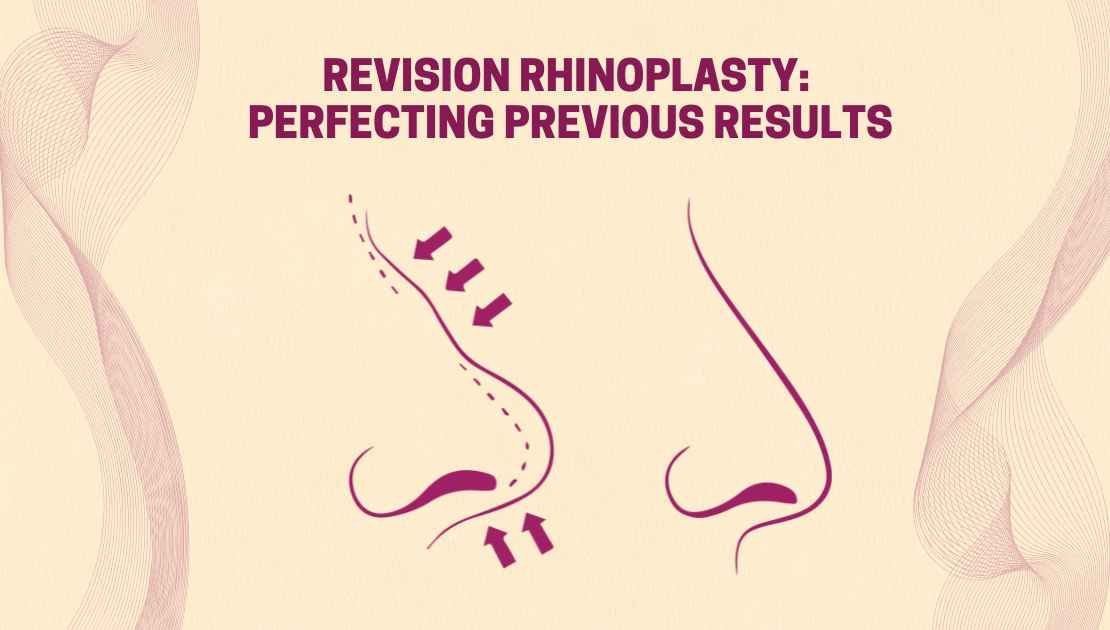
Revision rhinoplasty in Mumbai helps correct cosmetic or functional problems after a previous nose surgery. At Allure Medspa, revision planning focuses on structure, breathing, scar tissue, cartilage support, realistic expectations, and long-term facial harmony. You can book a revision rhinoplasty consultation or read the main rhinoplasty surgery guide to understand the full procedure first.
What Is Revision Rhinoplasty?
Revision rhinoplasty, also called secondary rhinoplasty, is nose surgery performed after a previous rhinoplasty to correct residual deformity, improve breathing, restore support, or address dissatisfaction. Revision rhinoplasty is usually more complex than primary rhinoplasty because the nose has already been surgically altered.
Primary rhinoplasty starts with untouched anatomy. Revision rhinoplasty starts with scar tissue, changed cartilage, altered support, and sometimes reduced blood supply. That is the practical difference. It is not “just a small correction” unless the examination proves it.
Revision rhinoplasty may involve:
- Cosmetic correction: Hump, asymmetry, tip shape, nostril imbalance.
- Functional correction: Nasal obstruction, valve collapse, septal deviation.
- Structural repair: Weak bridge, collapsed middle vault, poor tip support.
- Grafting: Septal, ear, or rib cartilage when support is deficient.
- Staged planning: Some complex cases may need more than one step.
Source: NCBI – Rhinoplasty (StatPearls)
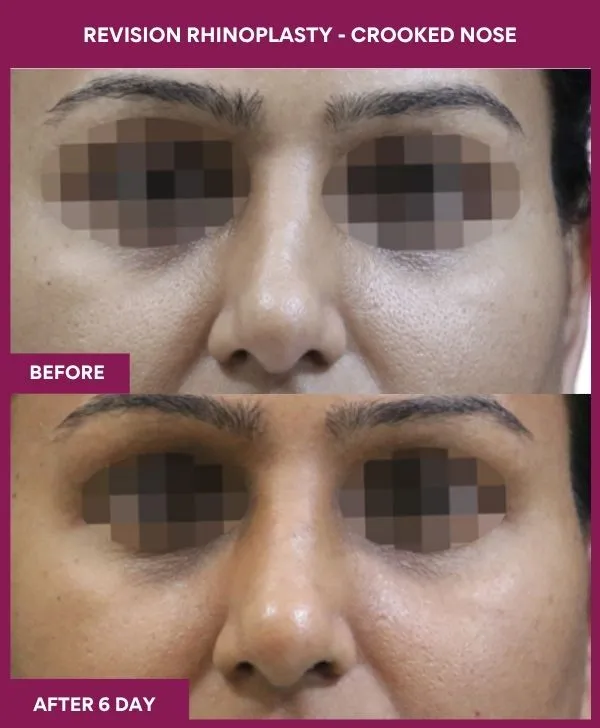
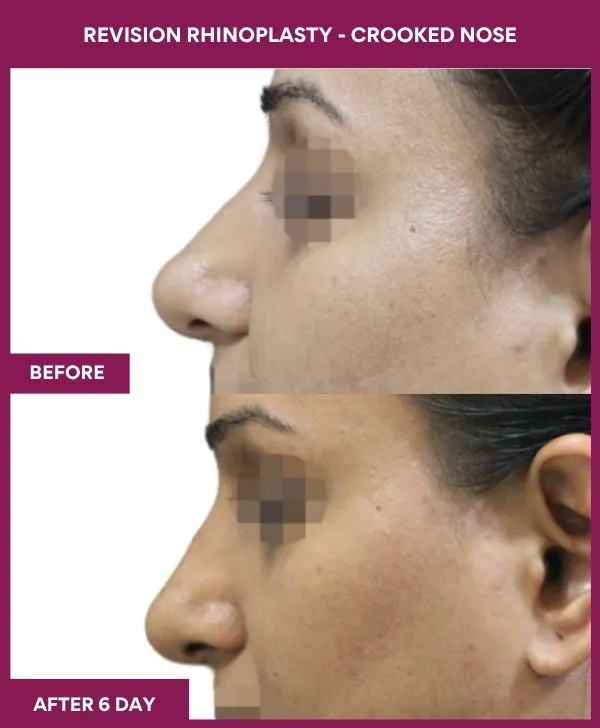
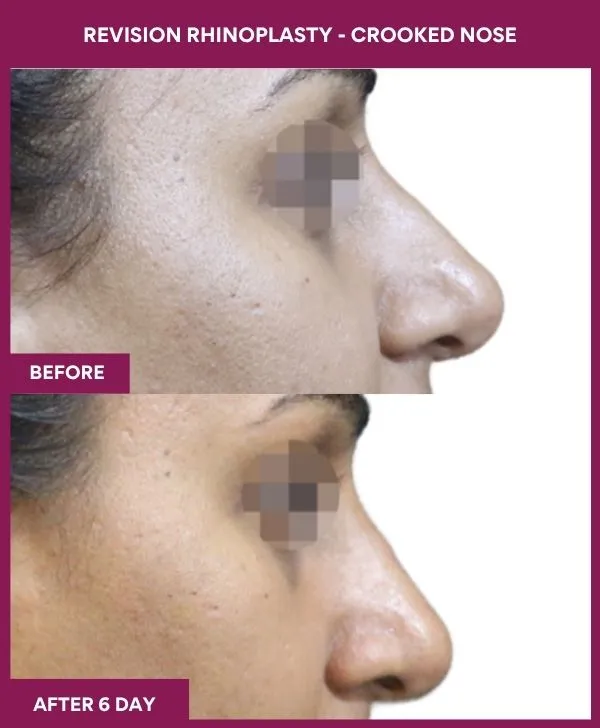
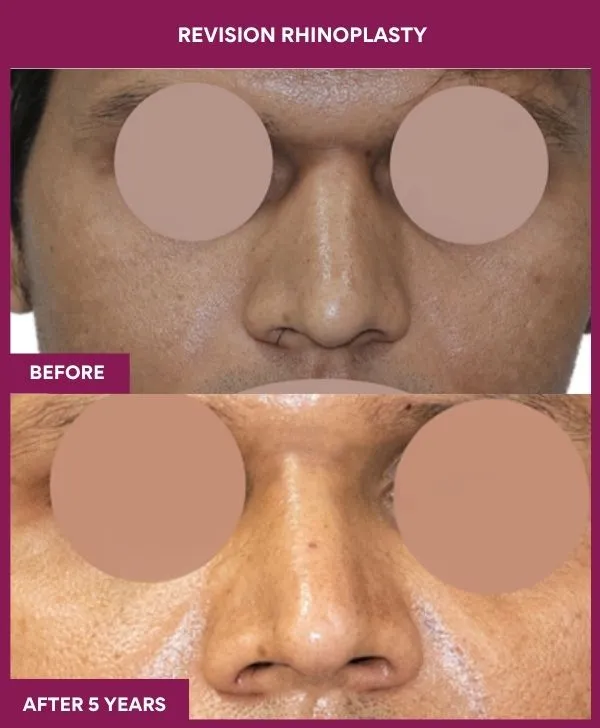
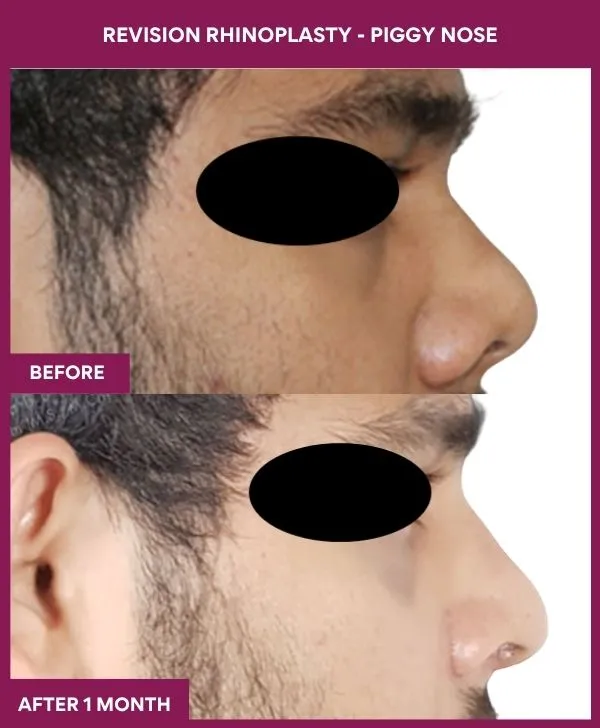
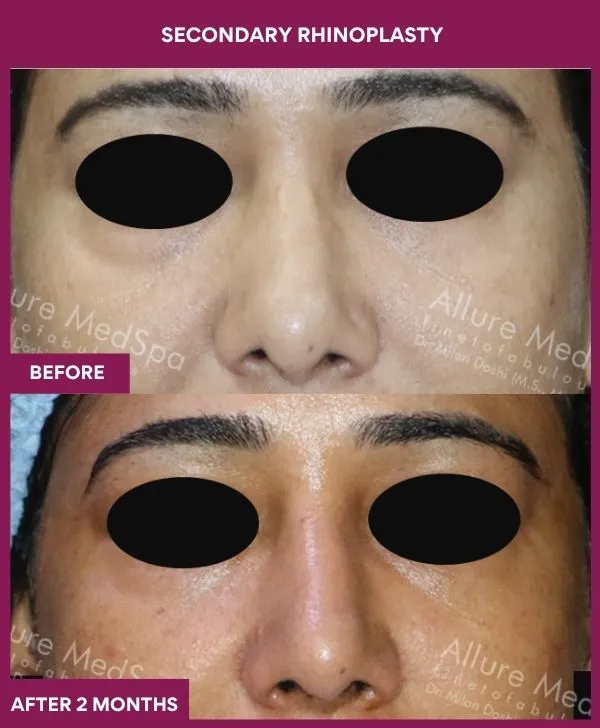
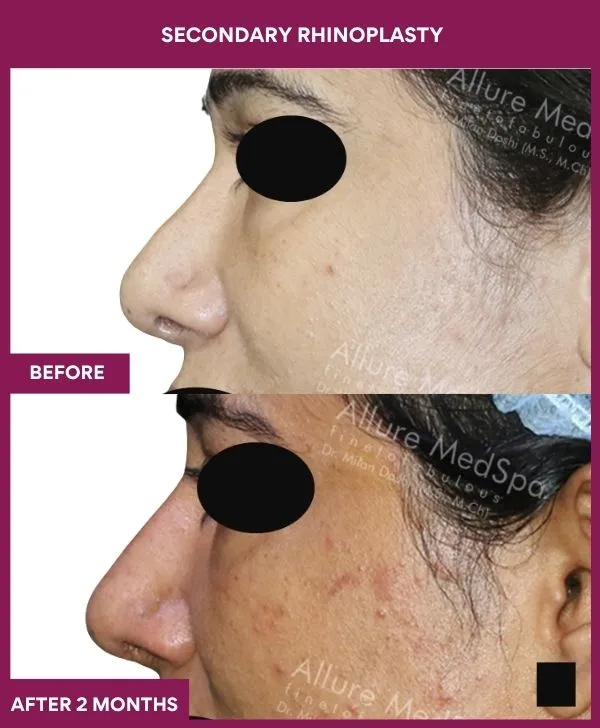
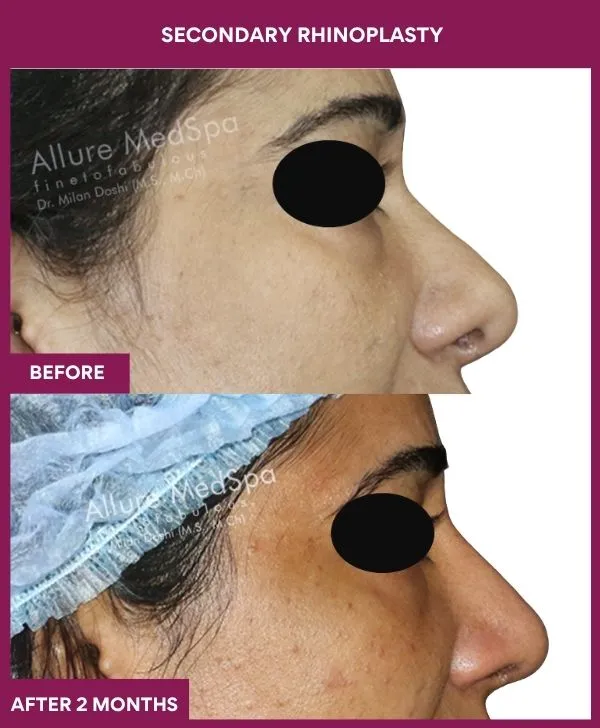
Revision Rhinoplasty Surgery Results: Before & After
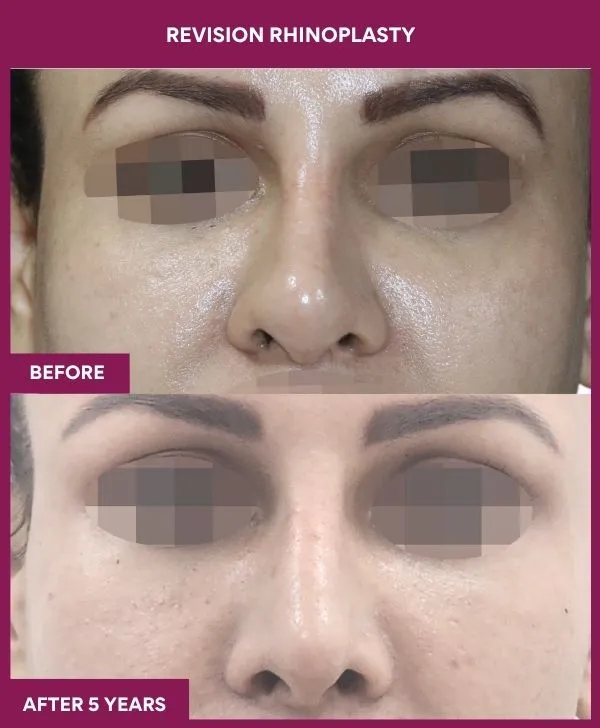
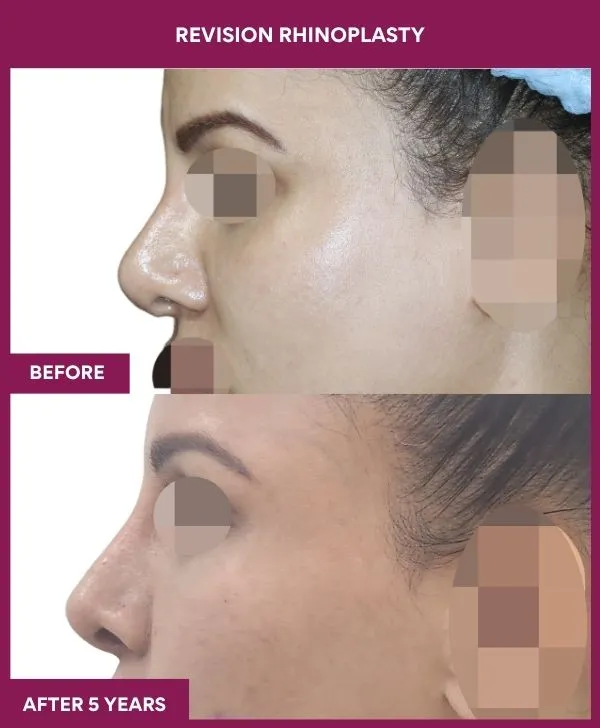
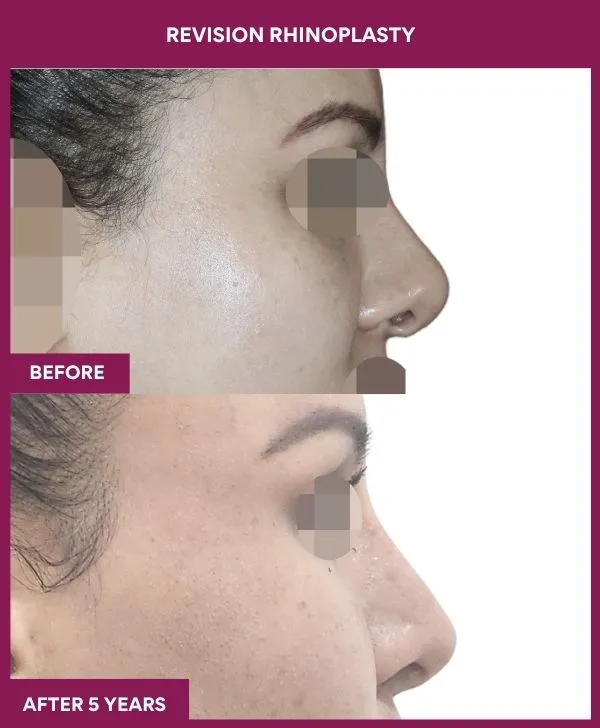
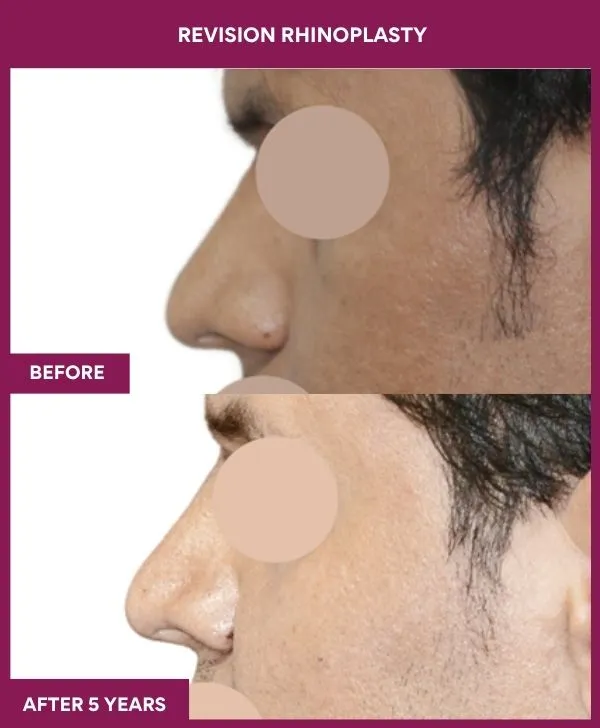
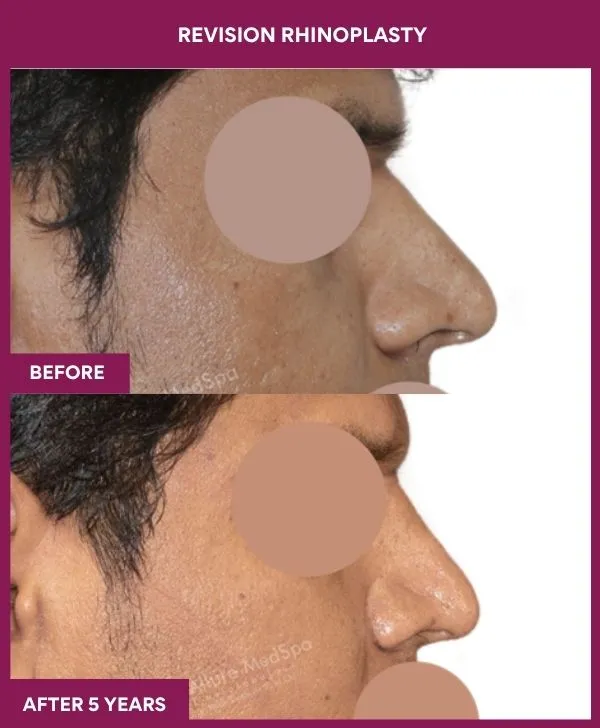
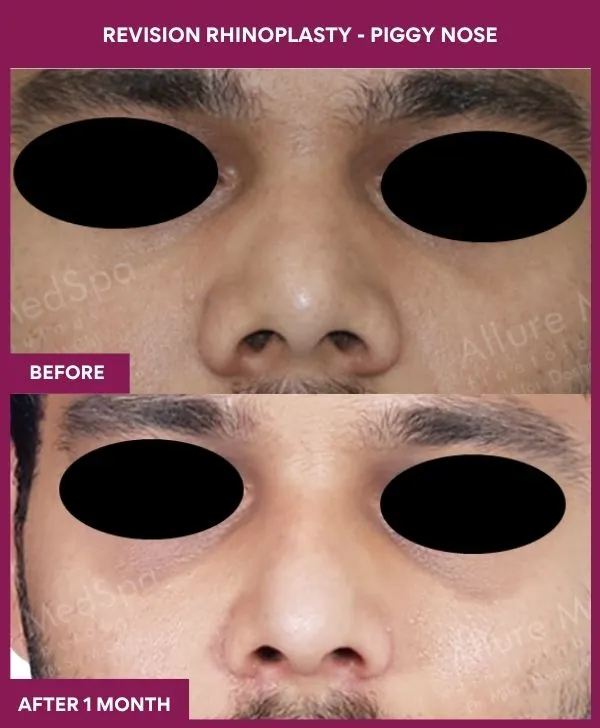
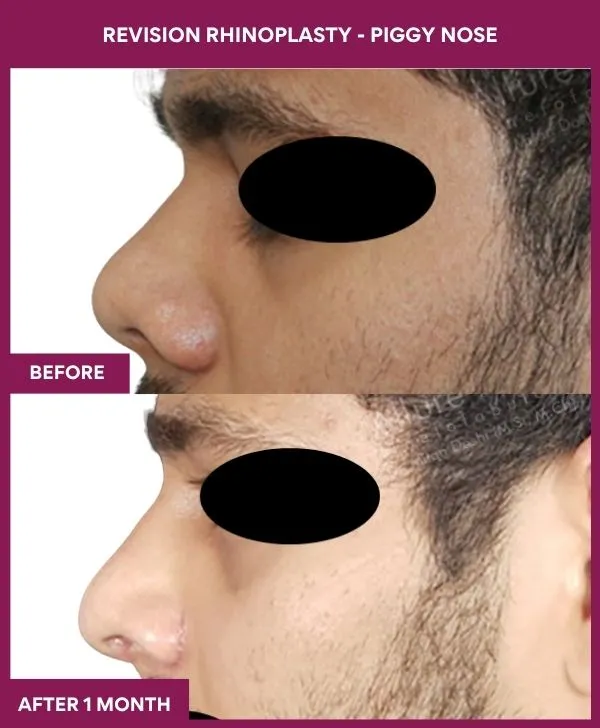
Revision Rhinoplasty Surgery Testimonials: Celebrities Patient

Awarded by Google.com
Rating: 4.7
Reviews: 485+
Awarded by WhatClinic.com
Rating: 4.8
Reviews: 119+

Awarded by Realself
Rating: 4.9
Reviews:453+

Awarded by Facebook
Rating: 4.6
Reviews:105+
Dr Milan Doshi and his staff are very professional and committed as the centre is highly equipped with advanced technology. I had closed rhinoplasty 4 months back and I’m seeing the results as to how it becomes successful.
Deepika Shetty
The doctor explained everything clearly and the surgery was smooth. Recovery was faster than I expected and the team was very supportive.
Rahul Mehta
Very natural results and excellent staff. From consultation to follow-up, the experience was outstanding and boosted my confidence.
Sneha Kapoor
Are You Unhappy With a Previous Nose Job?
Revision rhinoplasty patients are often disappointed, anxious, or frustrated after a previous nose job. The process should begin with calm assessment, not panic. The goal is to identify what is anatomical, what is still swelling, what affects breathing, and what can realistically be improved.
Common reasons patients seek revision include:
- Residual hump: Bridge still looks raised.
- Over-correction: Nose looks too scooped, pinched, or weakened.
- Under-correction: Original problem remains visible.
- Tip issue: Drooping, asymmetry, bulbousness, or poor support.
- Crooked nose: Persistent deviation or new asymmetry.
- Breathing problem: Obstruction after previous surgery.
- Nostril imbalance: Alar or base asymmetry.
Some dissatisfaction is real surgical failure. Some is swelling. Some is expectation mismatch. A serious revision consultation separates these three; otherwise, the second surgery can become a second mistake.
Sources: PubMed 30349780 · PubMed 23277618
What Are the Quick Facts About Revision Rhinoplasty?
Revision rhinoplasty usually takes longer than primary rhinoplasty and may require open exposure, structural grafting, airway correction, or staged planning. It should usually be considered after adequate healing time — commonly around 12 months — unless there is an urgent functional or structural concern.
| Quick fact | Guide information |
|---|---|
| Procedure | Revision / secondary rhinoplasty |
| Surgery time | Around 2–4 hours |
| Anaesthesia | Usually general anaesthesia |
| Wait before revision | Commonly about 12 months |
| Recovery | Often slower than primary rhinoplasty |
| Complexity | Higher than primary due to scar tissue and altered anatomy |
| Grafts | Septal, ear, or rib cartilage may be needed |
| Staged surgery | Possible in complex cases |
Source (revision complexity and timing guidance): NCBI – Rhinoplasty (StatPearls)
Why Do People Need Revision Rhinoplasty?
Revision rhinoplasty may be needed for aesthetic dissatisfaction, breathing problems, structural collapse, over-correction, under-correction, asymmetry, tip deformity, or persistent deformity after primary surgery. It is not one diagnosis; it is a corrective plan based on the specific failure pattern.
Common aesthetic reasons
| Concern | What it means |
|---|---|
| Residual dorsal hump | Bridge bump remains |
| Polly-beak deformity | Fullness above tip creates beak-like profile |
| Tip asymmetry | Tip looks uneven or twisted |
| Tip ptosis | Tip droops downward |
| Over-rotation | Tip looks too lifted |
| Inverted-V deformity | Midvault collapse creates visible lines |
| Open-roof deformity | Bridge appears flat or widened after hump removal |
Common functional reasons
| Concern | What it means |
|---|---|
| Persistent obstruction | Breathing remains blocked |
| Internal valve collapse | Narrow internal airway |
| External valve collapse | Nostril sidewall weakness |
| Septal deviation | Septum remains or becomes deviated |
| Over-reduction | Support loss affects airflow |
A 2018 study found respiratory functional disorder was associated with later revision, supporting the need to evaluate breathing both before and after rhinoplasty.
Source: PubMed 30349780
Am I a Candidate for Revision Rhinoplasty?
Revision rhinoplasty may suit patients with persistent cosmetic concern, breathing difficulty, structural collapse, or deformity after previous nose surgery. But most patients should wait until swelling and scar maturation have sufficiently settled — often around 6 to 12 months or longer depending on the case — before final revision planning. It should not be rushed while swelling and scar maturation are still evolving.
You may be a candidate if:
- Time has passed: Prior surgery was about 6 to 12 months ago or more.
- Concern is stable: Shape is no longer changing rapidly.
- Breathing is affected: Obstruction is persistent or worsening.
- Anatomy can support surgery: Skin and tissue condition are suitable.
- Expectations are realistic: Improvement, not perfection.
- Records are available: Previous operative notes help.
- You accept complexity: Grafts or staged correction may be needed.
Who should not rush into revision?
| Situation | Why wait or reconsider |
|---|---|
| Surgery was recent | Swelling may still be settling |
| Concern changes weekly | Target is not stable |
| Expectation is perfection | Revision has limits |
| Health is uncontrolled | Safety risk increases |
| Smoking continues | Healing risk may rise |
| Significant untreated emotional distress | Decision-making may not be reliable until counselling and expectations are stabilised |
| Surgeon has not examined airway | Functional cause may be missed |
Source (waiting period and revision planning): NCBI – Rhinoplasty (StatPearls)
What Can Revision Rhinoplasty Correct?
Revision rhinoplasty can correct selected aesthetic and functional problems after prior nose surgery, including bridge irregularity, tip deformity, nostril asymmetry, collapse, deviation, and breathing obstruction. It cannot create unlimited change because skin, scar tissue, cartilage supply, and blood supply may restrict correction.
| Area | Possible correction |
|---|---|
| Bridge | Residual hump, irregularity, saddle deformity |
| Tip | Drooping, asymmetry, over-rotation, poor definition |
| Nostril | Alar asymmetry, collapse, nostril imbalance |
| Septum | Persistent deviation or obstruction |
| Valve | Internal or external valve collapse |
| Support | Weak framework, collapse after over-reduction |
| Projection | Under-projected or over-projected nose |
Final suitability depends on examination. Results vary by individual anatomy and healing.
Why Is Revision Rhinoplasty Harder Than Primary Rhinoplasty?
Revision rhinoplasty is harder than primary rhinoplasty because the surgeon must work through scar tissue, distorted anatomy, previously altered cartilage, possible support loss, and sometimes reduced vascularity. It often becomes reconstructive surgery, not simple reshaping.
This is one of the most important sections to understand before considering revision surgery. The first operation may have removed cartilage, weakened support, changed tissue planes, narrowed the airway, or created scar contracture. The revision surgeon is no longer operating on untouched anatomy.
Why revision is technically demanding:
- Scar tissue: Makes dissection harder.
- Distorted landmarks: Normal anatomy may be unclear.
- Cartilage shortage: Septal cartilage may be depleted.
- Vascularity: Prior surgery may affect tissue healing.
- Support loss: Nose may need rebuilding.
- Airway risk: Cosmetic changes can worsen breathing if careless.
- Predictability: Outcomes are less predictable than primary surgery.
Source: NCBI – Rhinoplasty (StatPearls)
Harder surgery — that's why surgeon choice matters.
Scar tissue needs senior hands
Which Techniques and Grafts Are Used in Revision Rhinoplasty?
Revision rhinoplasty may use open or closed techniques, but open revision is often preferred when detailed exposure, grafting, tip reconstruction, or major structural correction is needed. It frequently requires cartilage grafts from the septum, ear, or rib when existing nasal support is inadequate.
Open vs closed revision rhinoplasty
| Approach | When it may be used | Key limitation |
|---|---|---|
| Open revision | Complex deformity, tip work, grafting, structural repair | Small columella incision; more dissection |
| Closed revision | Minor selected corrections | Limited visibility and access |
| Staged approach | Severe scarring, poor tissue condition, complex reconstruction | Requires more time and planning |
Cartilage graft options
| Graft source | Common use | Consideration |
|---|---|---|
| Septal cartilage | Support, spreader grafts, tip support | May be depleted after prior surgery |
| Ear cartilage | Tip, contour, selected support needs | Curved and softer |
| Rib cartilage | Major structural reconstruction | Donor-site surgery; warping risk |
Source (grafting and cartilage shortage in revision planning): NCBI – Rhinoplasty (StatPearls)
Ear, rib or septum — grafts rebuild support.
Plain-language technique guidance
What Are the Limitations and Realistic Expectations?
Revision rhinoplasty can improve a previous nose surgery result, but it has clear anatomical and healing limits. It is less predictable than primary rhinoplasty because scar tissue, skin thickness, cartilage loss, blood supply, and healing behaviour may restrict how much correction is safe or achievable.
What patients must understand:
- Not instant: Swelling can take longer than primary surgery.
- Not unlimited: Tissue quality controls what is possible.
- Not always single-stage: Some complex cases are staged.
- Not copy-paste: Another person’s nose cannot be replicated.
- Not purely cosmetic: Airway safety matters.
- Not risk-free: Revision carries added complexity.
- Not final until healed: Early swelling can mislead.
Published studies report different revision rhinoplasty rates — commonly cited ranges fall around 5–15%, influenced by case complexity, surgeon experience, patient expectations, healing behaviour, and whether the case is primary or secondary. These figures are useful for patient education, but they should not be read as Dr. Doshi’s clinic-specific revision rate.
At Allure Medspa, the focus is on reducing avoidable revision risk through detailed consultation, realistic expectation setting, structural planning, breathing assessment, careful technique, and proper follow-up. Still, no ethical surgeon should promise that revision will never be needed, because healing and anatomy vary from patient to patient.
Sources: PubMed 23277618 · PMC5600890
What Are the Risks and Complications of Revision Rhinoplasty?
Revision rhinoplasty has the usual surgical risks plus added revision-specific concerns such as scar-related unpredictability, compromised support, limited cartilage, persistent asymmetry, breathing issues, graft-related problems, and possible need for further surgery.
| Risk | Why it matters |
|---|---|
| Bleeding or infection | General surgical risk |
| Persistent swelling | May last longer in revision |
| Asymmetry | Scar tissue may heal unevenly |
| Breathing difficulty | Airway must be protected |
| Graft visibility | More likely in thin skin |
| Graft warping | Especially rib cartilage |
| Skin compromise | Prior surgery may affect vascularity |
| Further revision | Some cases may need additional correction |
Source (complexity factors): NCBI – Rhinoplasty (StatPearls)
What Is the Recovery Timeline After Revision Rhinoplasty?
Revision rhinoplasty recovery is often slower than primary rhinoplasty because scar tissue, grafting, structural repair, and repeated tissue trauma may prolong swelling and refinement. Patients should expect early social recovery first, while final contour and tip definition may take many months. For the full stage-by-stage guide, see the rhinoplasty recovery timeline.
| Time | What to expect |
|---|---|
| Day 1–3 | Swelling, bruising, splint, congestion |
| Day 5–10 | Splint review / removal depending on protocol |
| Week 2 | Social recovery improves |
| Weeks 3–6 | Swelling gradually reduces |
| Month 3–6 | Shape becomes clearer |
| Month 6–12 | Continued refinement |
| 12+ months | Final assessment more reliable in complex cases |
Your rhinoplasty surgeon should confirm the exact splint, travel, work, exercise, and follow-up protocol for your case.
How Much Does Revision Rhinoplasty Cost in Mumbai?
Revision rhinoplasty cost in Mumbai is usually higher than primary rhinoplasty because surgery may involve scar dissection, structural reconstruction, graft harvesting, airway correction, longer operating time, and more follow-up. At Allure Medspa, the guide range is ₹1,50,000–₹3,50,000, subject to consultation. For a fuller breakdown, see the rhinoplasty cost guide.
| Item | Guide range / note |
|---|---|
| Revision rhinoplasty | ₹1,50,000–₹3,50,000 |
| Graft requirement | May change cost |
| Septoplasty / airway correction | May change cost |
| Hospital stay / tests / medicines | Confirm inclusions at consultation |
Final cost is confirmed only after consultation.
Why Choose Dr. Milan Doshi for Revision Rhinoplasty?
Revision rhinoplasty requires a surgeon who understands facial aesthetics, nasal structure, airway function, grafting, scar tissue, and realistic correction. Dr. Milan Doshi is a plastic surgeon (MCh, MS) with ISAPS membership, 27+ years of experience, 16,000+ surgeries, and 1,500+ rhinoplasties. Read his full profile and credentials.
| Credential | Detail |
|---|---|
| Qualification | MCh, MS |
| Specialty | Plastic & cosmetic surgery |
| Experience | 27+ years |
| Surgeries | 16,000+ |
| Rhinoplasties | 1,500+ |
| Memberships / roles | ISAPS, IAAPS, MUHS |
Why revision expertise matters:
- Diagnosis: Identify why the first result failed.
- Structure: Rebuild support when needed.
- Airway: Protect or improve breathing.
- Grafting: Select septal, ear, or rib cartilage appropriately.
- Restraint: Avoid over-correction.
- Planning: Explain limitations honestly.
- Follow-up: Monitor slow healing carefully.
What Are the Most Common Questions About Revision Rhinoplasty
Revision rhinoplasty questions usually focus on timing, cost, grafts, recovery, risks, scarring, breathing, and whether a bad result can be corrected. The honest answer: improvement may be possible, but the second operation is more complex and less predictable than the first.
Q1. What is revision rhinoplasty?
Ans. Revision rhinoplasty is nose surgery performed after a previous rhinoplasty to correct cosmetic concerns, breathing problems, structural weakness, or a combination of these. It may be a small refinement or a major reconstruction depending on scar tissue, cartilage availability, and airway status.
Q2. Is revision rhinoplasty harder than primary rhinoplasty?
Ans. Yes. It is usually harder because prior surgery creates scar tissue, changes anatomy, may reduce available cartilage, and can affect tissue vascularity. The surgeon may need grafts and more structural planning than in a first-time rhinoplasty.
Source: NCBI – Rhinoplasty (StatPearls)
Q3. When can I have revision rhinoplasty after my first surgery?
Ans. Many patients are advised to wait about 12 months before revision assessment because swelling, scar maturation, and tissue remodelling continue for months. Earlier surgery may be considered only for urgent functional or structural problems.
Source: NCBI – Rhinoplasty (StatPearls)
Q4. What problems can revision rhinoplasty correct?
Ans. It may correct residual hump, crooked nose, tip asymmetry, drooping tip, over-rotation, nostril asymmetry, valve collapse, septal deviation, breathing obstruction, or structural weakness. Suitability depends on examination and previous surgical changes.
Q5. Will I need rib cartilage for revision rhinoplasty?
Ans. Not always. Revision rhinoplasty may use septal, ear, or rib cartilage depending on how much support is needed and what cartilage remains after prior surgery. Rib cartilage is generally considered when stronger or larger graft material is required.
Q6. Is revision rhinoplasty more expensive?
Ans. Yes, it is often more expensive than primary rhinoplasty because it may require scar dissection, grafting, structural repair, longer surgery, and more detailed planning. At Allure Medspa, the guide range is ₹1,50,000–₹3,50,000.
Q7. Can revision rhinoplasty improve breathing?
Ans. Yes, it may improve breathing if obstruction is caused by septal deviation, valve collapse, support loss, or airway narrowing after previous surgery. The cause must be diagnosed before surgery; not every breathing problem is corrected by rhinoplasty.
Q8. Is revision rhinoplasty safe?
Ans. Revision rhinoplasty can be performed safely in selected patients, but it is more complex and less predictable than primary rhinoplasty. Risks include bleeding, infection, swelling, asymmetry, breathing issues, graft problems, and possible further revision.
Q9. How long is recovery after revision rhinoplasty?
Ans. Recovery may be slower than primary rhinoplasty because tissues have already been operated on and grafting may be needed. Social recovery may happen within weeks, but swelling and final shape can continue changing for many months.
Q10. Can revision rhinoplasty fully fix a bad nose job?
Ans. Sometimes it can significantly improve a poor result, but it cannot promise complete correction. Scar tissue, skin thickness, cartilage loss, blood supply, and healing behaviour limit what can safely be achieved.
Q11. Will revision rhinoplasty leave scars?
Ans. If an open revision approach is used, there may be a small columella incision. Scar visibility depends on technique, healing, skin type, and prior surgery. Closed revision avoids an external incision but may not be suitable for complex reconstruction.
Q12. Do all failed rhinoplasties need surgery again?
Ans. No. Some concerns are due to swelling, healing, or expectation mismatch. Revision should be considered only after proper evaluation, adequate healing time, airway assessment, and realistic discussion of benefits, limits, and risks.
Ready for answers about your nose, not noses?
Personal assessment with specialist, ₹1500
Medical Disclaimer
This page is for educational information only and does not replace a personal consultation, physical examination, diagnosis, or treatment plan from a qualified medical professional. Revision rhinoplasty suitability, timing, risks, recovery, cost, and outcome vary by individual anatomy, previous surgery, health status, and healing.