
Thread Lift in Mumbai — A Non-Surgical Lift, Honestly Explained

Indian Board Certified Plastic Surgeon
M.CH, MS, ISAPS Mentor
16000+ Cosmetic Surgeries
400+ Thread Lift Surgery
A thread lift is a minimally invasive treatment that places fine absorbable sutures under the skin to give modest, temporary support to mildly sagging facial tissue — about 30–45 minutes under local anaesthesia, with results that commonly last 6–12 months. It is often promoted as a “non-surgical facelift”, but it does not work in the same way or deliver the same correction: threads reposition tissue to a limited extent and cannot remove loose skin, release deep retaining ligaments or reproduce a mini, SMAS or deep-plane facelift. So the useful question is not “can I avoid surgery?” but “is my laxity mild enough that threads can realistically give me the change I want?” — which is exactly what Dr. Milan Doshi assesses at Allure Medspa, Andheri West, Mumbai.
Thread Lift Surgery Before And After Images
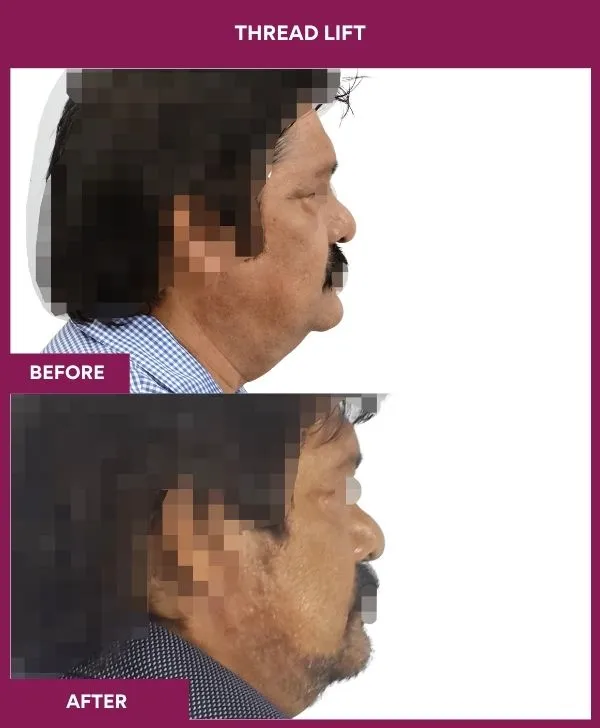
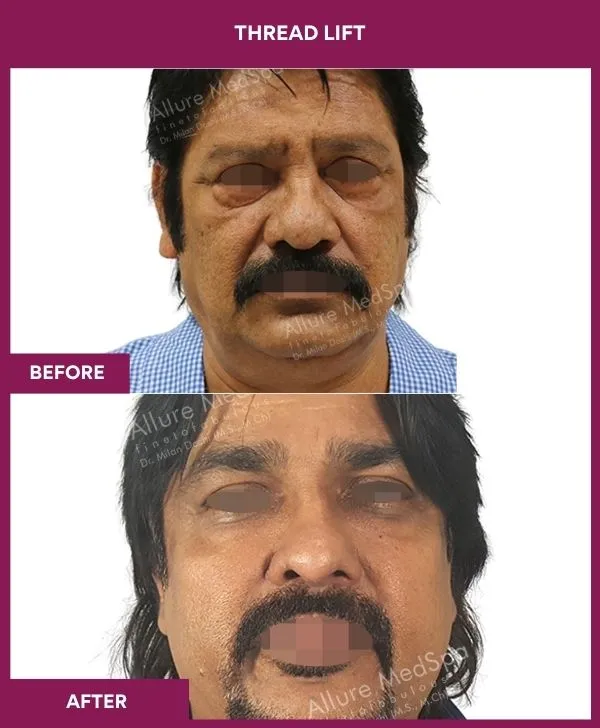
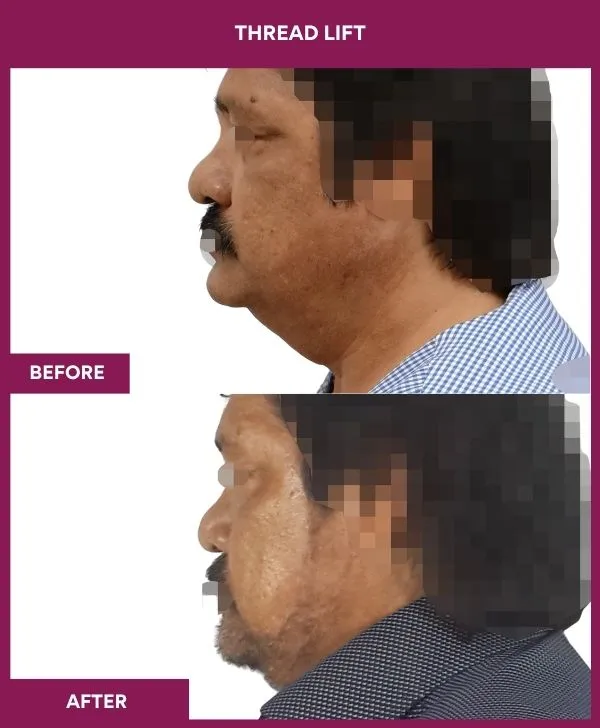
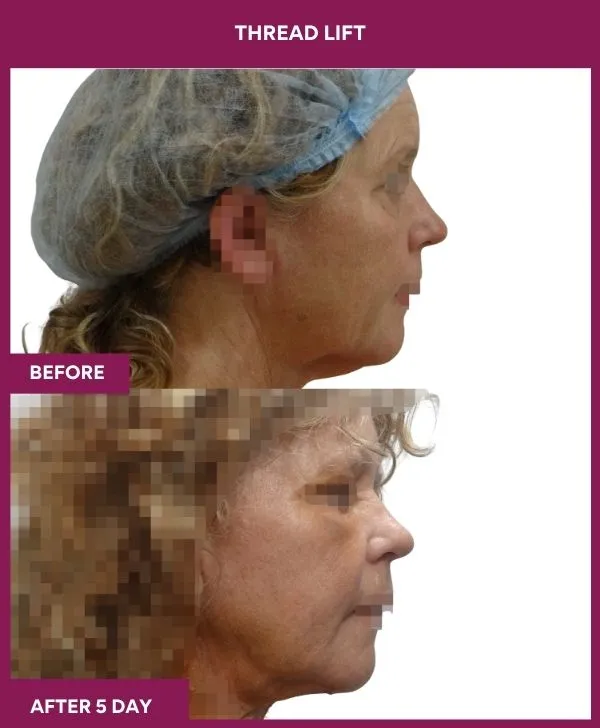
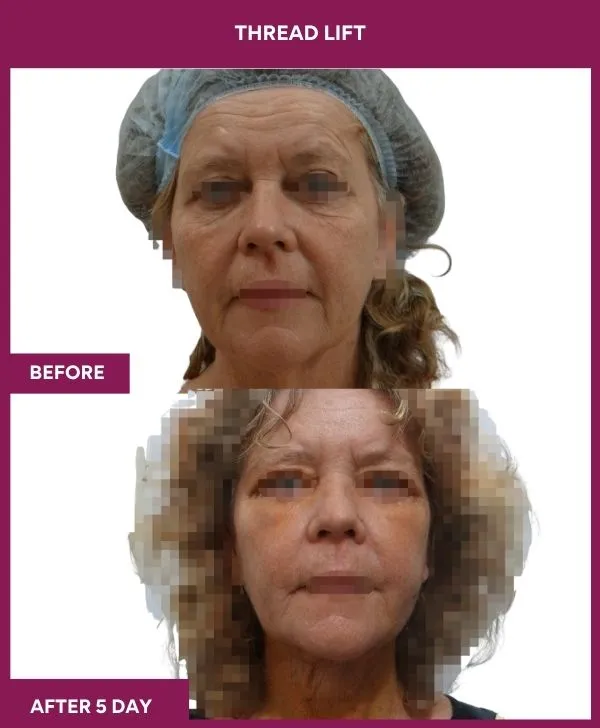
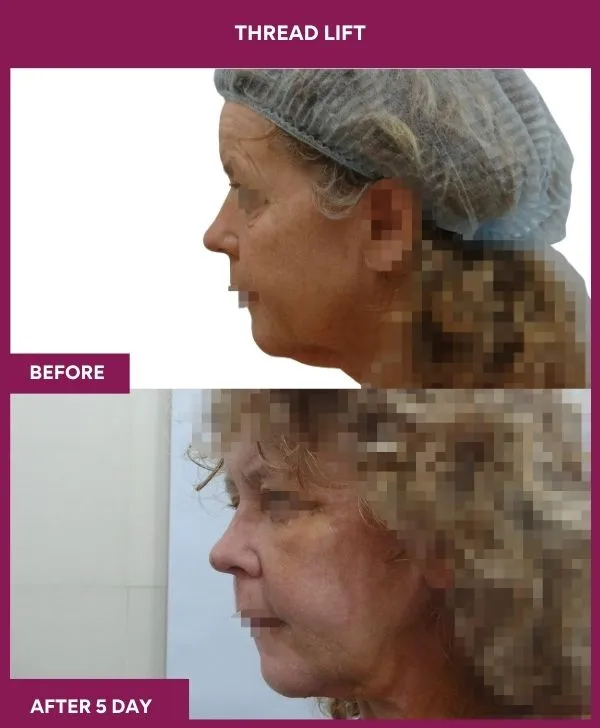
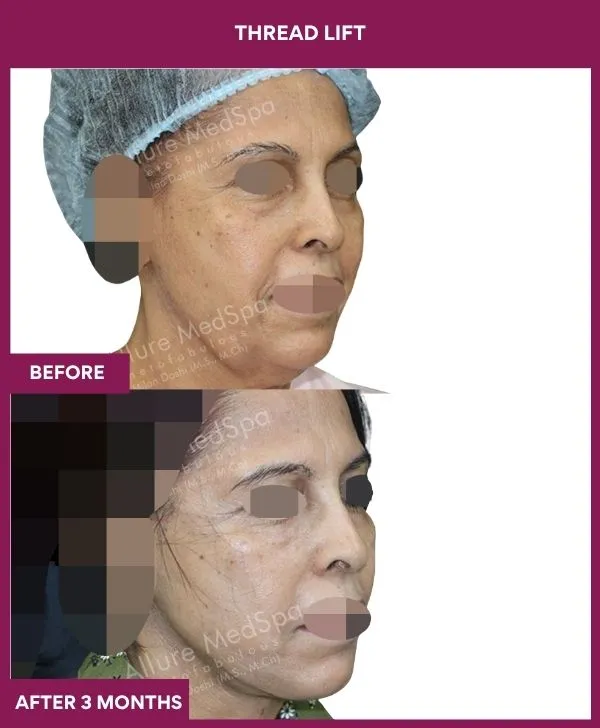
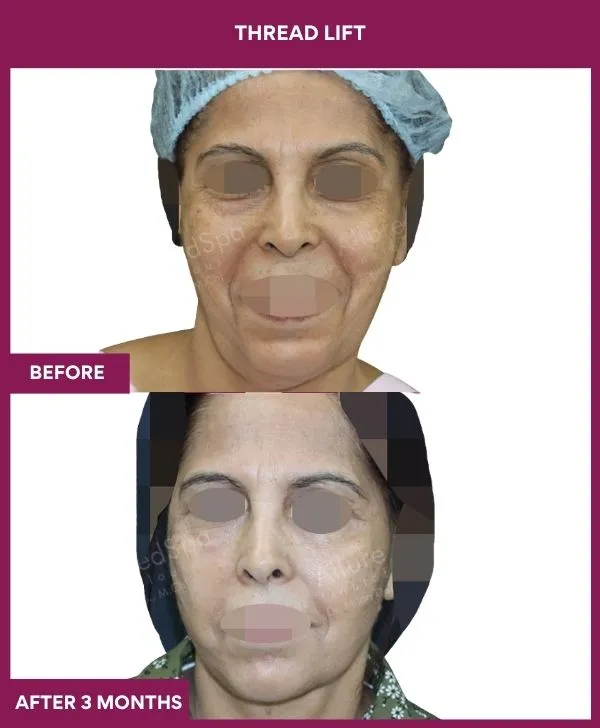
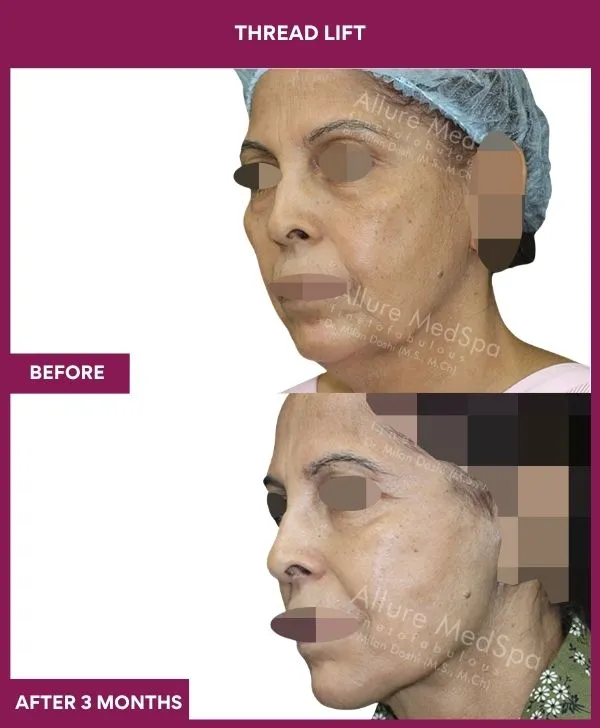
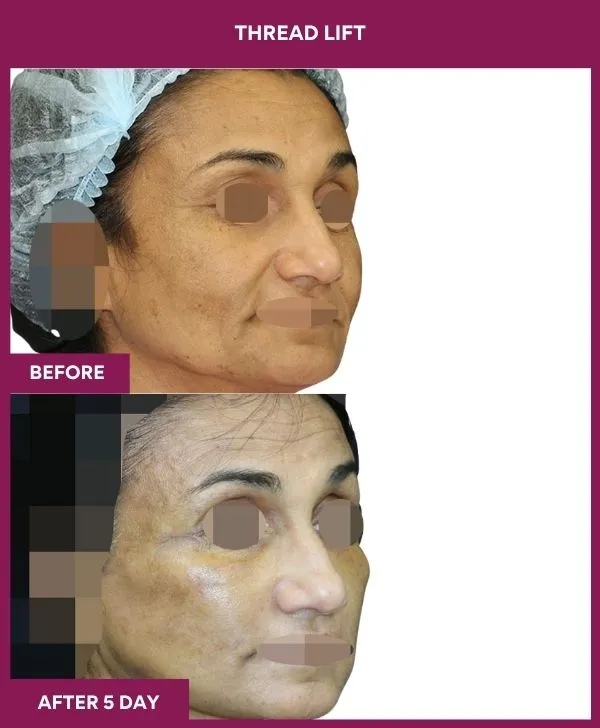
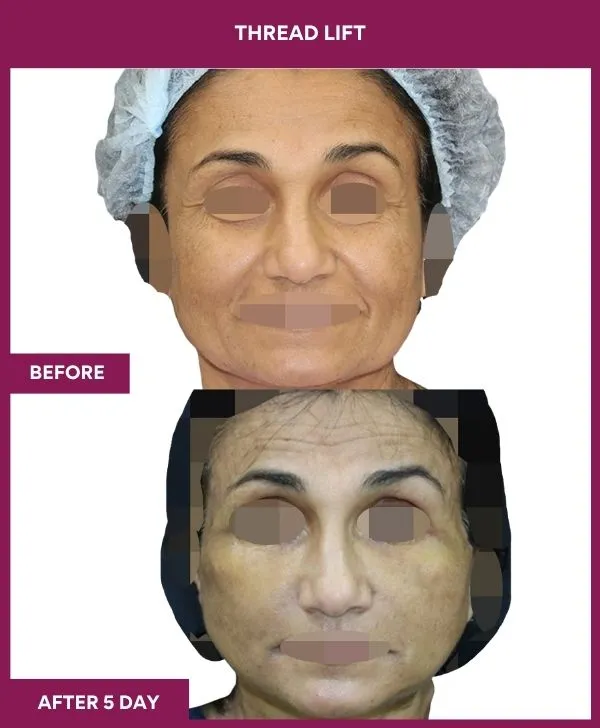
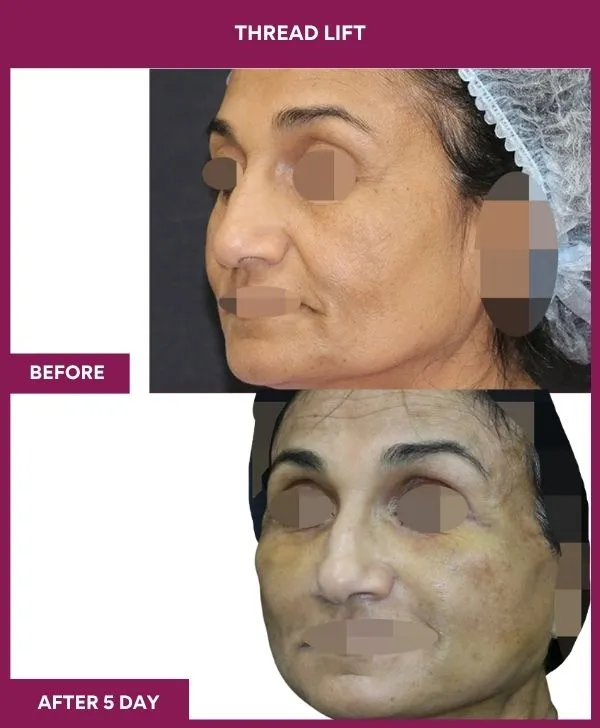
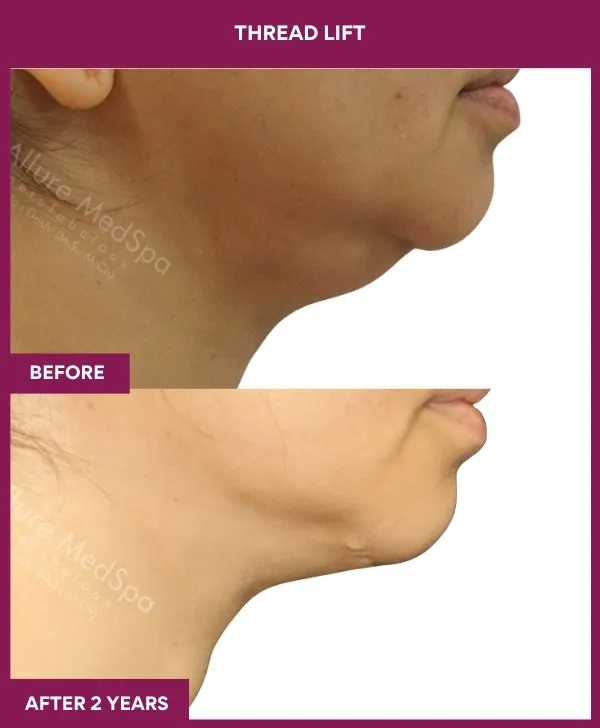
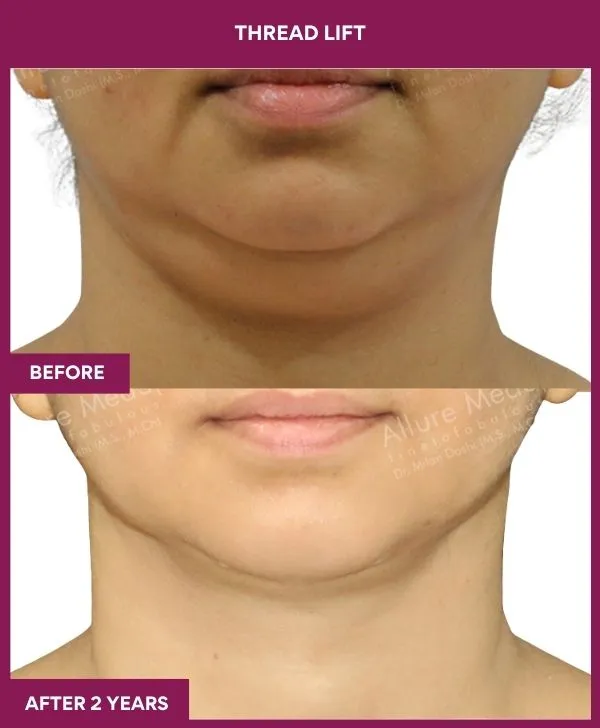
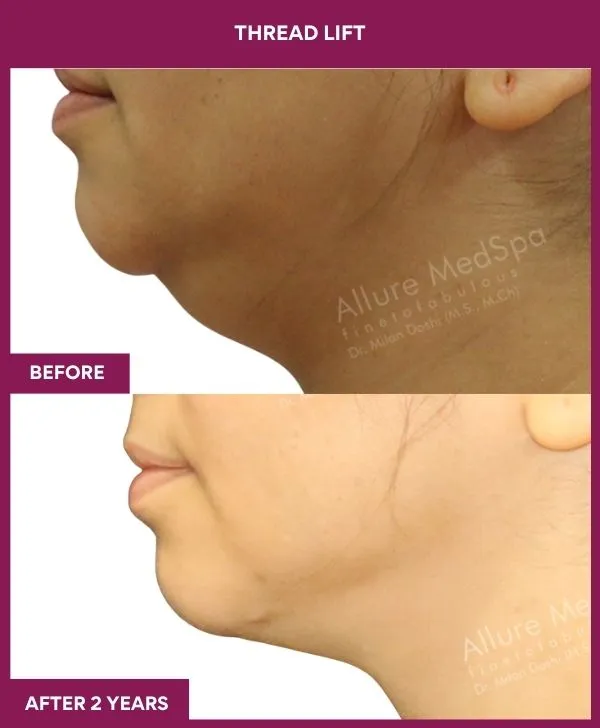
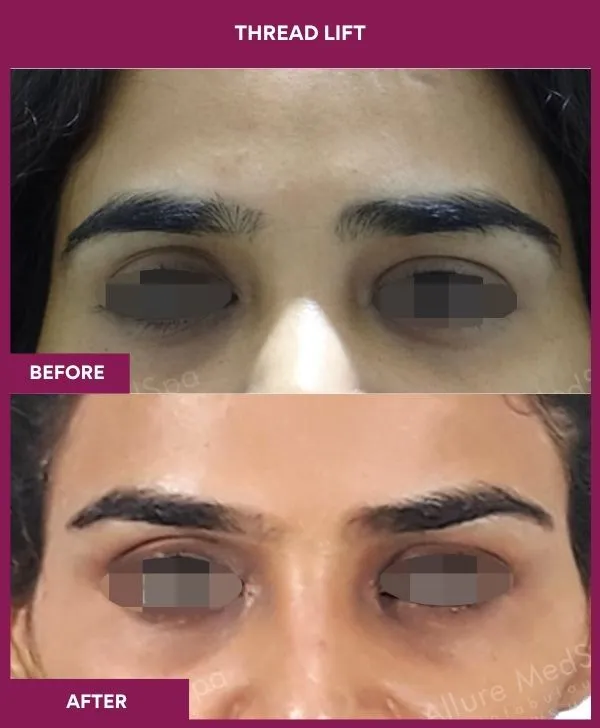
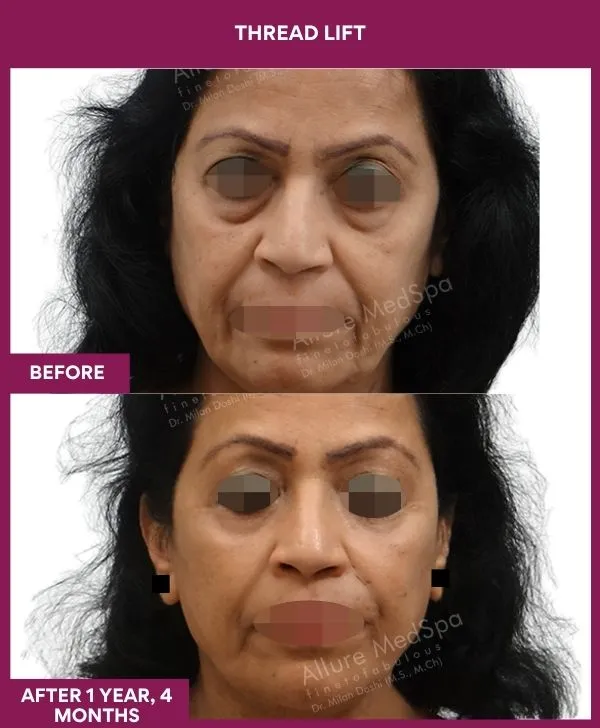
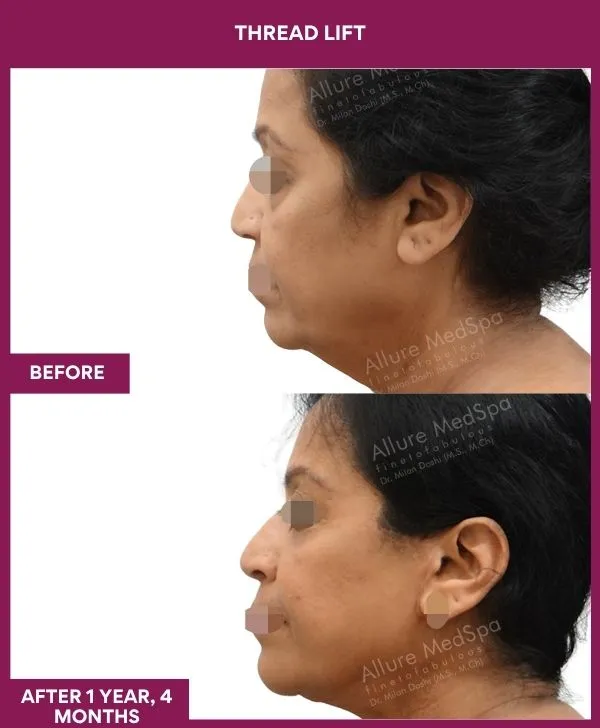
See real transformations from fine to fabulous — achieved with precision and care.
Thread Lift Surgery Testimonials: Fine To Fabulous Journeys
Thousands have trusted Dr. Milan Doshi to turn back time with natural, youthful results.
Video: How Thread Lift Treatment Works
Is My Laxity Mild Enough For A Thread Lift?
(4 quick questions)
Quick Facts About Thread Lift
TIME REQUIRED
30–45 minutes
ANESTHESIA
Local
SKIN REMOVED
None
PAIN LEVEL
Mild–moderate
BACK TO WORK
2–3 days
RESULTS LAST
6–12 months
SUCCESS RATE
97–98%
Cost
₹50,000 – ₹1,00,000
How Much Does Thread Lift Cost in Mumbai?
A thread lift in Mumbai costs ₹50,000–₹1,00,000 per session at Allure Medspa, by thread type and count, areas and complexity; confirmed at planning.
| Cost factor | Why it matters |
|---|---|
| Thread material | PDO is the baseline; PLA and PCL threads cost more per thread and dissolve more slowly |
| Thread design and number | Cog (barbed) lifting threads cost more than mono threads; a jawline typically needs 2–4 cogs per side, a mid-face 2–3 🩺 |
| Areas treated | Jawline alone vs jawline + mid-face vs adding brow or neck |
| Complexity | Previous threads, asymmetry or heavier tissue need more planning time |
| Add-ons | PRP, fillers or HIFU suggested to enhance or prolong results are priced separately |
| Repeat cycle | A maintenance procedure — budget roughly yearly top-ups |
| Treatment | Estimated cost (₹) 🩺 |
|---|---|
| Jawline / early jowls — PDO cog threads, both sides | 50,000 – 70,000 |
| Mid-face + jawline — PDO cogs | 70,000 – 1,00,000 |
| Brow or neck add-on area | Quoted at consultation |
| Mono threads for skin quality (per area) | Quoted at consultation |
| PLA / PCL longer-dissolving threads | Upper end of the range; quoted at consultation |
| Mini facelift (for comparison) | See Facelift Surgery Cost |
| Facelift surgery (for comparison) | See Facelift Surgery Cost |
- Included: consultation, threads, local anaesthesia, procedure, review visit
- Not included: repeat maintenance sessions, add-on treatments, GST
- EMI options → Cosmetic Surgery Payment Process · online pre-assessment → Online Consultations
- Thread-lift pricing is kept separate from the facelift surgery cost page because it is a non-surgical procedure
Get your exact quote & surgery plan
Share your details — our team responds within working hours with cost, EMI options and next steps.
Most Common Question People Ask
Q1. What is a thread lift?
Ans. Specialised absorbable sutures (PDO, PLLA or PCL) placed beneath the skin to give modest mechanical support to mildly descended facial tissue. It needs far less intervention than facelift surgery but cannot remove loose skin or reproduce a surgical lift.
Q2. How long does a thread lift really last?
Ans. Results are temporary and vary. One 160-patient study found the lifting effect gone by one year; a large clinical group reports roughly 6–12 months in its own practice; systematic reviews say reliable long-term data are lacking. Treat any fixed one- or two-year promise with caution.
Q3. Thread lift or facelift — which is better?
Ans. Neither, without the problem in front of you. Threads may suit mild laxity when a subtle temporary change is acceptable; facelift surgery is designed for more significant descent and excess skin. Using threads for a surgical problem simply under-treats it.
Q4. Is a thread lift a good alternative to a facelift?
Ans. Only in selected mild cases — and “alternative” should not imply equivalence. It is a different, smaller intervention for earlier changes, not a non-surgical version of the same operation.
Q5. What are the risks and side effects?
Ans. Swelling, bruising and tenderness are common. Dimpling, visible or palpable threads, asymmetry, thread exposure, altered sensation and infection are also reported. Pooled rates vary widely between studies, so published percentages are not your personal risk.
Q6. When can I go back to work after a facelift?
Ans. You may be if sagging is mild, skin quality reasonable and you accept a subtle temporary result. Heavy jowls, significant loose skin or neck laxity point to surgery. Examination matters more than age.
Q7. Does it hurt, and how much downtime is there?
Ans. Local anaesthesia is used, but it should not be described as painless. Tenderness, swelling, bruising, tightness or temporary dimpling can follow. Downtime is shorter than surgery — most people are back at a desk the next day and socially presentable in 2–3 days.
Q8. Can a thread lift be reversed?
Ans. The threads are absorbable and dissolve on their own. A thread causing a problem early on can usually be released, trimmed or removed.
Q9. How often can I repeat it?
Ans. Usually every 12 months or so if you want to maintain the effect — after a fresh assessment, not on a schedule.

Why Choose Dr. Milan Doshi?
Dr. Milan Doshi, MCh, MS — plastic surgeon with 27+ years, 16,000+ cosmetic surgeries and 400+ thread lifts; because he offers both answers, threads are recommended only when they are enough. Consults and treats at Andheri West; surgeries at the NABH-accredited surgical centre, Goregaon West.
Dr Doshi Note:
“I recommend a thread lift when facial laxity is early, skin quality is suitable and the patient expects a modest improvement. When there is significant loose skin, pronounced jowling or neck laxity, the anatomy has moved beyond what threads can meaningfully correct. In such cases, I explain the limitations clearly and discuss whether a surgical facelift would be more appropriate.”
The Complete Guide About Thread Lifts
What Is A Thread Lift?
A thread lift is a minimally invasive treatment that passes absorbable sutures under the skin to give modest, temporary support to sagging tissue.
- Modern absorbable threads use PDO (polydioxanone), PLLA (poly-L-lactic acid) or PCL (polycaprolactone); a 2025 systematic review of 12 studies and 818 patients found PDO the most commonly evaluated
- No facelift incisions, no skin removal, and a temporary effect — it is not a smaller surgical facelift
- Threads can be smooth (mono) or barbed (cog) and absorbable or, historically, permanent; barbs or cogs engage soft tissue to produce the repositioning
- Early PDO work found the best results in patients with modest facial sagging rather than advanced laxity
- The accurate mental model: small structural support for a mild problem — not a substitute for removing or repositioning substantially loose tissue
Synonyms for thread lift
Thread facelift, PDO thread lift, barbed suture lift, cog thread lift, silhouette lift and lunchtime lift all describe the same procedure.
- Patient terms: thread facelift, PDO thread lift, lunchtime lift, non-surgical facelift threads, silhouette lift
- Medical terms: barbed suture suspension, absorbable suture lift, polydioxanone thread lifting, minimally invasive suspension
Which threads does Allure Medspa use?
Allure Medspa uses absorbable threads only — PDO as standard, PLA/PCL where slower absorption is planned; brands confirmed at consultation.
| Allure thread protocol | Detail 🩺 |
|---|---|
| PDO | Standard — mono, cog and screw designs |
| PLA / PLLA | Offered where longer absorption is planned |
| PCL / PCA | Offered for the longest absorption profile |
| Permanent (polypropylene) threads | Not used |
How Does A Thread Lift Work?
Barbed threads mechanically engage and reposition soft tissue for an immediate, limited lift; as they dissolve they trigger a small collagen response.
| Mechanism | What it contributes | What it cannot do |
|---|---|---|
| Mechanical suspension | Cogs catch the subcutaneous tissue and hold it in a higher position along the planned vector — the change you see on the day | Hold heavy or substantially loose tissue; the suture cheese-wires through or the effect relaxes |
| Collagen response | Absorbable material provokes fibrosis around the thread track as it degrades, adding a little firmness for months | Remove excess skin or reproduce a surgical lift — it is real and it is small |
| Swelling | Early oedema adds apparent volume and tightness in the first 1–3 weeks | Last — which is why early photographs overstate the result |
Do threads stimulate collagen?
Yes — absorbable threads provoke a healing response and new collagen, but the visible lift on the day comes from mechanical suspension, not collagen.
- Histology shows fibrous tissue along the thread track as PDO degrades over 6–8 months
- The collagen effect improves skin texture and firmness modestly; it does not reposition tissue
- It should not be sold as the mechanism that changes the mirror image on day one
How long does the mechanical lift hold?
Evidence is mixed: one controlled study found no lasting improvement in the thread-only group; small uncontrolled series report 1–2 years in some.
- Abraham et al. 2009 (blinded assessors, 21-month follow-up): improvement did not persist in the thread-only group; early effect possibly oedema
- Wattanakrai et al. 2019 (21 patients, mesh thread): improvement maintained at one year in about two-thirds and at two years in eight patients
- Overall, long-term effectiveness remains insufficiently established — plan for 6–12 months
What Can A Thread Lift Treat — And What Can’t It Treat?
Threads are most defensible for early jowling, a softened jawline and mild mid-face descent; they cannot remove loose skin or treat heavy jowls.
| Worth discussing when | Unlikely to be enough when |
|---|---|
| Jowling is early rather than heavy | There is significant loose skin |
| Jawline definition has only started to soften | Jowls are well established |
| Tissue is not excessively heavy | The neck has substantial laxity or platysmal bands |
| Loose skin is limited | Deeper tissues need meaningful repositioning |
| The desired result is subtle | The expected result resembles a surgical before-and-after |
| Minimal downtime matters and repeat treatment is understood | — |
- A published PDO cohort concluded the technique suited patients with modest facial sagging and fine wrinkles
- For earlier surgical laxity → Mini Facelift · for moderate-to-advanced ageing → Facelift Surgery · for the neck → Neck Lift Surgery
Source: writer-drafted note 🩺 · Suh DH, et al. Outcomes of polydioxanone knotless thread lifting for facial rejuvenation. Dermatol Surg. 2015;41(6):720–725.
Which Areas Can Be Treated With A Thread Lift?
The jawline and early jowls are the most common area, then the mid-face, the brow, the neck and — with fillers — nasolabial and marionette folds.
| Area | What threads can do | Typical threads 🩺 | When something else is better |
|---|---|---|---|
| Jawline & early jowls | Softens early jowling and sharpens the jaw-neck line | 2–4 cog threads per side | Established jowls → mini facelift |
| Cheeks / mid-face | Restores a little lift and contour where it has drifted | 2–3 cogs per side | Volume loss → fillers; heavy descent → facelift |
| Brow | A subtle lateral brow lift for a more open eye | 1–2 per side | True ptosis → Brow Lift Surgery |
| Neck | Mild tightening of early laxity only | 2–4 per side | Bands or loose skin → Neck Lift |
| Nasolabial & marionette folds | Some softening, usually alongside fillers | Mono threads | Deep folds → fillers + lift, not threads alone |
| Nose (bridge / tip) | Marketed widely; nose-specific evidence is limited and risks include extrusion | Not recommended | See Non-Surgical Rhinoplasty |
Global and Indian demand
Over 327,000 thread lifts were recorded worldwide in 2024, and India ranks among the top countries, led by demand in Mumbai, Delhi and Bangalore.
- Mostly patients aged 30–50 seeking a non-surgical option — the group for whom candidacy matters most
Source: ISAPS Global Survey 2024
How Long Does A Thread Lift Really Last?
Thread-lift results are temporary — commonly 6–12 months — and no single evidence-based duration applies; some studies show the lift gone by one year.
| Study | Size | What it found |
|---|---|---|
| Bertossi et al., Aesthet Surg J 2019 | 160 patients | Immediate improvement, progressive reduction, no apparent lifting effect at one year; 34% early adverse-event rate, largely minor |
| Abraham et al., Arch Facial Plast Surg 2009 | 33 treated, 10 controls | Blinded assessors, 21-month mean follow-up; improvement did not persist in the thread-only group; early effect possibly oedema |
| Tamura et al., PRS Glob Open 2025 | 110,000+ procedures | Perceived lift averaged roughly 6–12 months in that group’s practice, varying by material and area; no objective long-term measurement |
| Wattanakrai et al., Aesthetic Plast Surg 2019 | 21 patients | Mesh suspension thread; improvement maintained at one year in about two-thirds, at two years in eight patients |
| Riopelle et al., Dermatol Surg 2025 | 12 studies, 818 patients | Immediate aesthetic improvement across studies, but long-term efficacy data remain lacking |
What affects how long a thread lift lasts?
Material (PDO ~6–8 months, PLA ~12, PCL ~12–15 to absorb), thread count and design, tissue weight, skin quality, area and two weeks’ aftercare.
| Factor | Effect on longevity |
|---|---|
| Material | Slower-dissolving PLA / PCL may modestly extend the effect — “longer to dissolve” is not proven to mean a much longer lift |
| Design and number | More cogs over a longer track hold better than a single thread; over-tensioning causes dimpling rather than durability |
| Tissue weight | Heavy tissue relaxes the suspension quickly; light tissue holds longest |
| Area | Brow and mid-face tend to hold longer than the jowl, which bears gravity and jaw movement |
| Aftercare | Wide mouth opening, massage, side sleeping and hard exercise in the first 2 weeks loosen the anchors |
| Combination | Fillers for volume and HIFU for skin tightening can enhance and prolong the perceived result → Dermal Fillers · HIFU Treatment |
What Are The Risks And Side Effects Of A Thread Lift?
Swelling (34%), bruising (26%) and pain (11%) are expected; visible thread (10%), dimpling (7%), numbness (6%), exposure (5%), infection (2%) are not.
| Expected early effects — settle without intervention | Pooled rate |
|---|---|
| Swelling | 34% |
| Bruising / ecchymosis | 26% |
| Pain or tenderness | 11% |
| Problems that may need intervention — repositioning, release, removal or treatment | Pooled rate |
|---|---|
| Visible or palpable thread | 10% |
| Skin dimpling or puckering | 7% |
| Altered sensation / paraesthesia | 6% |
| Thread exposure or extrusion | 5% |
| Infection | 2% |
| Asymmetry, migration, broken thread, granuloma, parotid duct or nerve injury | Reported; rare |
- Pooled analyses show substantial variation between studies — these are not an individual’s personal risk
- Most events are minor; a visible or palpable thread is the one patients find hardest to live with, and the one to ask who fixes, and at whose cost, before treatment
- Risk is reduced by patient selection, sterile technique, correct plane and vector, not over-tensioning, and an injector who can manage a complication
Increasing pain, spreading redness, discharge, a thread tip through the skin, new facial weakness or swelling that keeps growing — call the clinic.
- Spreading redness, heat, discharge or fever — possible infection; early treatment avoids thread removal
- A thread end visible or felt through the skin — do not pull it; it is trimmed or released in clinic
- Dimpling or puckering that has not softened by 2 weeks — usually released with a needle or massage in clinic
- New weakness of a facial movement or persistent numbness — rare; assessed urgently
- Swelling on one side only that keeps growing — haematoma or salivary (parotid) involvement; review
Thread Lift Or Facelift — Which Suits Your Degree Of Laxity?
Threads give a smaller, temporary change for mild laxity without removing skin; a mini or full facelift repositions deep tissue and removes skin.
| Feature | Thread lift | Mini or full facelift |
|---|---|---|
| Type | Minimally invasive thread suspension | Surgery |
| Usually suited to | Mild, early laxity | Early-to-advanced laxity depending on operation |
| Excess skin removal | No | Yes, where indicated |
| Deep-tissue repositioning | Limited mechanical suspension | SMAS or deep-plane treatment according to technique |
| Anaesthesia | Local | Local + sedation or general, by operation |
| Downtime | 2–3 days social; desk next day | 10–14 days social; 2–3 weeks to most activity |
| Result magnitude | Subtle | Greater structural correction |
| Longevity | Temporary; roughly 6–12 months | Generally 7–10+ years; ageing continues |
| Repeat treatment | Yearly as the effect fades | Not normally repeated on a short cycle |
| Cost | ₹50,000–₹1,00,000 per session 🩺 | See Facelift Cost |
- The distinction is not that surgery is automatically better: surgery is unnecessary when the concern is too mild to justify it
- Equally, choosing threads simply to avoid surgery leads to disappointment when the anatomy needs more than sutures can give
- Procedure-level surgical detail: Mini Facelift · Facelift Surgery · Recovery
Five-year cost — threads vs a mini facelift
Yearly threads at ₹50,000–₹1,00,000 total ₹2,50,000–₹5,00,000 over five years — a one-time mini facelift’s range — so compare value, not price.
- Threads × 5 sessions: ₹2,50,000–₹5,00,000 + GST (if you maintain yearly) 🩺 arithmetic on the live per-session range
- Mini facelift: one procedure, one recovery → Facelift Cost
- Threads can still be the sensible choice: when laxity is mild, when a surgical result is not wanted, or when a two-week recovery is impossible
Threads, Dermal Fillers Or HIFU — Which Non-Surgical Option Is Right For You?
Fillers add volume, threads reposition mildly sagging tissue and HIFU tightens skin — they solve different problems and are often combined.
| Parameter | Dermal fillers | Thread lift | HIFU |
|---|---|---|---|
| Main purpose | Add volume to specific areas | Lift and support mildly sagging tissue | Tighten skin and SMAS with focused ultrasound |
| Time taken | 10–15 minutes | 30–45 minutes | 45–90 minutes |
| How long it lasts | 6–12 months (varies by filler) | Roughly 6–12 months | 12–18 months, building over 3 months |
| Downtime | Little to none | A few days | None to a day |
| Results visible | Almost immediately | Immediately, refining over weeks | Gradually over 2–3 months |
| Typical side effects | Bruising, swelling; rare vascular events | Bruising, dimpling, visible thread, rarely extrusion | Redness, tenderness, rare nerve irritation |
| Cost per session 🩺 | From ₹25,000 by area → Dermal Fillers | ₹50,000–₹1,00,000 | ₹15,000–₹25,000 → HIFU Treatment |
- Often combined — fillers restore lost volume, threads lift, HIFU tightens, and all can pair with anti-wrinkle injections → Anti-Aging Injection
- The combined, staged non-surgical plan is described on the non-surgical facelift page → Non-Surgical Facelift
Who Is A Good Candidate For A Thread Lift?
The strongest candidate has mild laxity, adequate skin quality, realistic expectations and wants a smaller temporary change with little downtime.
| You may be suitable if you have | You may not be suitable — or need specialist assessment — if you have |
|---|---|
| Early softening of the jawline or early jowls | Substantial loose skin, heavy tissue or established jowls |
| Mild mid-face descent with reasonable skin quality | Significant neck laxity or platysmal bands |
| A preference for a subtle, temporary improvement with 2–3 days’ downtime | An expectation of facelift-scale change or longevity |
| Good general health; non-smoker or willing to stop | Active skin infection, acne flare or cold sore near the area |
| Understanding that repeat treatment is likely | Previous threads or filler of unknown type or date; keloid tendency |
| Typical age 30–55 — but anatomy, not age, decides | Pregnancy or breastfeeding; bleeding disorders or anticoagulants without physician advice |
Why age decides very little
A younger patient with heavy tissue and real jowls may be a poor thread candidate; an older patient with limited laxity may still be worth assessing.
- Patient selection appears repeatedly in the evidence as the main determinant of outcome
- Earlier PDO literature found favourable results specifically in modest sagging; systematic reviews describe immediate efficacy in appropriately selected patients alongside uncertainty about long-term results
Why Is A Consultation Essential Before A Thread Lift?
The consultation decides whether threads are enough at all — skin excess, tissue weight, jowls and neck — and plans thread type, number and vectors.
- Accurate assessment: thread lift vs mini facelift vs HIFU vs fillers for your degree of sagging
- Personalised plan: material, design, number and placement vectors for your anatomy
- Safety review: skin condition, medical history, medications, previous threads or fillers
- Honest expectations: how much lift, how long, what the first two weeks look like, when a repeat would be due
- Performed by a plastic surgeon — Dr. Doshi — who can offer the surgical answer when threads are not enough → Cosmetic Surgeon
Questions to ask whoever offers you threads
Ask what they would do if threads were not enough, which material and how many, who fixes a visible thread at whose cost, and the after-photo dates.
- “What would you do if threads were not enough?” — a practice with one answer will give you that answer
- Which material (PDO / PLA / PCL), which design (mono / cog) and how many threads, and why
- Who releases a dimple or trims an exposed thread — and is it included?
- How should I sleep, how wide can I open my mouth, when can I exercise — for the first two weeks
- May I see before-and-after photographs taken at 6–12 weeks and at 6 months?
What should I bring — and can I start online?
Bring your medical history, medication list and details of any previous threads or fillers; an online consultation can start the assessment.
- Clear front and side photographs in daylight if the concern shows differently in photos and mirrors
- A list of previous facial treatments with dates and products
- Online pre-assessment → Online Consultations · travelling to Mumbai → Outstation Patients
- Consultation fee ₹1,500 🩺
What Types Of Threads Are Used In A Thread Lift?
Most thread lifts use bio-absorbable PDO, PLA or PCL threads in mono, cog or screw designs, differing mainly in lifting strength and time to dissolve.
| Material | Absorbed in | Character | Typical use |
|---|---|---|---|
| PDO — polydioxanone | ~6–8 months | Most widely used; a long-standing suture material; most studied | All designs; jawline, mid-face, brow, neck |
| PLA / PLLA — poly-L-lactic acid | ~12 months | Dissolves more slowly; stronger collagen stimulator | Where a longer absorption profile is planned |
| PCL / PCA — polycaprolactone | ~12–15 months | Longest-lasting material with continued collagen stimulation | Selected patients; higher cost |
Thread designs
Mono threads are smooth and improve skin quality, cog threads are barbed and lift, and screw threads add a little volume to hollow areas.
| Design | What it does | Where |
|---|---|---|
| Mono (smooth) | Collagen and skin quality; no lift | Around the mouth, brow, cheeks, neck skin, scars |
| Cog (barbed, uni- or bi-directional) | Catches tissue to lift cheeks, jowls and jawline | Jawline, mid-face, brow, neck |
| Screw / tornado | Adds a little volume | Hollow areas, nasolabial folds |
| Mesh / suspension | Broader support surface; small series only | Research and selected practices |
- Thread systems also differ between absorbable materials and permanent polypropylene sutures; permanent threads carry higher long-term palpability and extrusion risk and are not used at Allure Medspa 🩺
How Is A Thread Lift Performed? (Step By Step)
After photographs and marking, local anaesthetic is placed, cog threads go in by needle or cannula along planned vectors, are tensioned and trimmed.
| Stage | What happens |
|---|---|
| Before | Photographs; vectors marked with you sitting upright; consent reviewed; skin cleansed; topical then infiltrated local anaesthetic along the entry points and tracks |
| During | Threads introduced through small needle or cannula entry points into the subcutaneous plane; tissue gently gathered along the thread and set in its higher position; entry points closed without sutures |
| Before you leave | Symmetry checked, cold compress, written aftercare, review booked at 2 weeks; you drive or travel home the same day |
| Allure protocol | Detail 🩺 |
|---|---|
| Anaesthesia | Local (topical + infiltration) |
| Typical procedure time | 30–45 minutes; single area 20–30 |
| Treatment location | Allure Medspa, Andheri West (clinic procedure; not the Goregaon surgical centre) |
| Return to routine activity | Desk work next day |
| Exercise restrictions | Avoid strenuous exercise and extreme facial movements for 2 weeks |
| Sleeping-position advice | On the back, head elevated, for 1 week |
| Dental treatment | Avoid dental work and wide mouth opening for 2 weeks |
- A large 2025 multicentre series describes threads introduced with blunt cannulas into the subcutaneous plane under local anaesthesia — one group’s protocol, not automatically Allure’s
What Is The Recovery Timeline After A Thread Lift?
Swelling and tightness peak in the first 48 hours, bruising fades by one week, threads settle by 2–3 weeks and collagen remodelling ends by 4–6 weeks.
| Time | What you notice | What to do |
|---|---|---|
| Day 0 | Immediate lift; numbness from the anaesthetic; mild puckering at entry points is normal | Cold compress; sleep on your back, head elevated |
| Days 1–2 | Swelling, tightness and tenderness peak; bruising appears | Soft diet; paracetamol; no make-up on entry points; desk work is fine |
| Days 3–7 | Bruising fades; movement feels less tight | No facial massage, facials, strenuous exercise or alcohol; avoid wide yawning and chewing hard food |
| Weeks 2–3 | Threads settle; early dimples soften; review at 2 weeks | Review visit: any persistent dimple released; resume moderate exercise after 2 weeks |
| Weeks 4–6 | Collagen stimulation and final settling; the result to photograph | Resume facials and skin treatments after week 2–3; dental work after 2 weeks |
| Months 6–12 | Gradual softening of the lift as the thread absorbs | Reassess; repeat only after examination |
- Surgical recovery for comparison → Facelift Recovery Timeline
What Aftercare Protects A Thread Lift Result?
For two weeks sleep on your back; avoid massage, facials, wide mouth opening, hard exercise and dental work; report redness or an exposed thread.
| Do / avoid | Why |
|---|---|
| Sleep on your back with the head elevated for about a week | Prevents one-sided pressure dragging the threads |
| Avoid facial massage, facials and skin treatments for 2–3 weeks | Lets the cogs anchor undisturbed |
| Avoid big facial expressions, wide yawning, hard or chewy food for 2 weeks | Jaw movement loosens the jawline anchors |
| Delay strenuous exercise, saunas, alcohol for 1–2 weeks | Limits swelling and bruising |
| Keep entry points clean; no make-up for 24–48 hours | Reduces infection risk |
| Do not pull a visible thread end; call the clinic | It is trimmed or released in clinic |
What Are The Limitations Of A Thread Lift?
A thread lift is temporary, subtle and additive: it cannot remove skin or fat, treat severe sagging, fix the neck or stop ageing; it needs repeating.
| Limitation | Why it matters |
|---|---|
| Mild-to-moderate laxity only | Severe sagging or a lot of loose skin needs excision |
| Temporary | The lift fades as the thread absorbs — months to about a year; repeat sessions |
| Cannot remove skin or fat | It repositions; it excises nothing |
| Subtle, not dramatic | Less effect than surgery and less than many patients expect |
| Visible or palpable threads | Thin-skinned patients may see or feel threads |
| Cumulative cost | Yearly maintenance can match a one-time surgical option over five years |
| When surgery is better | Advanced ageing, established jowls, neck laxity → facelift or neck lift |
Medical Codes Of A Thread Lift?
A thread lift is coded as an elective cosmetic encounter (ICD-10 Z41.1) with unlisted skin procedure CPT 17999, not the facelift codes 15824–15829.
| Code | Description | Note |
|---|---|---|
| ICD-10 Z41.1 | Encounter for cosmetic surgery / procedure | Primary — elective thread lift |
| ICD-10 M95.2 | Other acquired deformity of head | Age-related facial contour change, where recorded |
| ICD-10 R23.8 | Other skin changes | Facial laxity; supporting |
| CPT 17999 | Unlisted procedure, skin, mucous membrane and subcutaneous tissue | The code used for suture-suspension thread lifts |
| CPT 15824 / 15828 / 15829 | Rhytidectomy — forehead / cheek-chin-neck / SMAS | Facelift SURGERY codes — listed for comparison only; not thread lift |
(FAQs) Frequently Asked Question About Thread Lift
Q1. Is a thread lift painful?
Ans. It is done under local anaesthesia, so you should not feel pain during the procedure. Mild soreness, tightness or bruising afterwards is common and usually settles within a few days.
Q2. Can a thread lift be reversed?
Ans. The threads are absorbable and dissolve on their own. If a thread causes a problem early on it can usually be released, trimmed or removed.
Q3. How should I sleep after a thread lift?
Ans. On your back with the head slightly elevated for about a week, to avoid pressure on the treated areas. Avoid sleeping on your side or front.
Q4. What should I avoid after a thread lift?
Ans. For two weeks: facial massage, vigorous exercise, alcohol, big facial expressions, wide mouth opening and dental work; for 2–3 weeks: facials and other skin treatments.
Q5. Who should perform a thread lift?
Ans. A doctor trained in thread techniques who can also manage complications — at Allure Medspa, plastic surgeon Dr. Milan Doshi performs every thread lift himself.
Q6. What happens when a thread lift wears off?
Ans. As the threads dissolve the mechanical lift gradually fades. Some collagen-related firmness may remain, but the face returns largely towards its pre-treatment state unless repeated.
Q7. Thread lift or mini facelift — what is the difference?
Ans. A thread lift is non-surgical, subtle and temporary; a mini facelift is surgical, giving a bigger and much longer-lasting result. Your degree of sagging decides.
Q8. Are the results dramatic?
Ans. No — a subtle refresh, not the change a facelift provides. If you want a dramatic, lasting result, surgery is the better route.
Q9. Do thread lifts leave scars?
Ans. No visible scars — threads enter through tiny puncture points rather than incisions. Entry-point marks fade within days.
Q10. Can thread lifts go wrong?
Ans. Complications are usually minor and temporary — bruising, dimpling, a visible thread — but they are not rare: published series report early events in roughly a quarter to a third of cases. Selection and technique reduce them.
Q11. What is the best age for a thread lift?
Ans. Usually the 30s to 50s for mild laxity — but anatomy decides, not age.
Q12. Is a thread lift worth it?
Ans. For subtle lifting with little downtime, many patients find it worthwhile — provided they expect a temporary, modest result rather than a facelift, and have budgeted for repeats.
Q13. Can I have a facial after a thread lift?
Ans. Wait at least two to three weeks before facials, massages or other skin treatments so the threads settle undisturbed.
Q14. Can threads be combined with fillers or Botox?
Ans. Yes — fillers restore volume, anti-wrinkle injections soften movement, threads support; they are commonly planned together, sometimes on different days.
Q15. Can I have a facelift later if I have had threads?
Ans. Yes. Absorbed PDO leaves fine fibrous tracks that do not prevent surgery; tell the surgeon the material and dates. Permanent threads are more of a nuisance at surgery.
Q16. Can a thread lift be done on the nose or the body?
Ans. Nose threads are widely marketed but poorly evidenced and prone to extrusion — see the non-surgical rhinoplasty page. Body threads (arms, abdomen, knees) give minimal, short-lived change.
Related Links
- Facelift Surgery (Hub)
- Facelift Cost in Mumbai
- Mini Facelift
- Facelift Recovery Timeline
- Revision Facelift
- Non-Surgical Facelift (Combined Plan)
- Neck Lift Surgery
- Brow Lift Surgery
- HIFU Skin Tightening
- Dermal Fillers
- Anti-Wrinkle Injections (Botox)
- Anti-Aging Treatment
- Face Rejuvenation
- Microneedling RF
- PRP Treatment
- Non-Surgical Rhinoplasty (Nose Threads Discussed)
- Laser Eyelid Surgery
- Meet Dr. Milan Doshi