
Facelift Recovery Timeline: What to Expect After Facelift Surgery
Most facelift patients return to desk work and ordinary social activity around 10 days to 2 weeks after surgery. Swelling, bruising, tightness and numbness improve substantially over the first month, while subtle settling continues for several months. The result is usually well established by around six months, though scars keep maturing for a year or longer.
How Long Does Facelift Recovery Take?
| Recovery stage | What may typically be happening |
|---|---|
| First 24 hours | Swelling, tightness and dressings expected; highest-alert period for an expanding haematoma |
| Days 2–4 | Swelling and bruising may look worse before improving |
| Week 1 | Face still swollen/tight; dressings, drains or sutures reviewed per protocol |
| Week 2 | Many patients feel socially presentable; desk work often resumes |
| Weeks 3–4 | Contours clearer; activity increased gradually after clearance |
| Months 1–3 | Residual swelling, firmness, numbness and tightness improving |
| Around 6 months | Result substantially settled; scars still remodelling |
| 6–12+ months | Subtle refinement, scar maturation, sensation recovery |
When Should I See My Surgeon Urgently?
| Warning sign | Why it needs assessment |
|---|---|
| Rapid one-sided swelling or pressure | Possible expanding haematoma |
| Severe one-sided pain, especially early | May accompany a haematoma |
| Rapidly worsening asymmetry or bruising | Possible bleeding beneath the skin |
| Dark or dusky skin | May indicate compromised skin viability |
| Spreading redness, fever, concerning drainage | Possible infection |
| New inability to move part of the face | Needs neurological/surgical assessment |
| Heavy or persistent bleeding | Prompt evaluation |
| Chest pain or shortness of breath | EMERGENCY medical symptoms |
Allure postoperative emergency line: +91 82918-63159
The Week-by-Week Recovery Guide
What Happens in the First 24–72 Hours?
During the first 24–72 hours after facelift surgery, swelling, bruising, tightness, numbness and a degree of wound drainage can occur. The first 24 hours need particular vigilance because major postoperative haematomas most often develop during this early period and may present with rapidly increasing swelling, pressure or pain.
What Can Be Expected Early?
Mayo Clinic includes pain, drainage, swelling, bruising and numbness among expected early postoperative findings. ASPS notes that bruising and swelling may look most pronounced around days 3–4 before improving.
| Early recovery area | General guidance |
|---|---|
| Head position | Rest with the head raised as instructed. |
| Activity | Prioritise rest and avoid unnecessary exertion, bending or straining. |
| Medicines | Take only medicines according to the treating team’s instructions. |
| Dressings | Leave dressings in place, or change them only according to the surgeon’s protocol. |
| Observation | Watch for rapidly increasing asymmetry, pressure, bleeding or severe worsening pain. |
Mayo specifically advises resting with the head raised during the first few postoperative days.
Medication caution Do not independently stop prescribed medication, and do not add medicines or supplements that could influence bleeding unless your medical team has advised you to do so.
Healing varies with skin and tissue characteristics, age, surgical technique, combined procedures, overall health and adherence to postoperative instructions.
Source: Mayo Clinic — Face-lift
What Happens During Week 1?
During the first week after a facelift, swelling and bruising are still clearly visible, although they usually begin to improve after the early peak. Tightness, puffiness and altered sensation are common at this stage. Dressings, drains and sutures are reviewed according to the surgeon’s protocol, and the exact timing may vary depending on the technique used and individual healing.
Allure Week-One Milestones
| Milestone | Allure timing |
|---|---|
| First postoperative review | Usually within 24–48 hours after surgery |
| Dressing change/removal | Usually during the first review, or as advised by Dr. Doshi |
| Drain removal, if used | Commonly within 24–72 hours, depending on drainage |
| Suture removal/review | Usually reviewed around day 5–7; some sutures may be removed later depending on location |
| Garment/sling instructions | If prescribed, usually worn as instructed during the first week, especially while resting |
Healing varies with skin thickness and tissue characteristics, age, technique, combined procedures and adherence to postoperative instructions. Your own surgeon’s schedule overrides generic online timelines.
What Happens During Week 2?
Around days 10–14 after a facelift, many patients feel sufficiently presentable for desk-based work and quiet social activity. Some bruising, swelling, tightness or numbness can still remain, so “back to work” does not mean the tissues have finished healing.
Jobs involving lifting, repeated bending, outdoor activity, frequent travel or highly visible public interaction may justify additional recovery time.
Returning to Work After Facelift Surgery
| Activity | Typical planning range |
|---|---|
| Remote/desk work | Often around 10 days–2 weeks, if swelling is settling and no complications are present. |
| Office work | Often around 2 weeks, depending on bruising, comfort and confidence. |
| Public-facing work | Some patients may prefer 2–3 weeks, depending on residual swelling, bruising and visibility. |
| Physical work | Requires individual clearance and is usually resumed later than desk work, especially if lifting, bending or sweating is involved. |
| Gentle walking | Usually encouraged gradually from the early recovery phase, as advised by the surgical team. |
| Flying | Usually planned only after review and clearance. Short essential travel may be considered after early healing, while long flights or frequent travel may be delayed because swelling and clot risk must be considered. |
ASPS states that many patients feel ready to return to work and light activity by the end of the second week. Columbia provides a similar planning range of roughly 10 days to two weeks.
Key rule: Your surgeon’s clearance beats the calendar, particularly for physical work, strenuous travel or exercise.
Healing varies with skin thickness and tissue characteristics, age, technique, combined procedures, health and compliance with postoperative instructions.
What Happens During Weeks 3–4?
By weeks 3–4, many patients look and feel much more normal. Mild puffiness, tightness or altered sensation may still be present, but facial contours are easier to appreciate. Some patients may begin increasing activity during this stage, always subject to individual surgical clearance.
Activity Planning During Weeks 3–4
|
Activity |
General planning point |
|---|---|
|
Walking |
Often increased progressively. |
|
Light exercise |
May be considered after individual clearance. |
|
Heavy lifting |
Should not be resumed automatically simply because week 3 has arrived. |
|
Contact/impact sport |
Usually requires later and specific clearance. |
|
Sun exposure to scars |
Healing incisions should be protected as instructed. |
ASPS’s facelift timeline describes weeks 3–4 as a period when many patients begin exercising again and can see clearer improvement in facial contours.
Mayo advises avoiding hard activity during the first three weeks. Read together, these sources support a gradual, surgeon-led return to exercise rather than a universal release date.
Do not use the calendar alone. Your surgeon’s clearance beats the calendar. Exercise progression should be based on how you are healing and on the actual operation performed.
Healing varies with skin thickness and tissue characteristics, age, technique, combined surgery, health and adherence to postoperative instructions.
What Happens From Months 1–3?
During months 1–3, most obvious bruising has resolved and facial contours are much clearer. However, subtle swelling, firmness, tightness and areas of altered sensation can still be present. A person who looks socially recovered may therefore still be healing internally.
What Is Usually Improving — and What May Still Be Present?
|
Often improving |
May still persist |
|---|---|
|
Visible bruising |
Small areas of swelling |
|
Major puffiness |
Tight or firm sensations |
|
Early contour distortion caused by swelling |
Patchy numbness or tingling |
|
Social self-consciousness |
Pink or immature scars |
Numbness is a recognised postoperative finding after facelift surgery and may take time to improve. New weakness, rapidly developing asymmetry, worsening swelling or a new painful lump should not automatically be dismissed as routine healing.
Technique Does Not Create a Guaranteed Recovery Speed
Healing varies with skin thickness and tissue characteristics, age, technique, adjunct procedures, health and postoperative compliance.
What Happens After 6 Months?
Around six months after facelift surgery, the major contour changes are usually well established. Healing is not necessarily complete, however. Small areas of altered sensation, scar colour or scar firmness can continue to evolve because soft-tissue remodelling and scar maturation occur over a longer biological timeline.
What May Still Change After Six Months?
What may still change | Why |
|---|---|
Scar colour | Immature scars can remain pink before becoming lighter. |
Scar firmness | Collagen continues to remodel. |
Minor tightness | Soft tissues continue adapting. |
Residual sensation change | Sensory recovery may be gradual. |
General surgical-wound evidence places the remodelling phase from approximately week 3 through as long as 12 months. Scar-specific references note that complete scar maturation may take around 12–18 months.
Healing varies with skin thickness and tissue characteristics, age, operative technique, health, scar biology and compliance with aftercare.
When Is the Final Facelift Result Seen?
The main facelift result becomes progressively clearer over the first few months. “Final” should be understood as a gradual settling period rather than one exact date. Minor swelling, tightness or numbness may persist for up to a year, while scars can continue maturing beyond twelve months.
Why early judgement is unreliable: A result seen at two weeks or six weeks is still being influenced by swelling, tissue adaptation and early scar biology. It is therefore premature to judge the mature result at those stages.
What About Revision?
There is no universal rule stating that every possible revision must wait exactly 6 months or exactly 12 months. Timing depends on the nature of the concern.
- An urgent complication requires immediate assessment rather than delayed revision planning.
- Some contour concerns become easier to assess after postoperative swelling has subsided.
- Purely scar-focused surgical revision is usually deferred until scar maturation is sufficiently advanced.
- General scar guidance places maturation at approximately 12–18 months.
Healing varies with skin thickness and tissue characteristics, age, technique, health, adjunct procedures and postoperative compliance.
What Are the Main Facelift Aftercare Do’s and Don’ts?
Facelift aftercare during the first several weeks should focus on following wound instructions, keeping the head elevated early, avoiding smoking or nicotine, limiting strenuous activity and attending follow-up. Medication and blood-pressure management must follow the treating team’s individual instructions rather than generic internet advice.
Facelift Aftercare Checklist
| Do | Don’t |
|---|---|
| Keep your head elevated as instructed. | Do not sleep or position yourself in a way that places pressure on healing incisions. |
| Follow wound and dressing instructions. | Do not pick at crusts or wounds. |
| Take medicines exactly as directed. | Do not independently add or stop medicines or supplements. |
| Attend scheduled follow-ups. | Do not rush back to strenuous exercise. |
| Avoid nicotine and smoking. | Do not assume “just one cigarette” is harmless to wound healing. |
| Protect healing scars from sun exposure. | Do not intentionally expose healing incisions to strong sun. |
Mayo advises head elevation during early recovery, appropriate wound care and avoidance of hard activity in the initial period. It also identifies smoking as an important factor that can interfere with healing.
Blood thinners and other prescribed medicines Do not independently stop prescribed blood-thinning treatment or any other medication. Any change should come from the clinicians managing your care.
Activity rule Your surgeon’s clearance beats the calendar for exercise, driving, work and travel.
How Can I Support Facelift Recovery Safely?
There is no proven shortcut that compresses facelift healing into a few days. The safest way to support recovery is to follow postoperative instructions, rest appropriately, keep the head elevated early, avoid nicotine, protect healing skin and increase activity only after the treating surgeon says it is appropriate.
Helpful Recovery Principles
- Head elevation during the early recovery period, according to your surgeon’s advice.
- Wound and dressing protection according to the clinic protocol.
- Appropriate gradual mobilisation rather than prolonged unnecessary inactivity or premature exertion.
- Nicotine avoidance because smoking can impair wound healing.
- Sun protection for healing incisions and scars.
- Attendance at scheduled follow-up so problems can be identified and assessed promptly.
Myth: “Once the Bruising Is Gone, the Facelift Is Healed.”
Not true. Bruising may settle enough for social recovery within approximately two weeks, while subtle swelling, sensation changes, tissue remodelling and scar maturation continue for months.
Supplements are not automatically safe Do not take unapproved supplements, herbal remedies or “anti-swelling” products simply because they are marketed as natural. Some supplements can affect bleeding or interact with medicines.
What Affects How Fast You Heal After a Facelift?
Recovery varies from person to person because healing is influenced by general health, nicotine exposure, blood-pressure control, surgical extent, combined procedures, individual tissue characteristics and complications. The technique name alone does not reliably predict who will look or feel recovered first.
Factors That Can Influence Recovery
|
Factor |
Why it matters |
|---|---|
|
General health |
Medical conditions can influence healing and surgical risk. |
|
Smoking/nicotine |
Can impair wound healing and increase skin-complication risk. |
|
Blood-pressure control |
Hypertension is associated with facelift haematoma risk. |
|
Procedure extent |
Additional face or neck procedures may change swelling and recovery. |
|
Individual tissue/scar biology |
Patients swell, bruise and scar differently. |
|
Aftercare |
Early problems are safer when recognised and assessed promptly. |
Current StatPearls identifies hypertension, nicotine exposure, medical comorbidity and postoperative management as important influences on facelift outcomes.
Frequently Asked Questions About Facelift Recovery
Q1. How long does facelift recovery take?
Ans. Most facelift patients need approximately 10 days to 2 weeks before resuming desk work and ordinary social activity. Subtle swelling, tightness and numbness may continue for months, and ASPS notes that very minor changes can persist for up to a year.
Q2. How long does swelling last after a facelift?
Ans. Swelling often becomes most noticeable during the first few days and then improves substantially over the following two weeks. Smaller amounts of residual swelling can persist for much longer and may continue changing for months. The exact timeline depends on surgical extent and individual healing.
Q3. When can I return to work after a facelift?
Ans. Desk-based work is commonly resumed in roughly 10 days to 2 weeks. Highly public-facing work, jobs involving travel, or physically demanding work may require longer. Your surgeon’s clearance should take priority over any generic date.
Q4. When can I exercise after a facelift?
Ans. Some patients begin increasing exercise during weeks 3–4, but there is no universal exercise-release date. Mayo advises avoiding hard activity during the first three weeks, while ASPS describes gradual return thereafter. Your surgeon’s clearance beats the calendar.
Q5. How should I sleep after a facelift?
Ans. Early recovery generally involves sleeping or resting with the head raised and avoiding pressure on the healing face and incisions. The duration and exact position should follow your surgeon’s instructions. Mayo and Columbia both recommend head elevation during early recovery.
Q6. When can I fly after a facelift?
Ans. There is no universal safe flying day that applies to every facelift patient. Timing should take account of surgical extent, swelling, postoperative review requirements and individual medical risks rather than being determined solely by the number of days since surgery.
Q7. Is facelift recovery painful?
Ans. Recovery can involve pain, tightness, pressure, soreness and altered sensation, particularly during the first few days. Pain should be managed according to the individual medication plan. Severe or rapidly worsening one-sided pain, especially during the first 24 hours, requires prompt assessment.
Q8. When do facelift scars fade?
Ans. Facelift scars change gradually rather than disappearing at a fixed date. Surgical wounds enter a prolonged remodelling phase, and mature scars tend to become flatter and lighter. General scar literature places complete maturation at approximately 12–18 months.
Q9. How long does numbness last after a facelift?
Ans. Numbness and altered sensation are common early after facelift surgery and may take weeks or months to improve. ASPS notes that small residual areas of numbness or tightness can occasionally remain noticeable to the patient for up to a year.
Q10. What warning signs should I call about?
Ans. Rapid one-sided swelling, severe worsening pain or pressure, heavy bleeding, dark or dusky skin, concerning infection signs, new facial weakness, chest pain or breathlessness warrant urgent assessment. Significant or rapidly worsening symptoms should be treated as medical concerns, not routine recovery questions.
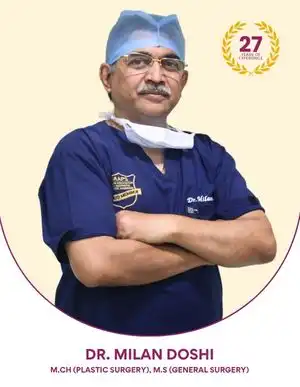
Why Choose Dr. Milan Doshi?
Dr. Milan Doshi, MCh, MS — Indian board-certified plastic surgeon with 27+ years in aesthetic surgery. ISAPS mentor, trusted by patients from 70+ countries. Consults at Andheri West; surgeries at the NABH-accredited surgical centre, Goregaon West.
Dr Doshi Note: “Patients often ask how much skin I will remove, expecting more to mean a better result. It is the opposite. The tight, operated look almost always comes from over-resection of skin combined with insufficient deeper support. My planning starts with the SMAS and treats the skin as the last, most conservative step.”