Revision Rhinoplasty in Mumbai: Correcting a Previous Nose Job — Rebuilt, Not Just Reshaped
Indian Board Certified Plastic Surgeon
M.CH, MS, ISAPS Mentor
16000+ Cosmetic Surgeries
1500+ Rhinoplasty Surgeries
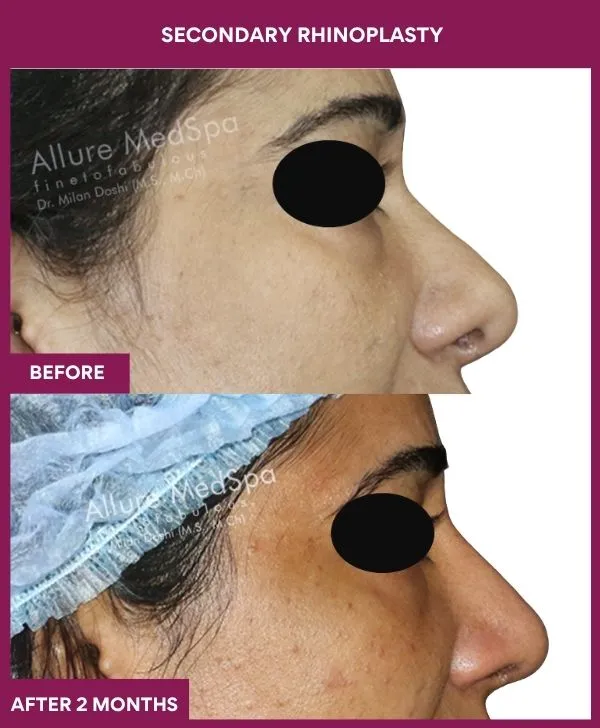
Revision rhinoplasty corrects a nose that a previous operation left collapsed, pinched, scooped, crooked, over-lifted or blocked — by rebuilding the support that was lost before refining the shape. At Allure Medspa Mumbai, Dr. Milan Doshi treats a second surgery as a different discipline: first understanding what the first operation changed, then restoring structure with your own cartilage, and only then refining — so the nose is stronger, breathes properly, and looks natural rather than operated.
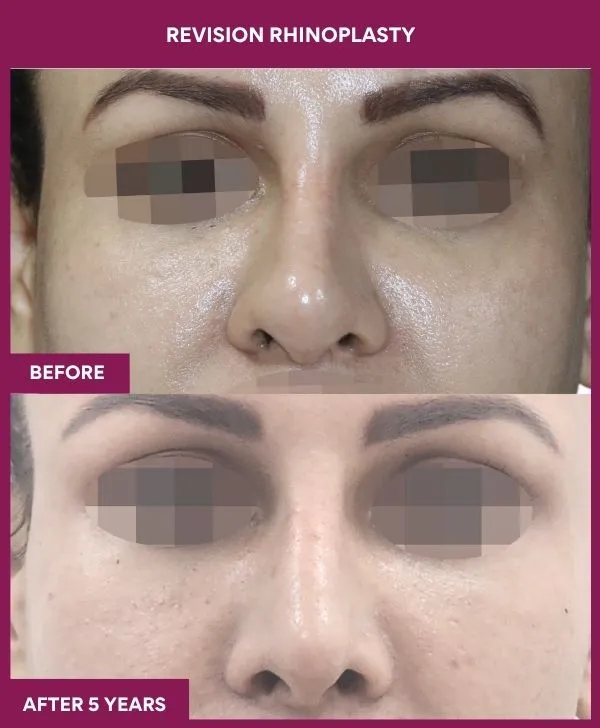
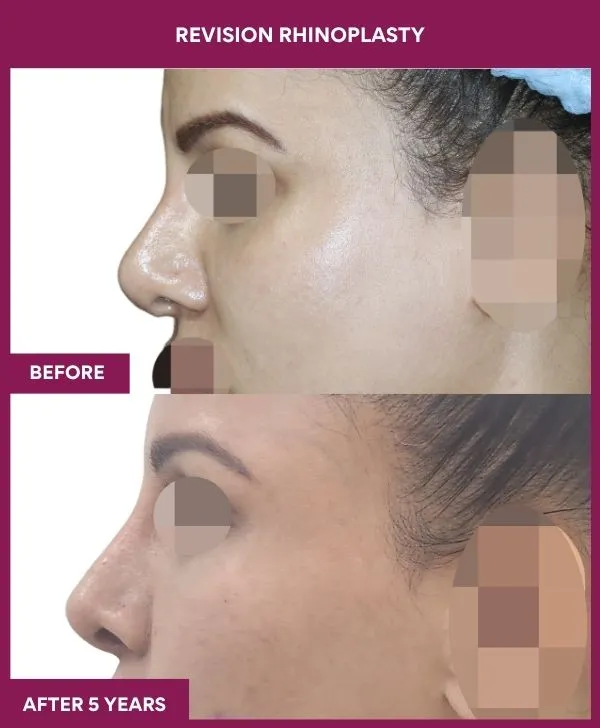
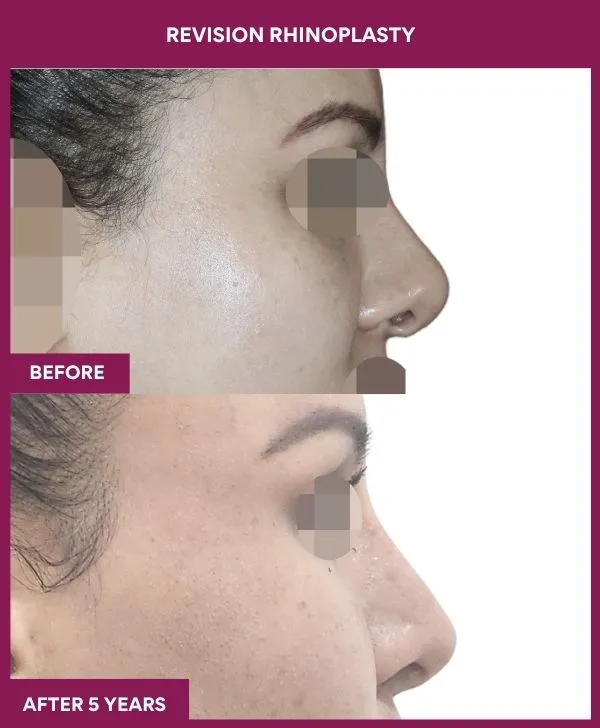
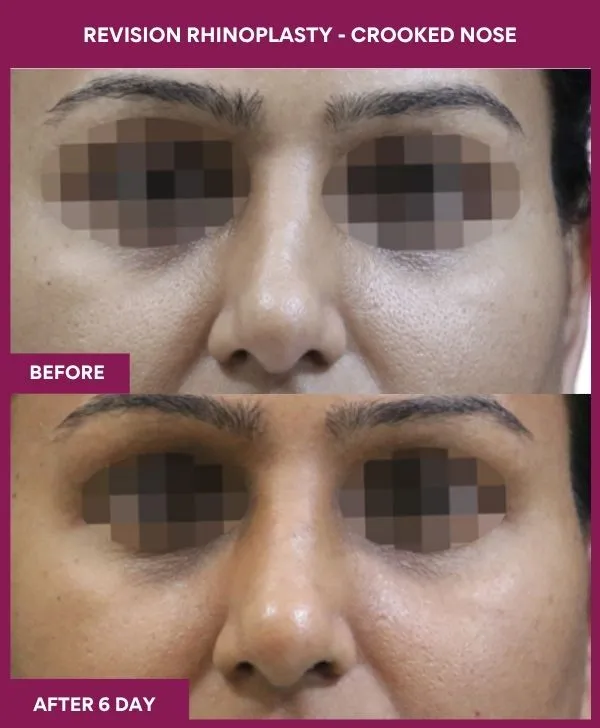
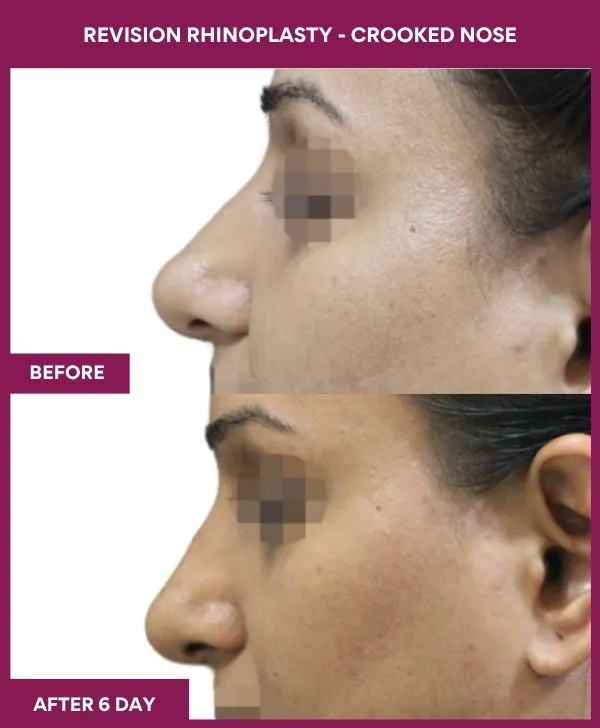
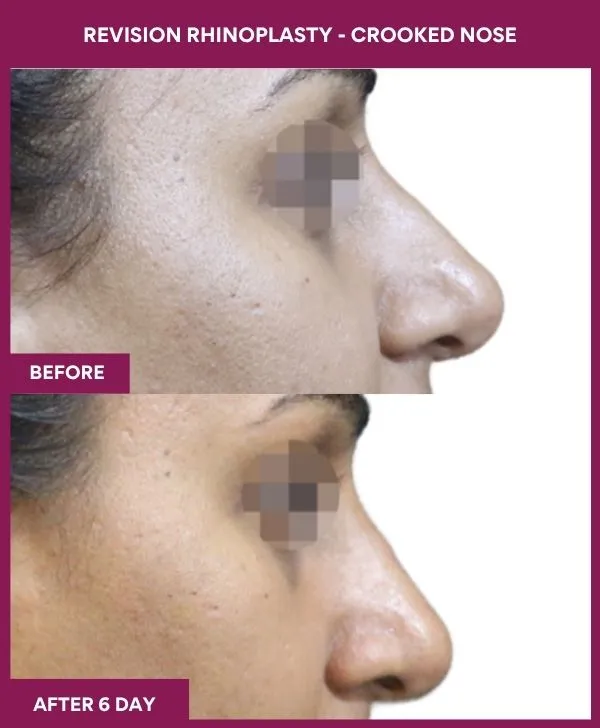
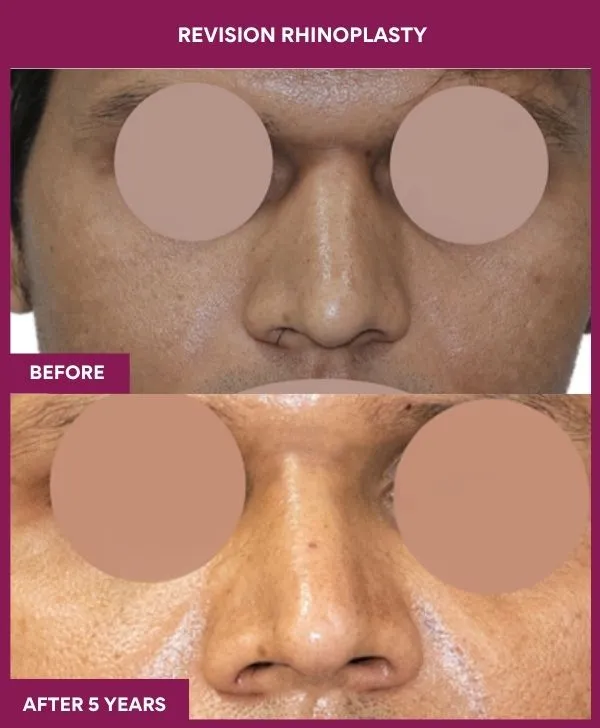
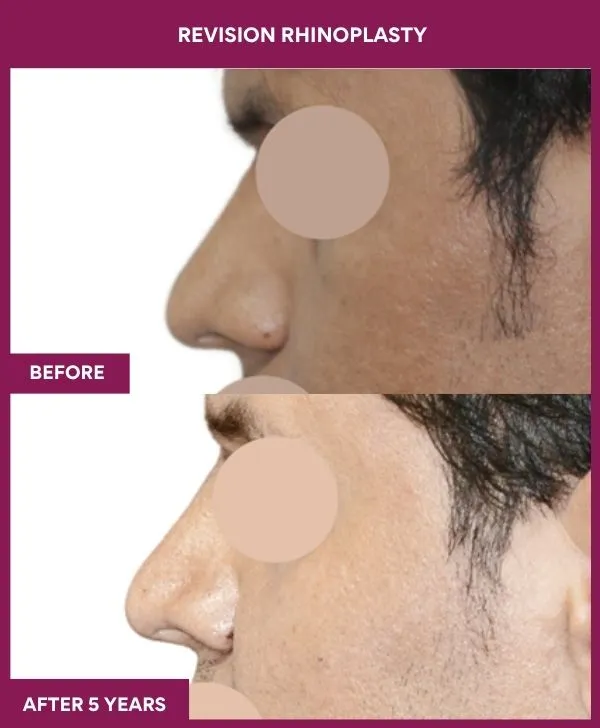
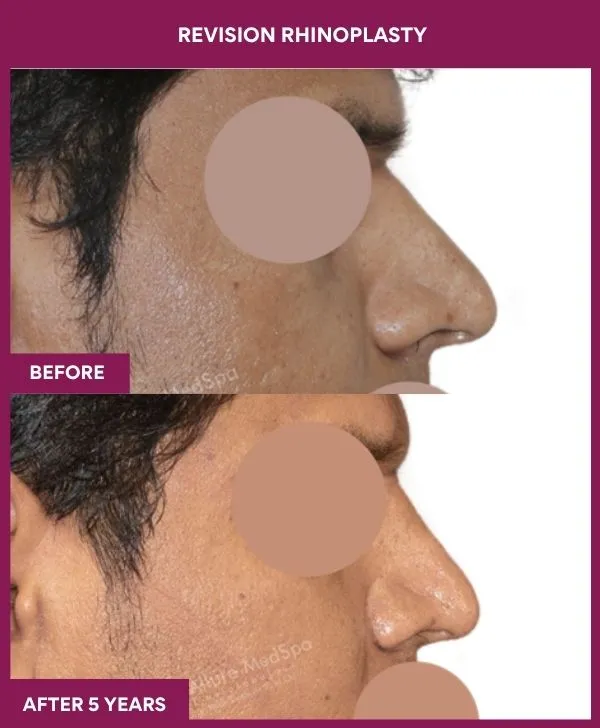
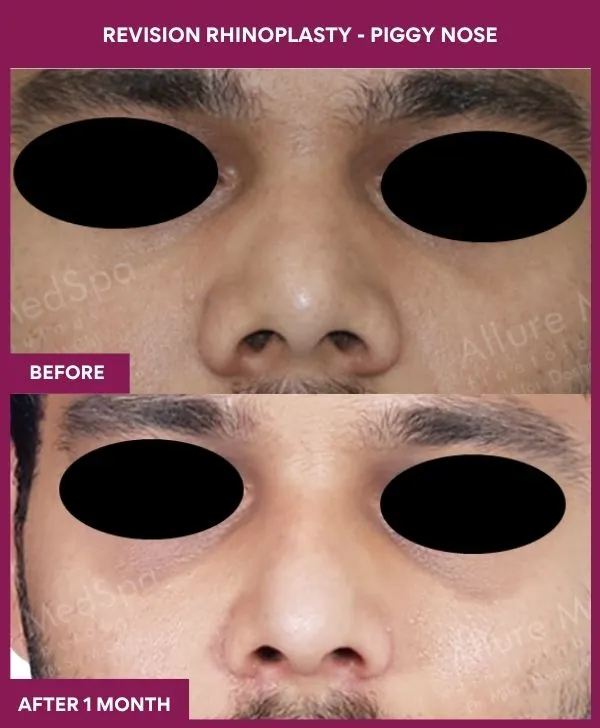
Revision Rhinoplasty Before And After Images
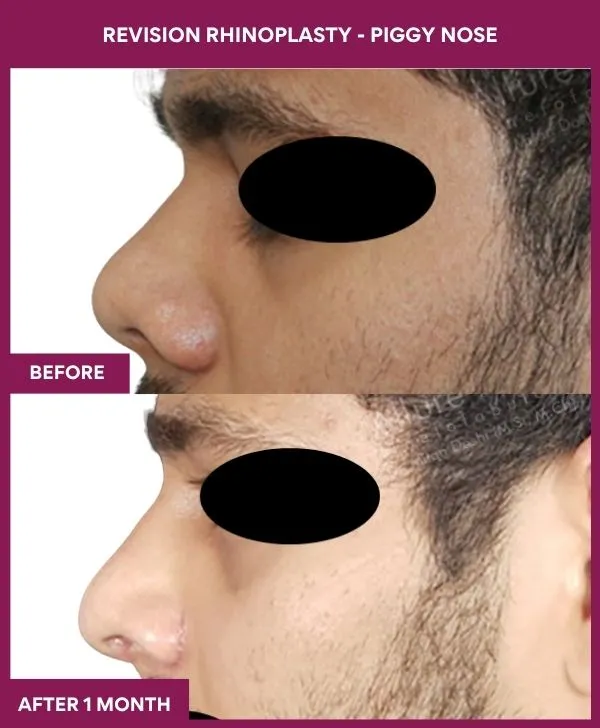
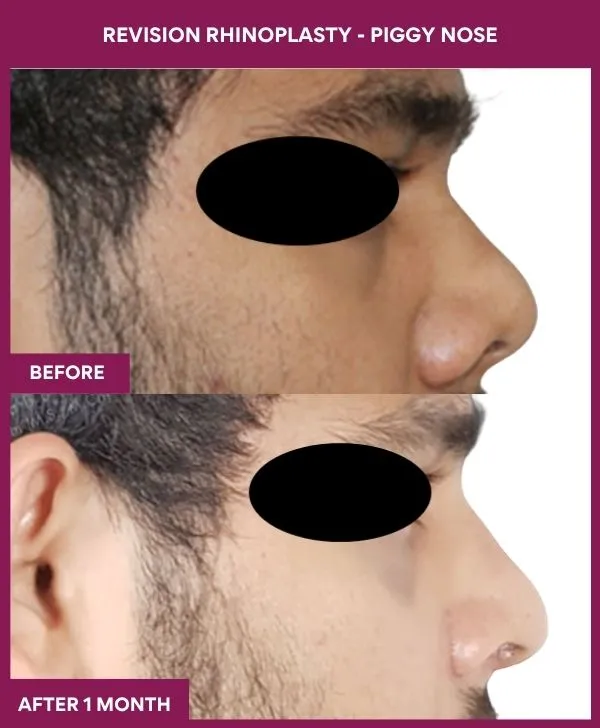
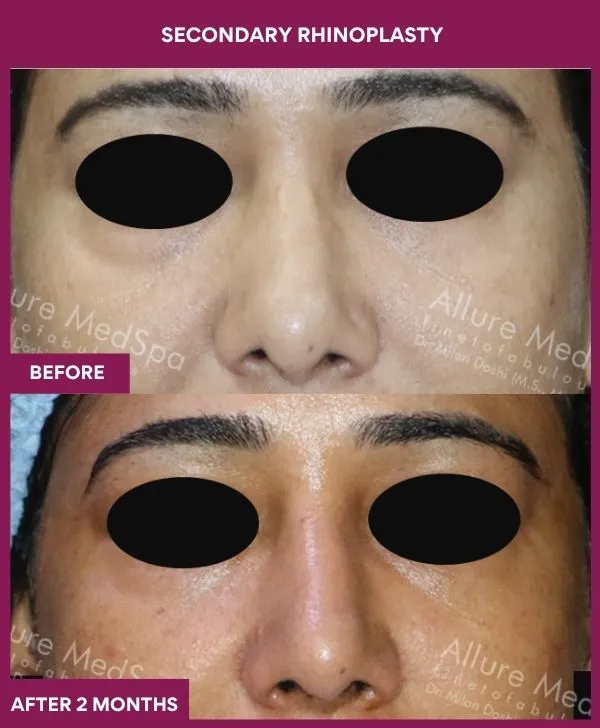
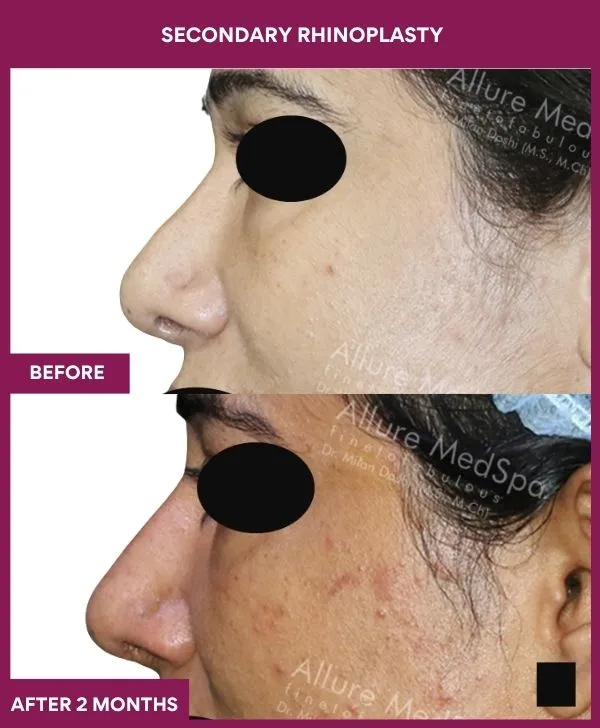
Rhinoplasty Surgery Testimonials: Celebrities Patient

Awarded by Google.com
Rating: 4.7
Reviews: 485+
Awarded by WhatClinic.com
Rating: 4.8
Reviews: 119+

Awarded by Realself
Rating: 4.9
Reviews:453+

Awarded by Facebook
Rating: 4.6
Reviews:105+
Dr Milan Doshi and his staff are very professional and committed as the centre is highly equipped with advanced technology. I had closed rhinoplasty 4 months back and I’m seeing the results as to how it becomes successful.
Deepika Shetty
The doctor explained everything clearly and the surgery was smooth. Recovery was faster than I expected and the team was very supportive.
Rahul Mehta
Very natural results and excellent staff. From consultation to follow-up, the experience was outstanding and boosted my confidence.
Sneha Kapoor
Video: Best Rhinoplasty Surgeon explain nose reshape procedure
Dr Milan Doshi is describing the Rhinoplasty Surgery in detail with benefits, techniques, recovery, result, risk and complecations
Am I a Candidate?
(4 quick questions)
Quick Facts About Revision Rhinoplasty
TIME REQUIRED
2–4 hours
ANESTHESIA
General
HOSPITAL STAY
1 night
PAIN LEVEL
Mild–moderate
BACK TO WORK
10–14 days
RESULTS LAST
Permanent
SUCCESS RATE
90–95%
COMPLICATIONS
Under 5%
How Much Does Revision Rhinoplasty Cost in Mumbai?
Revision rhinoplasty in Mumbai starts from ₹1,50,000 to ₹3,50,000 — usually higher than primary rhinoplasty because surgery may involve scar dissection, structural reconstruction, graft harvesting from the ear or rib, airway correction, longer operating time and more follow-up. Cost varies with how much support must be rebuilt, the graft source, whether breathing is corrected, whether the case is staged, and how many previous operations there have been. A final quotation follows examination — ideally with your previous operative notes — and a written surgical plan; it cannot be given accurately by phone or from photographs.
| Revision rhinoplasty scope | Indicative price range |
|---|---|
| Minor revision — small dorsal irregularity, tip asymmetry (closed or limited open) | ₹1,50,000 – ₹2,00,000 |
| Tip reconstruction — pinched, over-rotated or collapsed tip (septal / ear cartilage) | ₹1,90,000 – ₹2,50,000 |
| Dorsal reconstruction — scooped, saddled or inverted-V bridge (spreader + onlay grafts) | ₹2,00,000 – ₹2,70,000 |
| Functional revision — valve collapse / obstruction after previous surgery | ₹1,90,000 – ₹2,60,000 |
| Crooked nose revision — re-straightening with septal reconstruction | ₹2,00,000 – ₹2,80,000 |
| Full structural revision with rib cartilage | ₹2,60,000 – ₹3,50,000 |
| Implant removal and replacement with cartilage | ₹2,40,000 – ₹3,20,000 |
| Staged reconstruction (per stage) | Quoted per stage after examination |
Disclaimer note:
+5% GST · Includes surgeon, anaesthesia, OT, hospital stay, medicines and follow-ups. EMI available. Where nasal obstruction after previous surgery is documented, the functional component may be considered by insurers — see the insurance FAQ.
Get your exact quote & surgery plan
Share your details — our team responds within working hours with cost, EMI options and next steps.
Most Common Question People Ask
Q1. When can I have revision rhinoplasty after my first surgery?
Ans. Most patients are advised to wait about 12 months before revision assessment, because swelling, scar maturation and tissue remodelling continue for months and the target must be stable. Earlier surgery is considered only for urgent functional or structural problems — a collapsing airway, an exposed graft or implant, or a displaced bone in the first weeks.
Q2. How much does revision rhinoplasty cost in Mumbai?
Ans. The guide range is ₹1,50,000–₹3,50,000 plus 5% GST — higher than primary rhinoplasty because it may require scar dissection, grafting, structural repair, longer surgery and more detailed planning. A written quotation follows examination.
Q3. Can revision rhinoplasty fully fix a bad nose job?
Ans. Sometimes it can significantly improve a poor result, but it cannot promise complete correction. Scar tissue, skin thickness, cartilage loss, blood supply and healing behaviour limit what can safely be achieved. The honest word is “improvement,” not “perfection.”
Q4. Is revision rhinoplasty harder than primary rhinoplasty?
Ans. Yes. Prior surgery creates scar tissue, changes anatomy, may reduce available cartilage and can affect tissue vascularity. The surgeon usually needs grafts and far more structural planning than in a first-time rhinoplasty — it often becomes reconstructive surgery, not simple reshaping.
Q5. Will I need rib cartilage?
Ans. Not always. Revision may use septal, ear or rib cartilage depending on how much support is needed and what cartilage remains after prior surgery. Rib cartilage is considered when stronger or larger graft material is required — typically for a collapsed bridge, a badly over-resected tip or a removed implant.
Q6. How long is recovery after revision rhinoplasty?
Ans. Slower than primary. Splint off at about a week, desk work in 10–14 days, social recovery over 2–3 weeks; but swelling in scarred tissue settles slowly and the final shape is judged at 12 months, often 18 in complex or rib-grafted cases.
Q7. Do all failed rhinoplasties need surgery again?
Ans. No. Some concerns are due to swelling, healing or expectation mismatch rather than surgical failure. A serious revision consultation separates the three; revision is considered only after proper evaluation, adequate healing time, airway assessment and a realistic discussion of benefits, limits and risks — and sometimes the honest advice is “wait.”
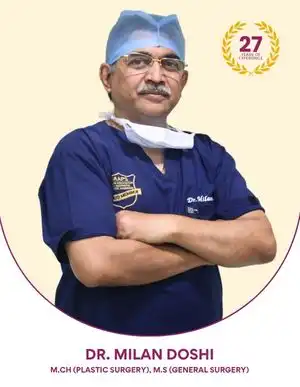
Why Choose Dr. Milan Doshi?
Dr. Milan Doshi, MCh, MS — Indian board-certified plastic surgeon with 27+ years in aesthetic surgery and 1,500+ rhinoplasties, including the difficult ones: noses referred from elsewhere with collapsed bridges, pinched tips, failed implants and blocked airways. Revision requires a surgeon who understands facial aesthetics, nasal structure, airway function, grafting, scar tissue and realistic correction. ISAPS mentor, trusted by patients from 70+ countries. Consults at Andheri West; surgeries at the NABH-accredited surgical centre, Goregaon West.
🩺 Dr Doshi Note: “In revision rhinoplasty, I do not look only at what the patient dislikes. I first study what the previous surgery has changed: support, skin behaviour, cartilage availability, breathing pathway, scar tissue, and facial balance. Many revision noses are not simply ‘under-corrected’ or ‘over-corrected’; they are structurally weakened or imbalanced. That is why my planning starts with three questions: what must be corrected, what must be rebuilt, and what should not be disturbed further. A second surgery is a different discipline.”
The Complete Guide About Revision Rhinoplasty
What Is Revision Rhinoplasty?
Revision rhinoplasty, also called secondary rhinoplasty, is nose surgery performed after a previous rhinoplasty to correct residual deformity, improve breathing, restore support or address dissatisfaction. Revision rhinoplasty is usually more complex than primary rhinoplasty because the nose has already been surgically altered.
Primary rhinoplasty starts with untouched anatomy. Revision rhinoplasty starts with scar tissue, changed cartilage, altered support and sometimes reduced blood supply. That is the practical difference. It is not “just a small correction” unless the examination proves it.
This distinction matters. A revision approached as “a bit more reshaping” tends to remove more tissue from a nose that has already lost too much — and produces a third problem. A revision approached as reconstruction puts structure back first, and only then refines.
Revision rhinoplasty may involve
- Cosmetic correction: hump, asymmetry, tip shape, nostril imbalance.
- Functional correction: nasal obstruction, valve collapse, septal deviation.
- Structural repair: weak bridge, collapsed middle vault, poor tip support.
- Grafting: septal, ear or rib cartilage when support is deficient.
- Staged planning: some complex cases may need more than one step.
Why is revision rhinoplasty harder than primary rhinoplasty?
Revision rhinoplasty is harder because the surgeon must work through scar tissue, distorted anatomy, previously altered cartilage, possible support loss and sometimes reduced vascularity. It often becomes reconstructive surgery, not simple reshaping. The first operation may have removed cartilage, weakened support, changed tissue planes, narrowed the airway or created scar contracture. The revision surgeon is no longer operating on untouched anatomy.
- Scar tissue: makes dissection harder.
- Distorted landmarks: normal anatomy may be unclear.
- Cartilage shortage: septal cartilage may be depleted.
- Vascularity: prior surgery may affect tissue healing.
- Support loss: nose may need rebuilding.
- Airway risk: cosmetic changes can worsen breathing if careless.
- Predictability: outcomes are less predictable than primary surgery.
Is revision rhinoplasty cosmetic or reconstructive?
| Type | Main purpose | Common example |
|---|---|---|
| Cosmetic (aesthetic) | Refine a residual or new cosmetic concern after primary surgery | Small dorsal irregularity or tip asymmetry smoothed |
| Reconstructive / functional | Rebuild lost support and restore breathing after over-resection, collapse or implant failure | Rib-cartilage reconstruction of a saddled, valve-collapsed nose |
| Mixed — the usual revision | Both: structure restored, then shape refined | Pinched, over-rotated tip rebuilt with grafts and re-rotated |
Most revisions are mixed. Where nasal obstruction after previous surgery is documented, the functional portion may be considered by insurers; cosmetic refinement is usually self-paid. Coverage in India is policy-specific and needs pre-authorisation.
Synonyms for revision rhinoplasty
Patient terms: second nose job, nose job correction, bad nose job repair, failed rhinoplasty fix, botched nose job surgery, redo rhinoplasty, corrective nose surgery
Medical terms: secondary rhinoplasty, tertiary rhinoplasty, reconstructive rhinoplasty, structural revision rhinoplasty, costal cartilage revision rhinoplasty, staged rhinoplasty
Sources: NCBI – Rhinoplasty (StatPearls)
🩺 Dr. Doshi’s Note —
“In revision rhinoplasty, we are often working with the consequences of the first surgery — scar tissue, missing cartilage, weak support, altered airway, and patient anxiety. My first job is not to operate quickly; it is to understand what has been damaged, what has been preserved, and what can be safely rebuilt. In many revision cases, the most important decision is not how much to change, but how much structure must be restored before refinement is even possible.”
Are You Unhappy With a Previous Nose Job?
Revision rhinoplasty patients are often disappointed, anxious or frustrated after a previous nose job. Many describe the same experience: they went in for a refinement and came out with a nose that looks pinched or scooped in photographs, that breathes worse than before, or that simply does not look like the plan — and now they are afraid of surgery itself. That fear is understandable, and the process should begin with calm assessment, not panic. The goal is to identify what is anatomical, what is still swelling, what affects breathing, and what can realistically be improved.
Three things patients actually say at consultation:
- “I asked for a small change and I got a nose that doesn’t look like me — and I can’t breathe through it.”
- “My surgeon says it’s still swelling. It’s been eight months. How do I know?”
- “I’m terrified of making it worse. Can it actually be fixed, or should I leave it?”
Some dissatisfaction is real surgical failure. Some is swelling. Some is expectation mismatch. A serious revision consultation separates these three; otherwise, the second surgery can become a second mistake. The useful question is not “can you fix it?” but “what exactly did the first operation change — and is it stable enough yet to correct?”
Common reasons patients seek revision
- Residual hump: bridge still looks raised.
- Over-correction: nose looks too scooped, pinched or weakened.
- Under-correction: original problem remains visible.
- Tip issue: drooping, asymmetry, bulbousness or poor support.
- Crooked nose: persistent deviation or new asymmetry.
- Breathing problem: obstruction after previous surgery.
- Nostril imbalance: alar or base asymmetry.
Global and Indian trends
Published studies report revision rates for rhinoplasty commonly in the 5–15% range, influenced by case complexity, surgeon experience, patient expectations and healing behaviour — which makes revision one of the most frequently performed secondary procedures in facial surgery. A 2018 study found respiratory functional disorder was associated with later revision, supporting the need to evaluate breathing both before and after rhinoplasty. In India, where rhinoplasty volumes have grown quickly and thick-skinned, low-bridged noses are often treated with reduction-only techniques, over-resected and Westernised noses are a large share of the revision workload. These figures are for patient education and should not be read as Dr. Doshi’s clinic-specific revision rate.
Sources: PubMed 30349780 · PubMed 23277618 · PMC5600890
What Are the Benefits of Revision Rhinoplasty?
The main benefits of revision rhinoplasty are restored structure in a nose that was left weak, a bridge and tip that look natural instead of operated, breathing that works again, and — for many patients — the end of a long period of distress about their appearance. Because the correction rebuilds support with the patient’s own cartilage, the result is stable and ages well.
Cosmetic benefits
- A rebuilt bridge — a scooped, saddled or inverted-V dorsum restored to a smooth, continuous line.
- A supported, natural tip — a pinched or collapsed tip given back its width and strength; an over-lifted tip brought down; a drooping one re-anchored.
- A straight nose — persistent or new deviation corrected structurally rather than camouflaged.
- Symmetric nostrils — retracted or uneven rims rebuilt with rim or composite grafts.
- The “operated look” removed — the tell-tale signs of over-resection softened so the nose stops announcing surgery.
- Recovered identity — for noses Westernised or over-reduced, ethnic character and facial harmony restored.
Functional and emotional benefits
- Internal and external valves rebuilt so breathing is restored — often better than before the first surgery.
- A structurally supported nose that will not continue to collapse or droop with age.
- Closure: a clear diagnosis of what went wrong, an honest plan, and an end to uncertainty.
Which Problems Can Revision Rhinoplasty Correct?
Revision rhinoplasty can correct selected aesthetic and functional problems after prior nose surgery, including bridge irregularity, tip deformity, nostril asymmetry, collapse, deviation and breathing obstruction. It cannot create unlimited change because skin, scar tissue, cartilage supply and blood supply may restrict correction. Final suitability depends on examination.
| Concern after previous surgery | Relevance to this page | Possible approach | Learn more |
|---|---|---|---|
| Residual dorsal hump or irregularity | Core target | Rasping, camouflage grafts, dorsal refinement | This page |
| Scooped dorsum / saddle nose (over-reduction) | Core target | Dorsal reconstruction with rib or diced cartilage | Augmentation rhinoplasty |
| Inverted-V / open-roof deformity | Core target | Spreader grafts, osteotomies | This page |
| Polly-beak (fullness above the tip) | Core target | Supratip revision, soft-tissue management, tip support | This page |
| Pinched tip / alar retraction | Core target | Lateral crural strut, rim and composite grafts | Bulbous tip correction |
| Over-rotated “piggy” tip | Core target | Septal extension graft to de-rotate and lengthen | Drooping tip correction |
| Tip ptosis or asymmetry | Core target | Tip reconstruction and re-anchoring | Nasal tip plasty |
| Still crooked / newly deviated | Core target | Septal reconstruction, osteotomies, asymmetric grafts | Crooked nose correction |
| Blocked breathing after surgery | Core target | Valve reconstruction, septal correction, scar release | Functional rhinoplasty |
| Failed, infected or visible implant | Core target | Implant removal and cartilage reconstruction | Augmentation rhinoplasty |
| Nostril / alar base asymmetry or notching | Core target | Rim grafts, scar revision, base correction | Wide nostril correction |
| Westernised / over-narrowed ethnic nose | Core target | Rebuild dorsal height and tip with rib cartilage | Ethnic rhinoplasty |
What went wrong the first time — the anatomy of revision
Understanding a few terms makes consultation far easier.
- Scar tissue — dense, fibrous tissue under the skin replacing the normal gliding planes. It hides landmarks, resists dissection and contracts over time, pulling the nose in unpredictable directions.
- Over-resection — too much bone or cartilage removed. The commonest cause of revision: it leaves a bridge that dips, a middle vault that collapses (inverted-V), a tip that pinches, and an airway that narrows.
- Cartilage supply — the septum is usually already harvested or damaged, so ear or rib cartilage becomes the graft source.
- Middle vault and internal valve — hump removal without spreader support leaves the upper lateral cartilages unsupported; the vault narrows and the airway with it.
- Tip tripod — trimming the tip cartilages weakens the tripod; the tip droops, pinches or rotates depending on which leg was cut.
- Skin–soft-tissue envelope — thinned by previous surgery in some noses (grafts show) or thickened by scar in others (definition hidden); blood supply may be reduced, especially after multiple operations.
- Alar rim and columella — retraction or notching here follows over-trimmed rims; rebuilt with cartilage or composite grafts.
What Are the Limitations and Realistic Expectations of Revision Rhinoplasty?
Revision rhinoplasty can improve a previous nose surgery result, but it has clear anatomical and healing limits. It is less predictable than primary rhinoplasty because scar tissue, skin thickness, cartilage loss, blood supply and healing behaviour may restrict how much correction is safe or achievable. Being clear about these boundaries before surgery is one of the strongest predictors of satisfaction afterwards.
What patients must understand
- Not instant: swelling can take longer than primary surgery.
- Not unlimited: tissue quality controls what is possible.
- Not always single-stage: some complex cases are staged.
- Not copy-paste: another person’s nose cannot be replicated — nor, often, the nose you originally asked for.
- Not purely cosmetic: airway safety matters.
- Not risk-free: revision carries added complexity.
- Not final until healed: early swelling can mislead.
Published studies report different revision rhinoplasty rates — commonly cited ranges fall around 5–15%, influenced by case complexity, surgeon experience, patient expectations, healing behaviour and whether the case is primary or secondary. These figures are useful for patient education, but they should not be read as Dr. Doshi’s clinic-specific revision rate. At Allure Medspa, the focus is on reducing avoidable revision risk through detailed consultation, realistic expectation setting, structural planning, breathing assessment, careful technique and proper follow-up. Still, no ethical surgeon should promise that revision will never be needed, because healing and anatomy vary from patient to patient.
Some patients should not have revision at all: where the concern is still swelling, where the target changes weekly, where expectation is perfection, or where distress is high enough that decision-making is not yet reliable. In those cases the honest advice is to wait, to treat the anxiety, or to accept the nose. Results vary by individual anatomy, previous surgery and healing.
Sources: PubMed 23277618 · PMC5600890
🩺 Dr. Doshi’s Note —
“In revision rhinoplasty, the most honest word is ‘improvement,’ not ‘perfection.’ I first explain to patients that the nose has already been changed once, so skin, scar tissue, cartilage support, blood supply, and healing behaviour may limit the final result. My aim is to identify the main correctable problem, improve structure where needed, protect breathing, and create a more natural-looking balance. A mature revision plan is not about doing everything the patient wants; it is about doing what the nose can safely accept.”
Why Consult Before Revision Rhinoplasty?
A revision consultation is a diagnostic appointment, not a sales appointment — and more than in any other rhinoplasty, it is also a timing decision. Its purpose is to establish what the first operation changed, whether the current concern is structural, swelling or expectation, whether the nose has settled enough to be a stable target, what cartilage is available to rebuild with, and whether surgery, waiting or no surgery is the right answer.
What happens during a revision consultation?
Assessment typically covers your account of the first surgery — what you asked for, what was done, and when; your previous operative notes and before-photographs if available; the timeline of change since; the nose from front, profile, three-quarter and base with the patient upright; palpation for scar, remaining cartilage, dorsal irregularity, tip support and bone position; skin thickness and quality — thinned, scarred or thickened; an internal examination of the septum (is cartilage left?), valves and any adhesions, with a breathing history and Cottle test; the ear and rib as potential donor sites; documented asymmetry; full medical history including medicines, supplements and nicotine use; and your goals in your own words — including how you are coping. You should leave understanding what the first operation changed, whether your concern is stable enough to correct, what must be rebuilt and what refined, the graft source, whether the case may be staged, the realistic degree of improvement, the risks and the recovery required — or a clear reason to wait.
What should I prepare before consultation?
- Previous operative notes and discharge summary — the single most useful document; request them from your previous surgeon.
- Photographs from BEFORE your first surgery, and a series since, so change over time can be judged.
- The date of the first surgery and of any further procedures, injections or fillers since.
- Your main concern now — bridge, tip, straightness, breathing — in order of priority, and whether it is still changing.
- All medicines and supplements, including blood thinners and herbal products.
- Medical and surgical history, including anaesthetic problems, previous ear or chest surgery, and keloid tendency.
- Your goals in writing — and what would count as “enough” improvement.
Is an online revision consultation possible?
If you are outside Mumbai, you can request a preliminary WhatsApp pre-check with front, profile, three-quarter and basal photographs in even, natural lighting, without makeup or filters, plus your previous operative notes and before-photographs if you have them. This is preliminary guidance only — and for revision it is particularly limited, because scar, cartilage supply and airway cannot be assessed from photographs. No definitive diagnosis, technique recommendation or final quotation can be given remotely.
Consultation fee: ₹1,500
Links: How to prepare · Online consultations
🩺 Dr. Doshi’s Note —
“In revision rhinoplasty, timing is as important as technique. I do not advise revision only because a patient is unhappy early after surgery. First, we must allow swelling, stiffness, scar maturation, and skin contraction to settle. Then I assess whether the problem is cosmetic, functional, structural, or emotional. A good revision candidate is not the patient who wants perfection quickly; it is the patient whose concern is stable, whose anatomy can safely support correction, and whose expectations are realistic.”
Which Techniques and Grafts Are Used in Revision Rhinoplasty?
“Technique” in revision rhinoplasty is mostly about reconstruction — where the graft material comes from, how support is rebuilt through scar, and how the airway is protected — and then about refinement. Revision may use open or closed techniques, but open revision is often preferred when detailed exposure, grafting, tip reconstruction or major structural correction is needed. It frequently requires cartilage grafts from the septum, ear or rib when existing nasal support is inadequate. These are surgical decisions made from what the first operation left behind, not a menu.
Open vs closed revision rhinoplasty
| Approach | When it may be used | Key limitation |
|---|---|---|
| Open revision | Complex deformity, tip work, grafting, structural repair | Small columella incision; more dissection |
| Closed revision | Minor selected corrections | Limited visibility and access |
| Staged approach | Severe scarring, poor tissue condition, complex reconstruction | Requires more time and planning |
Cartilage graft options
| Graft source | Common use | Consideration |
|---|---|---|
| Septal cartilage | Support, spreader grafts, tip support | May be depleted after prior surgery |
| Ear cartilage | Tip, contour, selected support needs | Curved and softer |
| Rib cartilage | Major structural reconstruction | Donor-site surgery; warping risk |
| Diced cartilage in fascia | Smoothing an irregular or scooped dorsum | Resists warping; some resorption |
| Composite (skin + cartilage) ear graft | Retracted alar rims, lining shortage | Small donor defect behind the ear |
Reconstruction techniques by problem
| Problem left by first surgery | Technique | Purpose |
|---|---|---|
| Collapsed middle vault / inverted-V | Spreader grafts | Re-open the valve, straighten dorsal lines |
| Scooped or saddled bridge | Dorsal onlay — carved rib or diced cartilage in fascia | Restore height and smooth contour |
| Pinched tip / alar retraction | Lateral crural strut grafts, alar rim grafts | Restore tip width and rim position |
| Over-rotated, short nose | Septal extension graft, extended spreader grafts | Lengthen and de-rotate |
| Drooping or unsupported tip | Columellar strut / extension graft | Re-anchor projection and rotation |
| Persistent deviation | Septal reconstruction, asymmetric osteotomies | Re-centre the nose |
| Blocked breathing | Valve grafts, septal correction, scar / synechiae release | Restore airway |
| Failed implant | Implant removal, capsule management, cartilage replacement (often staged) | Remove risk, rebuild safely |
| Polly-beak | Supratip cartilage and soft-tissue revision, tip support | Restore the supratip break |
Is open revision always better than closed?
No — but revision leans open more than any other rhinoplasty, and “open” or “closed” describes access, not what is done to the framework.
- Anatomy matters most. Rebuilding a collapsed vault or a pinched tip through scar needs direct vision; a small dorsal irregularity can be rasped closed.
- What is left matters. When the septum is depleted, the graft source (ear or rib) and the extent of reconstruction usually decide the approach.
- Blood supply matters. After multiple surgeries, dissection is kept to what is needed; staging is chosen over one heroic operation.
- Scar is minor either way. An existing columellar scar is usually reused; it should not be the deciding factor.
The right question at consultation is not “open or closed?” but “what must be rebuilt, from what, and in how many stages?”
Links: Open technique · Closed technique · Augmentation (materials in detail)
Sources: NCBI – Rhinoplasty (StatPearls)
What Are the Types of Revision Rhinoplasty?
Where technique describes how support is rebuilt, type describes the scope — how much went wrong, how much must be reconstructed, and whether it can be done in one stage.
- Minor revision — a small dorsal irregularity, a slightly asymmetric tip or a residual bump on an otherwise sound nose. Often closed, limited dissection. The most limited option.
- Tip reconstruction — for a pinched, collapsed, retracted, over-rotated or drooping tip after over-resection. Lateral crural struts, rim grafts, a septal extension graft; usually ear or septal cartilage.
- Dorsal reconstruction — for a scooped, saddled or inverted-V bridge. Spreader grafts plus a dorsal onlay of rib or diced cartilage.
- Functional revision — for breathing that got worse after cosmetic surgery. Valve grafts, septal correction, scar release; appearance preserved. Learn more about functional rhinoplasty.
- Crooked-nose revision — for a nose still or newly deviated. Septal reconstruction and asymmetric osteotomies and grafts. Learn more about crooked nose correction.
- Full structural revision — for a nose over-resected at every level. Rib cartilage rebuilds bridge, vault and tip in one plan. The most comprehensive single-stage option.
- Implant revision — for an infected, exposed, shifted or visible implant. Removal, capsule management and replacement with cartilage — often staged, with months between removal and rebuild if infection was present. Learn more about augmentation rhinoplasty.
- Ethnic restoration — for a nose Westernised or over-narrowed by earlier surgery. Dorsal height, tip support and base proportion rebuilt to the patient’s own heritage. Learn more about ethnic rhinoplasty.
- Staged reconstruction — for severe scarring, poor skin or multiple previous operations; support rebuilt first, refinement 9–12 months later.
- Tertiary and beyond — after two or more previous surgeries; the most demanding, with the most conservative goals.
Non-surgical options: hyaluronic-acid filler can camouflage a small dorsal dip or irregularity for 12–18 months and can be a reasonable alternative for a minor concern in a patient who does not want a third operation. It cannot restore support or breathing, and filler in a previously operated nose carries a higher vascular risk. Learn more about non-surgical rhinoplasty.
How Is Revision Rhinoplasty Performed Step-by-Step?
Revision rhinoplasty follows a rebuild-first sequence — harvest graft material, get through the scar safely, restore the airway and support, and only then refine — so nothing is refined on a foundation that is not there. Most revisions are open, reusing the previous columellar scar; ear or rib cartilage is taken through hidden incisions.
| Step | What happens |
|---|---|
| 1. Consultation and planning | Previous operative notes and photographs reviewed; what was changed, damaged and preserved mapped; timing confirmed (usually ≥12 months); rebuild vs refine plan written; graft source and staging decided; alternatives including waiting discussed. |
| 2. Preoperative preparation | Medical assessment, investigations, anaesthetic review, medication and supplement adjustment, confirmed nicotine cessation (critical after previous surgery), standard photographs; chest X-ray if rib harvest planned. |
| 3. Surgical markings | Existing scars, dorsal target line, tip target, osteotomy paths and asymmetry marked with the patient upright; donor site marked. |
| 4. Anaesthesia | General anaesthesia with the airway protected; local anaesthetic with adrenaline. Monitoring is continuous. |
| 5. Graft harvest | Remaining septal cartilage assessed; ear or rib cartilage harvested and prepared (carved or diced) before the nose is opened. |
| 6. Exposure through scar | Open approach, usually through the previous columellar scar; scarred planes dissected carefully to protect blood supply; landmarks re-identified. |
| 7. Airway first | Septal deviation corrected if present; adhesions released; valve status assessed. |
| 8. Middle vault reconstruction | Spreader grafts placed to re-open the internal valve and straighten the dorsal lines. |
| 9. Dorsal reconstruction | Scooped or irregular dorsum rebuilt with carved rib or diced cartilage in fascia; residual hump rasped. |
| 10. Tip reconstruction | Strut or septal extension graft placed; pinched or retracted cartilages rebuilt with lateral crural struts and rim grafts; rotation and projection reset. |
| 11. Refinement and symmetry check | Bones repositioned if needed; camouflage grafts placed; symmetry and airway checked before closure. |
| 12. Closure, splints and observation | Incisions closed with fine sutures; internal splints; external splint applied; donor site dressed; monitored recovery, usually overnight. |
Surgical elements and devices
| Element / device | Possible role | Important consideration |
|---|---|---|
| Previous operative notes | Map of what was removed and what remains | Requested from the previous surgeon; changes the plan. |
| Remaining septal cartilage | Small grafts if any is left | Often depleted; L-strut must not be weakened further. |
| Ear (conchal) cartilage | Tip, rim and lateral crural grafts; DC-F filler | Curved; ideal for tip reconstruction. |
| Rib (costal) cartilage | Dorsal, spreader, extension and strut grafts | The workhorse of major revision; carved from the core to limit warping. |
| Temporalis / rectus fascia | Wrap for diced cartilage; camouflage over thin skin | Small additional donor site. |
| Composite ear grafts | Alar rim retraction, lining shortage | Skin + cartilage taken together. |
| Permanent fine sutures | Graft fixation, tip shaping | Graft fixation is critical in scarred beds. |
| Internal silicone splints | Support septum, prevent re-adhesion | Removed at first follow-up. |
| External splint and tapes | Hold reconstructed framework | Must not be removed or wet by the patient. |
| Steroid injection (post-op, selected) | Control stubborn supratip / scar swelling | Used sparingly, surgeon-controlled. |
Sources: NCBI – Rhinoplasty (StatPearls)
When Will I See Final Revision Rhinoplasty Results?
Revision results reveal themselves more slowly than primary results. The rebuilt bridge and tip are visible when the splint comes off at about a week, but scarred tissue swells for longer and settles unevenly. A clearer sense of the new nose emerges at 3 months, contours refine through 6–9 months, and final assessment in complex, rib-grafted or multiply-operated noses is only reliable at 12–18 months. Do not judge a revision early — and do not let anyone else judge it early either.
| Time | What you may notice |
|---|---|
| First few days | Splint on, swelling and bruising — sometimes more than the first surgery; donor site sore. Do not judge the result at this stage. |
| 1 week | Splint and sutures removed. Structure visibly restored; swelling asymmetric and firm over scarred areas. |
| 2–4 weeks | Bruising gone; presentable in public. Nose still swollen and firm; may look over-built — this is swelling over grafts. |
| 3 months | Shape becoming clear; grafts integrating; firmness softening. |
| 6 months | Most of the intended correction visible; breathing result essentially final. |
| 9–12 months | Final shape in most revisions; scars mature. |
| 12–18 months | Final result in rib-grafted, thick-skinned and multiply-operated noses. Any further revision is not assessed before this point. |
What can affect the final result?
How much structure had been lost and how much could be rebuilt; scar tissue behaviour and contraction; graft source, carving and fixation; skin thickness and blood supply after previous surgery; the number of previous operations; whether the airway was fully addressed; smoking and nicotine exposure — the single most damaging factor in a previously operated nose; individual healing; whether glasses, pressure or knocks disturbed the grafts early; and adherence to taping, follow-up and any staged plan.
What Is the Aftercare After Revision Rhinoplasty?
What care is usually advised?
- Keep your head elevated on two pillows for the first week or as instructed.
- Protect the splint and tapes — keep them dry; do not press, adjust or remove them. They are holding grafts in place.
- Do not touch, press or “check” the nose — grafts in scarred tissue take longer to fix than in a first surgery.
- Do not blow your nose for the period advised; sneeze with the mouth open.
- Use saline spray and ointment inside the nostrils as shown; keep all incisions clean.
- Care for the donor site — ear: keep the dressing on, sleep on the other side; rib: keep the chest dressing dry, no heavy lifting for 4 weeks.
- Take medicines exactly as prescribed, complete the antibiotic course, and do not restart blood-thinning medicines or supplements without approval.
- Continue taping at night for as long as instructed — scarred tissue benefits from it more than primary tissue.
- Attend all follow-up appointments — splint removal, graft position check, scar and swelling review, selective steroid injection, and photographs at 3, 6 and 12 months.
What should patients avoid after revision rhinoplasty?
| Avoid | Why |
|---|---|
| Smoking, vaping, nicotine in any form — absolutely | Blood supply is already reduced by previous surgery; nicotine is the leading cause of graft failure and skin breakdown in revision. |
| Glasses resting on the bridge (6 weeks, or as advised) | Pressure can dent or shift dorsal grafts held in scarred tissue. |
| Contact sports, crowded transport, playing with small children near the face | A knock can displace grafts or bones before they fix. |
| Sleeping on your side or face | Pressure can push the reconstruction asymmetric. |
| Strenuous exercise and heavy lifting (4 weeks; 6 with rib harvest) | Raises blood pressure and swelling; strains the chest wound. |
| Swimming, steam, sauna (4 weeks) | Infection risk to incisions, grafts and donor site. |
| Direct sun on the nose and donor scars | Worsens swelling; darkens scars. |
| Unapproved medicines, supplements or scar creams | Some affect bleeding or healing — check every product with your surgeon. |
| Nasal filler or any injection into the nose (12 months, unless planned by your surgeon) | Vascular risk is higher in scarred tissue; interferes with settling. |
| Judging your result — or letting others judge it — in the first months | Revision swelling is slower and more uneven than primary. |
What Are the Risks and Complications of Revision Rhinoplasty?
Revision rhinoplasty has the usual surgical risks plus added revision-specific concerns such as scar-related unpredictability, compromised support, limited cartilage, persistent asymmetry, breathing issues, graft-related problems and possible need for further surgery. It is generally safe for an appropriately selected patient operated on by an experienced revision surgeon in an equipped facility — but it is more complex and less predictable than primary rhinoplasty, and no surgeon can eliminate risk.
Common / expected early effects (normal healing, not complications): swelling and bruising, sometimes more than after the first surgery; prolonged, uneven firmness over scarred areas; a blocked nose while splints are in; numbness of the tip; mild aching; donor-site soreness; temporary asymmetry.
Uncommon complications: bleeding; infection (a greater concern with grafts and in scarred tissue); persistent swelling; asymmetry — scar tissue may heal unevenly; graft visibility, especially in thin skin; graft shift or warping (rib); partial graft resorption; under-correction; recurrence of scar contracture; prolonged numbness; donor-site problems; dissatisfaction leading to a request for further revision.
Rare but important: skin compromise or necrosis — prior surgery may affect vascularity, and nicotine multiplies the risk; septal perforation where the septum was previously operated; loss of reconstructed support; pneumothorax during rib harvest; anaesthesia-related complications.
Revision-specific risks
| Risk | Why it matters |
|---|---|
| Bleeding or infection | General surgical risk; higher with grafts and scar. |
| Persistent swelling | May last longer in revision. |
| Asymmetry | Scar tissue may heal unevenly. |
| Breathing difficulty | Airway must be protected. |
| Graft visibility | More likely in thin skin. |
| Graft warping | Especially rib cartilage. |
| Skin compromise | Prior surgery may affect vascularity. |
| Further revision | Some cases may need additional correction. |
How risk is minimised
| Risk area | How we work to minimise it |
|---|---|
| Operating on an unstable or non-surgical problem | Minimum 12-month wait unless functional urgency; swelling vs structure vs expectation separated at consultation; willingness to advise “wait” or “no”. |
| Making a weak nose weaker | Rebuild-first principle: support restored with grafts before any refinement; nothing further removed. |
| Skin compromise | Absolute nicotine cessation enforced; dissection limited to what is needed; staging over one heroic operation in multiply-operated noses. |
| Cartilage shortage | Ear or rib planned from the outset; graft prepared before the nose is opened. |
| Graft warping / shift | Central-core carving, balanced cross-sections, dicing where suitable, secure fixation in the scarred bed. |
| Persistent airway problem | Septum, valves and adhesions assessed and treated with the reconstruction. |
| Unrealistic expectation | Written plan states expected degree of improvement; “improvement, not perfection” agreed before surgery. |
| Undetected medical risk | Preoperative medical evaluation, investigations and anaesthetic review. |
| Infection | Sterile technique, perioperative antibiotics, careful graft handling, wound-care instruction. |
| Facility and equipment risk | Surgery at an NABH-accredited surgical centre with appropriate equipment. |
| Delayed recognition of a problem | Structured observation, written warning signs, accessible follow-up over a long settling period. |
🩺 Dr. Doshi’s Note —
“Every revision patient arrives with two problems — the nose, and the fear of a third surgery. I cannot promise the first will be perfect, but I can promise the second will be honest: I will tell them what was removed, what can be put back, what cannot, and whether they should wait. Some of the best revision decisions I make are the ones where I send a patient home for six more months.”
⚠️ When to seek urgent medical attention
Seek urgent advice or immediate emergency care for: heavy or continuing bleeding · fever · spreading redness or warmth · pus or foul discharge · any graft or implant edge becoming visible or exposed · dusky, pale or darkening skin over the nose · sudden worsening of breathing · severe or escalating pain · chest pain or breathlessness after rib harvest.
In an emergency, go to the nearest emergency department or call emergency services. Do not wait for a WhatsApp or email reply.
Full risk guide: Rhinoplasty risks and safety
Sources: NCBI – Rhinoplasty (StatPearls)
What Is the Revision Rhinoplasty Recovery Timeline?
Revision rhinoplasty recovery is often slower than primary rhinoplasty because scar tissue, grafting, structural repair and repeated tissue trauma may prolong swelling and refinement. Splints come off at about a week; most patients return to desk work in 10–14 days; social recovery improves over 2–3 weeks. Final contour and tip definition take many months, and the final assessment in complex cases is only reliable at 12 months or later. This is a summary — for detailed day-by-day guidance, see the rhinoplasty recovery timeline.
| Timepoint | What typically happens |
|---|---|
| Days 1–3 | Swelling, bruising, splint, congestion; donor-site soreness. Overnight stay usual. Rest head-elevated. |
| Days 5–10 | Splint review / removal depending on protocol (usually around day 7); internal splints out; graft position confirmed. |
| Week 2 | Social recovery improves; many patients return to desk work from day 10–14. Nose firm and swollen over scarred areas. |
| Weeks 3–6 | Swelling gradually reduces; glasses, exercise and travel usually cleared at review (rib patients cleared for lifting at 4–6 weeks). Night taping continues. |
| Months 3–6 | Shape becomes clearer; grafts integrate; breathing result settles. |
| Months 6–12 | Continued refinement; scars mature. |
| 12+ months | Final assessment more reliable in complex cases; any further revision considered only from here. |
Key recovery points: downtime is about two weeks; settling is a year or more · swelling is slower and more uneven than after a first surgery — this is scar, not failure · nicotine is forbidden, not discouraged · glasses stay off the bridge for 6 weeks · flying requires written clearance at follow-up — do not book non-refundable travel around an assumed date · outstation patients usually stay in Mumbai 10–14 days and are followed by monthly photographs thereafter.
Your surgeon confirms the exact splint, travel, work, exercise and follow-up protocol for your case. Do not use another patient’s timeline — or your first surgery’s timeline — as a guide.
🩺 Dr. Doshi’s Note —
“Revision patients have already been through one recovery, and they measure the second against it. It is always slower, and I say so before surgery: the tissue has been operated on before and it swells longer and settles unevenly. The patients who do best are the ones who stop looking in the mirror every day and start looking at the monthly photographs instead.”
Links: Recovery timeline day 1 to final result · Outstation patients
Medical Codes for Revision Rhinoplasty
| CPT Code | CPT Description | ICD-10 |
|---|---|---|
| 30430 | Rhinoplasty, secondary; minor revision (small amount of nasal tip work) | Z98.890 (other specified post-procedural state) · M95.0 (acquired deformity of nose) |
| 30435 | Rhinoplasty, secondary; intermediate revision (bony work with osteotomies) | M95.0 · Z98.890 |
| 30450 | Rhinoplasty, secondary; major revision (nasal tip work and osteotomies) — the core structural-revision code | M95.0 · Z98.890 · T88.8XXA / T81.89XA (complication of procedure, payer-dependent) |
| 30520 | Septoplasty or submucous resection (when septum re-corrected) | J34.2 |
| 30465 | Repair of nasal vestibular stenosis (valve reconstruction after previous surgery) | J34.89 |
| 30560 | Lysis intranasal synechia (scar / adhesion release) | J34.89 |
| 20910 / 21235 / 20912 | Cartilage graft harvest — costochondral / ear / nasal septum | — |
| 20926 | Tissue grafts, other (fascia) | — |
| Implant removal (payer-specific code) | Removal of nasal implant with reconstruction | T85.79XA / T85.89XA (complication of implant) |
(FAQs) Frequently Asked Questions About Revision Rhinoplasty
Q1. Can revision rhinoplasty itself fail or need another revision?
Ans. Yes. Revision is less predictable than primary surgery; scar contraction, graft warping or resorption, uneven healing or persistent asymmetry can occur, and some complex noses are planned as staged reconstructions from the outset. Any further revision is assessed only after 12–18 months of settling, and each successive surgery has more conservative goals.
Q2. Is revision rhinoplasty safe in India?
Ans. It can be performed safely in selected patients when done by an experienced revision surgeon in an accredited facility with proper anaesthetic support — but it is more complex and less predictable than primary rhinoplasty. Risks include bleeding, infection, swelling, asymmetry, breathing issues, graft problems and possible further revision. Judge the surgeon’s revision volume and grafting experience, not the country.
Q3. How long does revision rhinoplasty surgery take?
Ans. Usually 2–4 hours — longer than primary — and more with rib cartilage harvest, implant removal or multi-level reconstruction. Staged cases involve two shorter operations months apart. The planned duration is confirmed only after examination.
Q4. What problems can revision rhinoplasty correct?
Ans. It may correct residual hump, crooked nose, tip asymmetry, drooping tip, over-rotation, pinched tip, scooped or saddled bridge, inverted-V, polly-beak, nostril asymmetry, valve collapse, septal deviation, breathing obstruction, failed implants or structural weakness. Suitability depends on examination and what the previous surgery changed.
Q5. Can revision rhinoplasty improve breathing?
Ans. Yes, if obstruction is caused by septal deviation, valve collapse, support loss, adhesions or airway narrowing after previous surgery — these are among the commonest reasons for revision. The cause must be diagnosed before surgery; not every breathing problem is corrected by rhinoplasty.
Q6. Will revision rhinoplasty leave scars?
Ans. If an open approach is used, the previous columellar scar is usually reused, so no new external nasal scar is added. Ear cartilage leaves a hidden scar behind the ear; rib cartilage a short scar at the breast fold. Closed revision avoids an external incision but is suitable only for minor corrections.
Q7. Should I go back to my original surgeon?
Ans. It is reasonable to return for a review — they know what was done and should provide operative notes. Whether they perform the revision depends on whether the problem is one they routinely correct; structural revision with rib grafting is a specific skill. Whoever operates, bring the notes.
Q8. What is a staged revision and why would I need one?
Ans. Some noses — severely scarred, multiply operated, or with an infected implant — cannot safely be rebuilt in one operation. Support is restored first (or an implant removed and the tissue allowed to recover), and refinement follows 9–12 months later. Staging trades a longer journey for a safer, more predictable result.
Q9. Can filler fix my bad nose job instead of surgery?
Ans. For a small dorsal dip or irregularity, filler can camouflage the problem for 12–18 months and may be a reasonable alternative to a third operation. It cannot restore support, correct a pinched tip or improve breathing, and injecting a previously operated nose carries a higher vascular risk — so it should be done only by an experienced medical injector who knows the nose has been operated.
Q10. When can I fly after revision rhinoplasty?
Ans. Only after written clearance at a follow-up review, usually once external and internal splints are off, graft position is confirmed and any donor site is healing — typically 10–14 days. Do not book non-refundable travel around an assumed date.
Q11. Does insurance cover revision rhinoplasty?
Ans. Cosmetic revision should not be assumed to be covered. Where nasal obstruction caused or left by previous surgery is documented (endoscopy findings, NOSE score), the functional component may be considered by insurers subject to policy wording and pre-authorisation. Confirm directly with your insurer before surgery; our team helps prepare the documentation.