
Back Liposuction in Mumbai: Bra Rolls, Back Fat and Buffalo Hump

Indian Board Certified Plastic Surgeon
M.CH, MS, ISAPS Mentor
16000+ Cosmetic Surgeries
4000+ Liposuction Surgeries
Back liposuction treats selected fatty fullness across the upper back, bra line and lower back. These areas behave differently from softer fat elsewhere, because the tissue is often dense and fibrous. A fat pad at the base of the neck needs an additional question answered first: why is it there?
Pathway callout: One roll is rarely the whole story on the back.
Bra line: the roll above, below or beside the bra strap.
Upper back: width around the shoulder blades, often blending into the underarm.
Lower back: the pad above the waistband that usually continues into the flanks.
Base of the neck: a dorsocervical fat pad (buffalo hump) — assessed medically before it is treated as a contour problem.
Cost: quoted after examination, because the back varies more than most areas.
At Allure Medspa Mumbai, Dr. Milan Doshi plans the back as connected zones rather than isolated rolls. This guide maps the back’s fat zones, explains why back fat usually needs ultrasound, how the operation and recovery work, when it won’t help — and why a neck hump is a medical question first. → Liposuction Surgery · Liposuction Body Areas
Back Liposuction Surgery Before and After Images
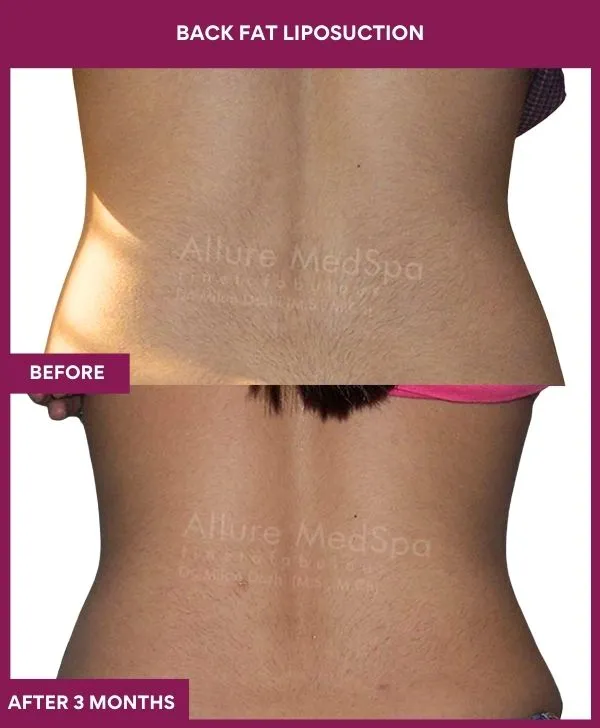
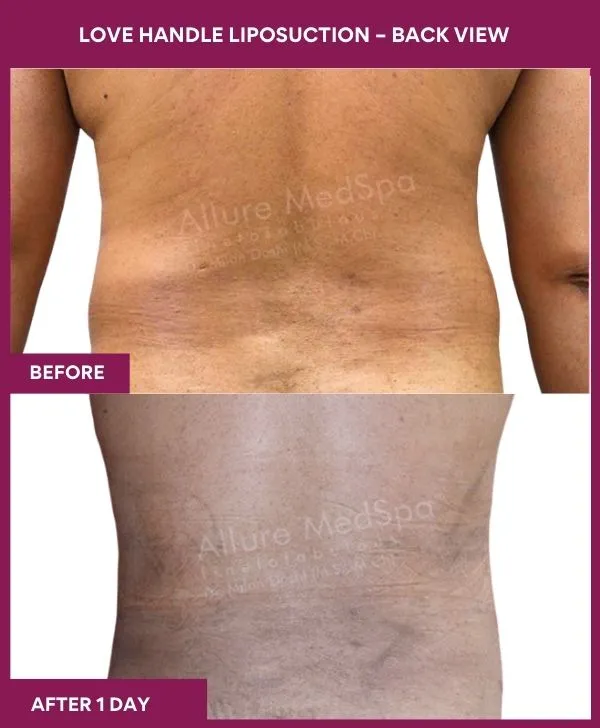
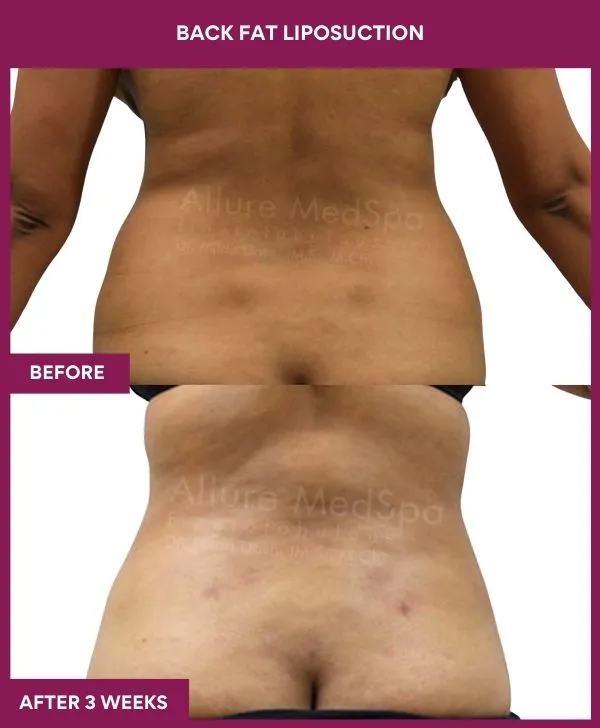
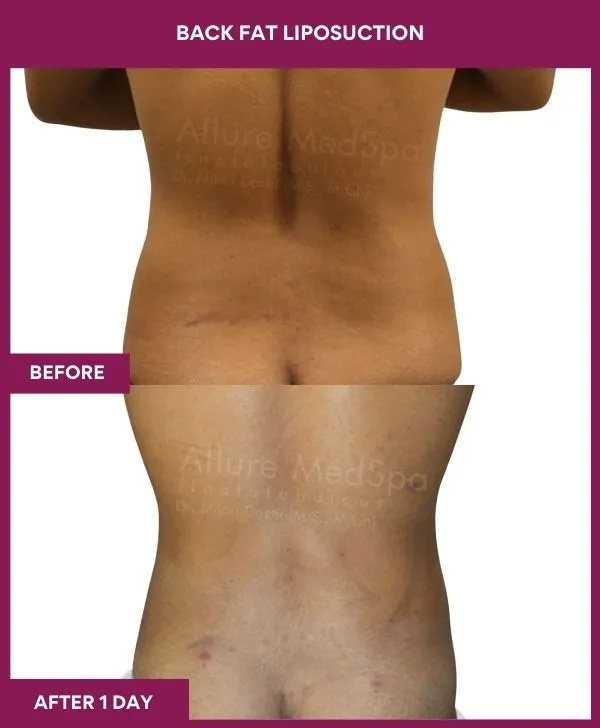
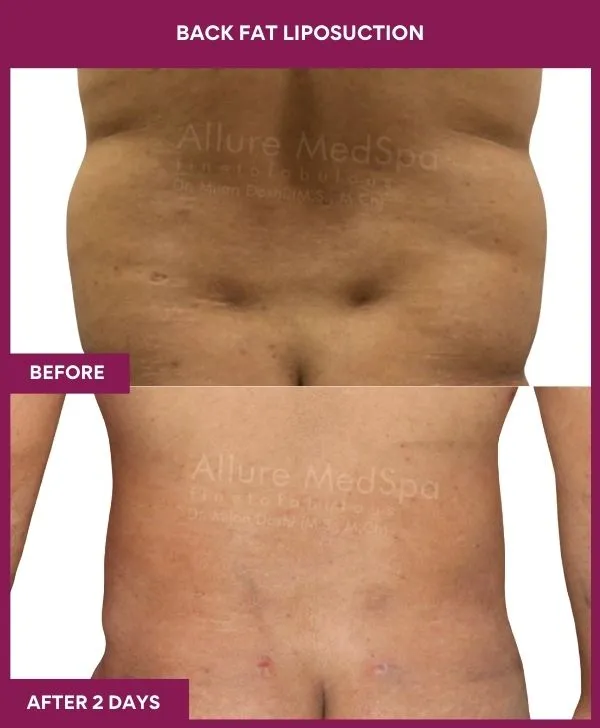
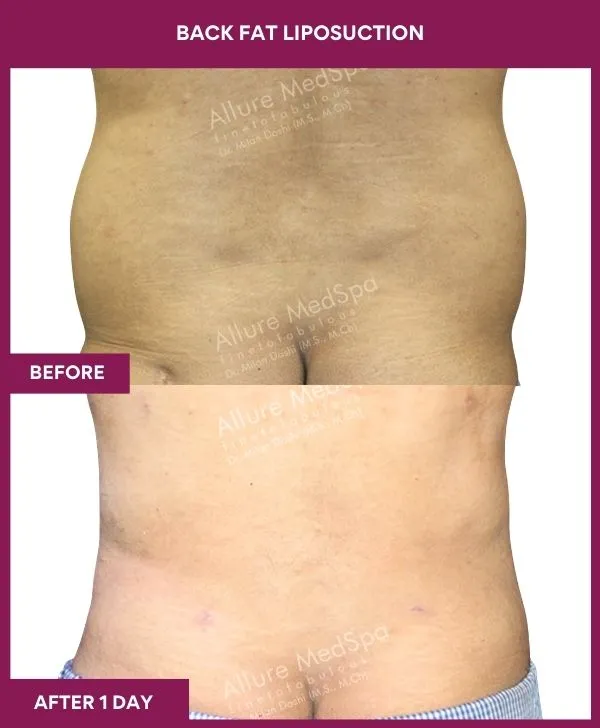
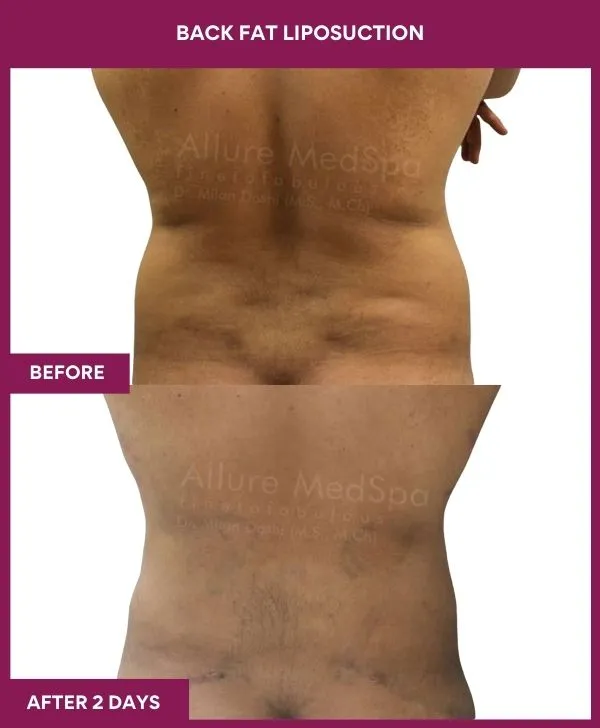
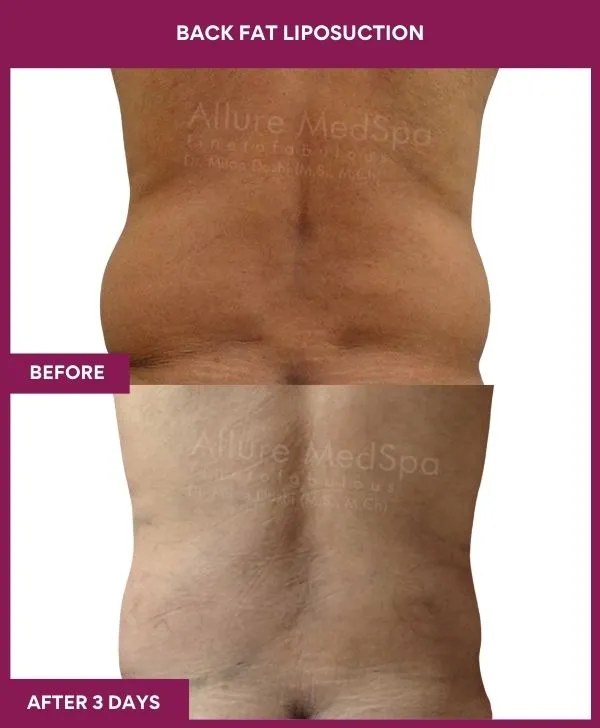
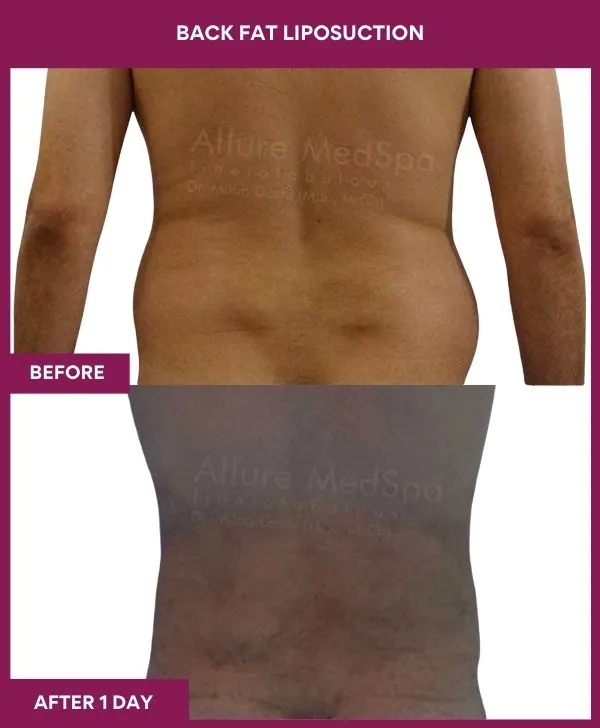
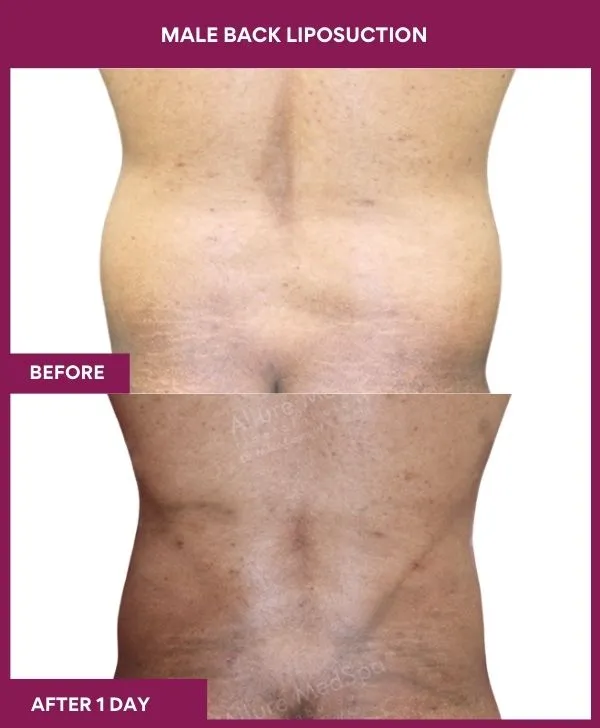
“Back Liposuction Surgery Cost.”
Liposuction Surgery Patient Testimonials: Fine To Fabulous Journeys

Awarded by Google.com
Rating: 4.7
Reviews: 485+

Awarded by WhatClinic.com
Rating: 4.8
Reviews: 119+

Awarded by Realself
Rating: 4.9
Reviews:453+

Awarded by Facebook
Rating: 4.6
Reviews:105+
Dr Milan Doshi and his staff are very professional and committed as the centre is highly equipped with advanced technology. I had closed rhinoplasty 4 months back and I’m seeing the results as to how it becomes successful.
Deepika Shetty
The doctor explained everything clearly and the surgery was smooth. Recovery was faster than I expected and the team was very supportive.
Rahul Mehta
Very natural results and excellent staff. From consultation to follow-up, the experience was outstanding and boosted my confidence.
Sneha Kapoor
Inspired by Their Transformation
Video: Liposuction Surgery Explain By Dr. Milan Doshi
Dr Milan Doshi is describing the Liposuction Surgery in detail with benefits, candidacy, associated risks and significance
Am I a Candidate?
(4 quick questions)
Quick Facts About Back Liposuction Surgery
TIME REQUIRED
1–3 hours
ANESTHESIA
General / local
HOSPITAL STAY
Day care
PAIN LEVEL
Mild–moderate
BACK TO WORK
3–7 days
Final RESULTS
3–6 months
SUCCESS RATE
97–98%
COMPLICATIONS
Under 2–3%
How Much Does Back Liposuction Surgery Cost in Mumbai?
Back liposuction is quoted after examination. The back varies more than most areas — a small bra-line roll and a full upper-to-lower back with flanks are very different operations — so a fixed number before examination would be a guess.
| Item | Allure price |
|---|---|
| Back liposuction | Quoted after examination |
| Back + flanks | Priced as a combination — less than two separate procedures |
| Love handles & hips (for comparison) | ₹50,000 – ₹90,000 |
| Lipo 360 (abdomen, flanks, hips, lower back) | ₹1,50,000 – ₹2,00,000 |
| Consultation | ₹1,500 |
| Is the consultation fee adjusted against surgery? | Yes — adjusted against surgery if the surgery is done within 6 months. |
| GST | Shown separately on your invoice |
| EMI | Available |
What’s included: surgeon, anaesthesia, OT, medicines and follow-ups.
What changes the back liposuction price?
- Upper versus lower back — and how many zones are treated.
- Bra-line treatment.
- Whether the flanks — or the arms and underarm roll — are included.
- Ultrasound assistance — often useful in dense back tissue.
- Anaesthesia and procedure volume.
Why is back + flanks such a common combination? The lower back and flanks are anatomically continuous; where both are full, treating them together creates a smoother transition. Because anaesthesia, theatre, garments and follow-up overlap, combination pricing differs from buying two separate procedures. A buffalo hump is quoted only after the medical questions are answered — and whether liposuction, excision or both is right also changes the quote. → Full liposuction cost guide
Get your exact quote & surgery plan
Share your details — our team responds within working hours with cost, EMI options and next steps.
Most Common Question People Ask
Q1. Can back fat and bra rolls be removed with liposuction?
Ans. Yes — selected bra rolls and back-fat deposits can respond well, although back tissue is often relatively fibrous, and the neighbouring upper-, mid- and lower-back zones need blending rather than being treated as isolated rolls. Ultrasound assistance may be particularly useful in dense back tissue, and lower-back fullness is frequently assessed with the flanks.
Q2. Will a buffalo hump come back after liposuction?
Ans. It can. A 2026 meta-analysis of 22 studies and 218 patients reported 10.6% recurrence after liposuction and 15.3% revision — 1.4% and 1.3% after sensitivity analysis — and 0% after excisional or hybrid approaches. Most cases were HIV-related, and an ongoing cause such as medication or hormonal disease makes recurrence more likely.
Q3. Do I need medical tests before having a buffalo hump removed?
Ans. You may, when the history suggests an endocrine, medication-related or other medical cause — a dorsocervical fat pad can occur with excess cortisol (Cushing syndrome) and long-term corticosteroid use. If you also have high blood pressure, raised blood sugar, easy bruising, poorly healing wounds or purple stretch marks, tell your physician and surgical team first.
Q4. Why does my bra roll look worse in clothes than unclothed?
Ans. Because a back roll is created by fat plus compression. A bra strap, fitted seam or waistband gathers soft tissue into a defined fold, making it more visible above and below the pressure point. This is anatomically reasonable, not imagined — and it is why a relatively modest volume of fat can look prominent.
Q5. Does back liposuction need VASER rather than standard suction?
Ans. Not always, but the fibrous back is one of the stronger reasons to discuss ultrasound assistance. A randomised trial comparing VASER-assisted with conventional suction reported better skin retraction and about 26% less blood loss on the ultrasound side. Technique should follow tissue, not marketing — there should be a clinical reason either way.
Q6. How long will I need off work after back liposuction?
Ans. Many desk-based patients return within about three to seven days. Bruising is often most visible around days three to five, reaching overhead or behind the body may feel uncomfortable for one to two weeks, and upper-body exercise resumes only after clearance. Timing is confirmed at follow-up rather than promised in advance.
Q7. Will back liposuction remove my rolls completely?
Ans. A realistic goal is a smoother, flatter transition — not a completely featureless back. Back rolls are created by both fatty volume and fibrous attachments, so reducing the fat can make the area considerably smoother without every anatomical fold becoming invisible. The final contour is judged at around three months.
Q8. Will back liposuction leave scars?
Ans. It leaves a few small access marks, usually a few millimetres long, placed around the bra line, near the waistband or in natural creases so clothing can usually conceal them. They are often pink at first and fade over months. The exact positions depend on which zones are treated.
Q9. Can my arms and back be treated in the same operation?
Ans. Often, yes. Upper-back fullness frequently continues into the underarm and upper arm, and treating them together keeps the arm-to-torso transition smooth. Combining areas adds operating time, volume and recovery, so the plan is set by what is genuinely full, not by a package.
Q10. Can a bra roll come back after liposuction?
Ans. Removed fat cells don’t return, but the fat cells that remain can enlarge with weight gain, and fat distribution shifts with age. A stable weight preserves the result. A buffalo hump is different — if its underlying cause continues, the pad itself can recur.

Why Choose Dr. Milan Doshi?
Dr. Milan Doshi, MCh, MS — Indian board-certified plastic surgeon with 27+ years in aesthetic surgery · ISAPS Mentor · 16,000+ cosmetic surgeries. Because a back result is judged on its transitions, not on the litres removed, he photographs every back from behind, marks it standing, plans the upper back, bra line, lower back and flanks as one contour — and asks the medical questions before any neck pad is treated.
What does that mean for your back?
- Standardised photographs — so you see your own back properly, often for the first time.
- Standing marking before you lie face down.
- Zones blended, not emptied — no step between back and flank.
- Technique matched to tissue — ultrasound assistance where back fat is dense.
- Medical assessment first for any dorsocervical fat pad.
The Complete Guide About Back Liposuction Surgery
What is Back Liposuction (Back Suction Lipectomy)?
Back liposuction — medically, suction-assisted lipectomy of the trunk — removes selected fat from the upper back, bra line and lower back through small access points. Most people considering it are describing a contour line rather than wanting their entire back made smaller — a bra roll showing through clothing, upper-back fullness, or a lower-back pad that continues into the flanks.
Why is the back different from other areas?
You don’t see your own back properly every day. Most patients know their abdomen intimately, because they see it in mirrors, when dressing and when sitting. The back is usually seen through photographs, changing-room mirrors, fitted clothing, comments from a partner, or the way a bra or waistband sits. That difference affects both the consultation and your expectations.
| Concern | What patients describe | What it is usually linked to |
|---|---|---|
| The bra-line roll | Fullness above the strap, under the band, beside the closure or near the underarm — far more noticeable in a fitted top | Compression from clothing gathering soft tissue into a fold |
| Upper-back fullness | Width across the back, fullness in sleeveless clothing, an uneven arm-to-torso transition | Fat around the shoulder blades blending into the underarm → arm liposuction |
| Lower-back fullness | A pad above the waistband | Usually the rear part of the waistline, continuous with the flanks → love handles & hips |
| A mound at the base of the neck | A hump between the shoulders | A dorsocervical fat pad — a medical question first |
Why do standardised photographs matter more here?
Because you can’t inspect your own back easily, photographs do the job a mirror does elsewhere. They show which rolls are actually present, whether the concern is fat or loose skin, whether the right and left sides differ, how far the fullness extends toward the flanks, and whether a neck prominence is separate from ordinary back fat. A patient may arrive concerned about one fold and discover the visual interruption is caused by the zone above or below it — and the reverse also happens.
Synonyms for back liposuction
- Patient terms: bra roll removal · back fat removal · bra bulge liposuction · upper back lipo · buffalo hump removal.
- Medical terms: suction-assisted lipectomy (trunk) · dorsal liposuction · dorsocervical fat pad reduction.
- Hindi / colloquial: पीठ की चर्बी हटाने की सर्जरी · ब्रा रोल लिपोसक्शन.
Sources: Salemy S. Where on your body can you get liposuction? American Society of Plastic Surgeons, 2019 · Wu S, Coombs DM, Gurunian R. Liposuction: concepts, safety, and techniques in body-contouring surgery. Cleve Clin J Med. 2020;87(6):367–375 · American Society of Plastic Surgeons. Liposuction
Does Your Back Look Fuller Than You Feel?
Back patients describe the same thing in different words: a concern they had never raised with anyone — not a partner, a friend or their own doctor. The roll shows in a fitted top or under a bra strap, and because you can’t see your back easily, it’s easy to assume nothing can be done.
Why does a bra roll form so clearly?
A back roll is created by two things together: fat + compression. Soft tissue that might otherwise lie relatively smoothly is compressed by a bra strap, tight shapewear, a fitted seam or a waistband — and then becomes more visible above and below the pressure point. That is why so many patients say “it only really looks bad when I’m dressed.” That observation is anatomically reasonable.
Is the bra roll usually a large volume of fat?
Not necessarily. A relatively modest amount of fat can look prominent when squeezed into a defined fold. That’s why the visual change after treating a bra-line roll can be greater than the volume removed would suggest.
| What you notice | What’s usually happening |
|---|---|
| The roll only bothers you in clothes | A strap, seam or waistband is gathering soft tissue into a fold |
| Exercise hasn’t changed it | Training changes muscle and overall energy balance, not where fat is released first |
| It appeared with age at the same weight | Fat distribution shifts toward the trunk with age |
| You’ve never seen it clearly | The back is seen only in photographs and changing-room mirrors |
Sources: Spalding KL, Arner E, Westermark PO, et al. Dynamics of fat cell turnover in humans. Nature. 2008;453(7196):783–787, PMID 18454136 · Carman W. Ten common misconceptions about liposuction. American Society of Plastic Surgeons, 2018 · Salemy S. Where on your body can you get liposuction? American Society of Plastic Surgeons, 2019
What Are the Benefits of Back Liposuction?
The main benefits are a smoother back contour in fitted clothing, fewer visible rolls at the bra line and waistband, and a cleaner transition into the flanks and underarm — through small access marks, when the problem is fat and the skin can re-drape.
| Benefit | What it means | The honest limit |
|---|---|---|
| A smoother bra line | Less roll above and below the strap | Fibrous attachments mean some folds remain |
| Better fit of fitted tops and dresses | Less tissue gathered by seams and straps | Swelling hides the change for weeks |
| A cleaner back-to-flank transition | No step at the side of the torso | Needs the flanks planned with the back |
| A smoother arm-to-torso line | Upper back and underarm blended together | Adds operating time and recovery |
| Small access marks | Placed where clothing usually conceals them | Can pigment in Indian skin |
| A lasting change in the treated area | Removed fat cells don’t return | Remaining fat cells can enlarge with weight gain |
Sources: American Society of Plastic Surgeons. Liposuction · Spalding KL, Arner E, Westermark PO, et al. Dynamics of fat cell turnover in humans. Nature. 2008;453(7196):783–787, PMID 18454136 · Carman W. Ten common misconceptions about liposuction. American Society of Plastic Surgeons, 2018
Which Problems Can Back Liposuction Correct?
Back liposuction is planned across connected zones — upper back, bra line and lower back — because removing one roll while leaving the neighbouring roll unchanged creates an obvious step rather than a smooth back contour.
| Zone | Where it sits | What it usually looks like | Planning note |
|---|---|---|---|
| Upper back | Around and between the shoulder blades | Fullness and width across the upper torso | Often continues into the underarm and upper arm |
| Bra line | Around the bra strap at mid-back level | A roll above or below the strap | Commonly accentuated by clothing compression |
| Lower back | Above the waistband and behind the flanks | A fat pad or roll above the belt line | Often continuous with the love handles |
| Dorsocervical fat pad | Base of the neck, above the upper back | A defined mound commonly called a buffalo hump | Needs a different, medical assessment first |
Why do the lower back and flanks travel together?
Lower-back fat rarely stops exactly at the side of the torso — it usually continues around into the flanks.
| If you reduce… | And leave… | You get |
|---|---|---|
| The lower back | Prominent flanks | A visible edge where the treated back meets the untreated side |
| The love handles | A full lower back | A waist that looks incomplete from behind |
| One bra-line roll | A full zone above or below it | A step instead of a smooth line |
When does Lipo 360 enter the discussion?
If fullness continues across the abdomen, flanks, hips and lower back, the issue may be circumferential rather than back-only. That’s when a Lipo 360 assessment becomes relevant. It shouldn’t be added automatically — if the abdomen and flanks are already proportionate, treating them simply because the back is being treated adds more surgery without useful benefit.
Sources: American Society of Plastic Surgeons. Liposuction · Dixit VV, Wagh MS. Unfavourable outcomes of liposuction and their management. Indian J Plast Surg. 2013;46(2):377–392, PMID 24501474
What Are the Limitations of Back Liposuction?
Back liposuction is unlikely to produce the intended result when the visible fold is mainly loose skin rather than fat, when skin laxity is significant, or when a neck or upper-back prominence comes from a medical or structural cause.
| Situation | Why liposuction falls short | What may fit better |
|---|---|---|
| The roll is mostly loose skin | Removing the little fat under lax skin makes the fold emptier and more obviously loose | Skin-excision discussion |
| Significant back skin laxity | Liposuction doesn’t remove excess skin — after ageing, major weight loss or repeated weight change | An upper-back lift or bra-line excision, which exchanges excess skin for a scar |
| A neck pad with a medical cause | Cortisol excess, medication-related redistribution or a metabolic cause comes first | Medical assessment and treatment |
| The prominence isn’t fat | Bone, spinal curvature or posture-related structure can’t be suctioned | Assessment of the underlying structure |
How does the pinch test work?
Gently pinch the back fold. A thick, soft fold suggests a meaningful fat component. A thin, loose, skin-like fold may be predominantly excess skin. The back generally has thicker skin than the inner thigh or upper arm, which helps — but back skin can still lose elasticity.
Will my rolls disappear completely?
Back rolls may improve without disappearing completely. They are created by both fatty volume and fibrous attachments. Reducing the fat can make the area considerably smoother, but it doesn’t mean every anatomical fold or attachment becomes invisible. A realistic goal is a smoother, flatter transition — not a completely featureless back.
Sources: Carman W. Ten common misconceptions about liposuction. American Society of Plastic Surgeons, 2018 · National Health Service (UK). Liposuction · Cleveland Clinic. Buffalo hump
Why Consult Before Back Liposuction?
A back consultation maps the zones with standardised photographs, checks fat against loose skin with the pinch test, and — for any neck pad — answers the medical questions before a contour plan is made.
Why does the medical check matter for a buffalo hump?
A 2025 study of 12 HIV-negative patients with a buffalo hump found that 8 had high blood pressure and 9 had raised cholesterol or lipids; three were newly diagnosed with a metabolic condition during the workup. The authors warned that the pad “often leads to an initial assumption of benign or aesthetic origin”, and recommended considering metabolic screening even without obvious disease. The series is small, but the message is practical: the neck mound may be the visible clue that leads to a diagnosis. In a 2026 series of ultrasound-assisted liposuction for idiopathic buffalo hump, secondary causes — including Cushing syndrome, HIV infection and long-term corticosteroid use — were excluded before any patient was treated.
| Area | What is asked or checked |
|---|---|
| Medication history | Current steroid medication, previous long-term steroid treatment, and other relevant prescription medicines |
| Associated symptoms | High blood pressure, diabetes or prediabetes, easy bruising, poorly healing wounds, purple or pink stretch marks — reasons to investigate, not proof of Cushing syndrome |
| How quickly it developed | A pad that appeared quickly without matching weight change deserves different attention from one that grew gradually with weight gain |
| Whether it is actually fat | Examination of whether it feels fatty, fibrous or structural; imaging or further medical evaluation in selected cases |
When do we refer before operating?
If the history or examination suggests a possible endocrine, metabolic, medication-related or structural cause, medical assessment comes before any cosmetic treatment decision. That isn’t delaying treatment unnecessarily — it’s making sure the visible problem is not the clue to a more important one. Never stop steroid medication yourself; discuss it with your treating physician.
What should I prepare before consultation?
- Photos from behind and at three-quarter view, in natural light.
- The pinch test — whether the fold feels thick or skin-like.
- For a neck pad: your medicines, especially steroids, and any blood pressure or blood sugar problems.
- Whether your flanks, abdomen or arms bother you too.
Sources: Lee NH, Lim BJ, Shin JY, Chung YK, Roh SG. Non HIV-associated buffalo hump as a clinical marker of metabolic disease. J Clin Med. 2025;14(17):5997 · Kim J, Kim Y, Rha E, Shin J. Ultrasound-assisted liposuction for idiopathic buffalo hump: anatomical considerations and technical implications. J Clin Med. 2026;15(7):2704, doi:10.3390/jcm15072704 · Cleveland Clinic. Buffalo hump · Cleveland Clinic. Cushing syndrome
Which Techniques Are Used in Back Liposuction?
Back fat is often denser and more fibrous than fat on areas such as the lower abdomen. It is held by tough connective bands, which makes it more difficult to remove evenly with standard suction alone — so technique is part of the plan.
What does “fibrous fat” mean?
Fibrous tissue contains dense connective bands running through the fatty layer. Instead of behaving like loose, soft fat, the tissue is held in a tighter framework. The back is one of the areas where this is most noticeable — along with the male chest, upper abdomen and selected revision areas. A standard cannula can still remove fibrous fat; it simply needs more mechanical effort, which makes even reduction more demanding.
| Outcome in the randomised trial | VASER-assisted | Conventional suction |
|---|---|---|
| Skin retraction per litre removed | 17% | 11% |
| Blood loss | About 26% less | Reference side |
Keep the absolute difference in view: the skin-retraction advantage was around six percentage points per litre — useful, but not a different operation.
Is VASER always better for every area?
No — technique should follow tissue rather than marketing. On relatively soft fat, adding an ultrasound device may change the complexity and price more than it changes the visible outcome. The fibrous back is one of the stronger anatomical reasons to discuss ultrasound assistance; that doesn’t mean every patient needs it, but there should be a clinical reason if it is recommended, or if it is not. A 2025 meta-analysis of isolated aesthetic liposuction found low pooled complication rates across techniques, with contour irregularity the most commonly reported problem; thermal energy brings its own precautions, protecting the skin and access points.
Sources: Nagy MW, Vanek PF Jr. A multicenter, prospective, randomized, single-blind, controlled clinical trial comparing VASER-assisted lipoplasty and suction-assisted lipoplasty. Plast Reconstr Surg. 2012;129(4):681e–689e, PMID 22456382 · Wu S, Coombs DM, Gurunian R. Liposuction: concepts, safety, and techniques in body-contouring surgery. Cleve Clin J Med. 2020;87(6):367–375 · Ahmed MB, Shraim BA, Al-Matwi MA, et al. Comparison of complications in isolated aesthetic liposuction procedures across different techniques: a systematic review and meta-analysis. Eur J Plast Surg. 2025;48(1):8, doi:10.1007/s00238-024-02268-0
What Are the Types of Back Liposuction?
Types describe which zones are treated — bra line, upper back, lower back, back with flanks or arms, Lipo 360 — and, separately, the dorsocervical fat pad, which follows its own medical pathway.
| Type | What it involves | Usually suits |
|---|---|---|
| Bra-line liposuction | The roll around the strap at mid-back level | A thick, soft roll that shows in fitted tops |
| Upper-back liposuction | Fat around the shoulder blades, blended into the underarm | Width across the upper torso |
| Lower back + flanks | The pad above the waistband with the love handles | Fullness that turns the corner into the waist |
| Back + arms | Upper back, underarm roll and upper arm together | Fullness that continues into the arm |
| Lipo 360 | Abdomen, flanks, hips and lower back | Genuinely circumferential fullness |
| Dorsocervical fat pad | Liposuction, excision or both — after the medical questions | A selected fatty neck pad |
What can cause a buffalo hump?
| Possible cause | What it means | Why it matters for treatment |
|---|---|---|
| Excess cortisol — Cushing syndrome | Prolonged exposure to too much cortisol, the adrenal stress hormone | Needs medical diagnosis and treatment — liposuction doesn’t treat the hormonal problem |
| Long-term corticosteroid medication | Medicines such as prednisolone or dexamethasone | Never stop medication yourself — discuss it with your treating physician |
| HIV antiretroviral therapy | Lipodystrophy — abnormal fat redistribution — reported particularly with older drug regimens | Understand and manage the cause before discussing removal |
| Central obesity | The pad forms as part of general weight gain | Examination and history still matter before assuming this |
| Madelung’s disease | A rare condition (multiple symmetric lipomatosis) causing abnormal fatty deposits | Deposits can be extensive and need a different plan |
| Familial partial lipodystrophy | An inherited abnormal distribution of fat tissue | The tendency continues after surgery |
Is every “hump” fat? No. A dowager’s hump is a forward curve of the upper spine (kyphosis), and the two can be easy to confuse. A visible prominence can also reflect bony anatomy or posture-related change. Liposuction can’t reduce bone or correct spinal curvature — which is why the area is examined before any plan is made.
Liposuction or excision for a neck pad?
| Liposuction | Excisional lipectomy | |
|---|---|---|
| How it works | Fat removed through small access points | The pad is cut out through an incision |
| Scar | Small access marks | A longer scar at the base of the neck |
| Pooled recurrence (2026 meta-analysis) | 10.6% headline · 1.4% after sensitivity analysis | 0% (with hybrid techniques) |
| Trade-off | Residual fullness or recurrence can occur | A different scar and surgical recovery |
Sources: Cleveland Clinic. Buffalo hump · Cleveland Clinic. Cushing syndrome · Escandón JM, Matsui C, De La Cruz Ku G, Escandón L, Ciudad P, Manrique OJ. Surgical management of dorsocervical fibro-lipodystrophy (buffalo hump): systematic review and meta-analysis. Aesthetic Plast Surg. 2026;50(11):4175–4190, doi:10.1007/s00266-026-05880-6 · American Society of Plastic Surgeons. Liposuction
How Is Back Liposuction Performed Step-by-Step?
Back liposuction is generally performed with the patient lying face down, through several small access points, with ultrasound assistance considered for dense tissue.
| Step | What happens | Why it matters |
|---|---|---|
| Standing marking | Upper-back fullness, bra-line folds, lower-back pads, flank continuation and right-left asymmetry are drawn while you stand | Back rolls flatten and move when you lie face down |
| Anaesthesia | General or regional, depending on extent and combined areas | Confirmed at consultation |
| Positioning | Usually prone (face down); repositioning if flanks, abdomen or arms are included | Each zone approached from the correct angle |
| Tumescent infiltration | A dilute local-anaesthetic and adrenaline solution is introduced into the fat | Reduces bleeding and discomfort |
| Ultrasound where tissue is dense | Energy loosens fibrous fat before suction | Allows more even reduction |
| Contouring | Deep fat reduced first; superficial work done carefully; edges feathered | Avoids grooves and steps between zones |
Where are the access points?
Small access points may be positioned around the bra line, near the waistband, close to natural creases, and near the midline where appropriate. The exact pattern depends on the areas treated; the aim is to place marks where clothing can usually conceal them, while still allowing safe cross-treatment of the zones from more than one direction.
Why deep fat first, and superficial work carefully?
The back has relatively thick skin, which can be forgiving — but the rolls themselves are strongly influenced by fibrous attachments, and aggressive superficial removal between those attachments creates contour irregularity. The plan is simple: reduce the bulk, preserve an even layer, blend the transitions.
Sources: Mysore V. Tumescent liposuction: standard guidelines of care. Indian J Dermatol Venereol Leprol. 2008;74 Suppl:S54–S60, PMID 18688105 · Wu S, Coombs DM, Gurunian R. Liposuction: concepts, safety, and techniques in body-contouring surgery. Cleve Clin J Med. 2020;87(6):367–375 · Klein JA, Jeske DR. Estimated maximal safe dosages of tumescent lidocaine. Anesth Analg. 2016;122(5):1350–1359, PMID 26895001
When Will I See Final Back Liposuction Results?
The back contour commonly settles around three months, with swelling and firmness continuing for weeks before that — so comparison photographs become useful from about month three.
| When | What you see |
|---|---|
| Weeks 1–2 | Swelling and bruising hide much of the change |
| Weeks 2–4 | Firmness or ridging along the treated rolls as tissue heals |
| Around month 3 | The back contour is more settled; fitted clothes sit differently |
| Months 3–6 | Final smoothing continues; remaining fold lines are judged |
A realistic result is a smoother, flatter transition — not a completely featureless back, because fibrous attachments remain. A buffalo-hump result is judged differently: meaningful improvement, with the possibility of residual fullness or later recurrence.
Sources: National Health Service (UK). Liposuction · Kim J, Kim Y, Rha E, Shin J. Ultrasound-assisted liposuction for idiopathic buffalo hump: anatomical considerations and technical implications. J Clin Med. 2026;15(7):2704, doi:10.3390/jcm15072704
What Is the Aftercare After Back Liposuction?
Back aftercare centres on a garment that covers the back properly, short regular walks, sleeping positions that avoid pressure on the treated back, and someone to help you check what you can’t see.
Why does the garment need to cover the back properly?
A garment covering only one narrow band is unlikely to stay stable. Back treatment generally needs a vest, a torso garment, or a circumferential garment where the flanks are included. A poorly fitted edge creates a pressure line across an area that has just been contoured. Ask which garment applies to your plan, whether it is included, and how long you’ll wear it.
| Situation | Why | What helps |
|---|---|---|
| Sleeping is awkward | Lying on a freshly treated back presses on it | Side sleeping or semi-propped positions, as your written aftercare advises |
| The garment is hard to fasten | You can’t see the back of it | Someone to check for folds, bunching, twisted straps and uneven pressure for the first few days |
| You can’t watch it heal | The back isn’t visible in a mirror | A weekly photograph from the same distance, light, angle and posture |
| Reaching behind is uncomfortable | It stretches the treated tissue | Expect one to two weeks; plan clothes that open at the front |
| Smoking | Slows healing and raises complication risk | Stop as advised before and after surgery |
Sources: Klein JA. Post-tumescent liposuction care: open drainage and bimodal compression. Dermatol Clin. 1999;17(4):881–889, doi:10.1016/S0733-8635(05)70135-2 · Mysore V. Tumescent liposuction: standard guidelines of care. Indian J Dermatol Venereol Leprol. 2008;74 Suppl:S54–S60, PMID 18688105 · National Health Service (UK). Liposuction · World Health Organization. Smoking greatly increases risk of complications after surgery. 20 Jan 2020
What Are the Risks and Complications of Back Liposuction?
Back liposuction is generally safe for an appropriately selected patient operated on by a trained plastic surgeon, but it is real surgery with recognised risks — and on the back, the biggest avoidable risks are uneven transitions between zones and treating a neck pad without asking why it formed.
| Complication (2024 meta-analysis, 29,368 patients, all areas) | Reported pooled rate |
|---|---|
| Any complication | 2.62% |
| Contour deformity / touch-up | 2.35% |
| Hyperpigmentation | 1.49% |
| Seroma | 0.65% |
| Haematoma | 0.27% |
| Infection | 0.02% |
| Risk area | How we work to minimise it |
|---|---|
| Steps and grooves between zones | Standing marking, blending across zones, feathered edges |
| Irregularity in fibrous tissue | Deep fat first, restraint in superficial tissue, ultrasound where tissue is dense |
| Skin or access-point injury with ultrasound | Controlled energy settings and skin protection |
| Local-anaesthetic toxicity | Tumescent dose calculated by body weight and documented |
| Blood clots | Risk assessment and walking from the first day |
| Treating the wrong problem | Pinch test for skin; medical questions for any neck pad |
Can a buffalo hump return after treatment?
It can. A 2026 systematic review and meta-analysis of 22 studies and 218 patients reported a pooled recurrence of 10.6% after liposuction, with revision procedures in 15.3% — falling to 1.4% and 1.3% after sensitivity analysis — and 0% after excisional lipectomy and hybrid techniques. Most cases in the review were associated with HIV-related lipodystrophy, where the underlying driver continues after surgery, so the figures may not reflect an otherwise healthy patient with an idiopathic pad. Removing the pad doesn’t remove the reason the body formed it — ongoing medication-related fat redistribution, an untreated hormonal cause or underlying lipodystrophy can bring it back.
Complete correction isn’t always possible. In a 2026 ultrasound-assisted series of five women, all improved and none had a major complication, but one remained under-corrected despite adequate aspiration volume; the authors suggest that deep fascial tethering in the dorsocervical region may limit complete correction.
Sources: Comerci AJ, Arellano JA, Alessandri-Bonetti M, et al. Risks and complications rate in liposuction: a systematic review and meta-analysis. Aesthet Surg J. 2024;44(7):NP454–NP463, doi:10.1093/asj/sjae074 · Escandón JM, Matsui C, De La Cruz Ku G, Escandón L, Ciudad P, Manrique OJ. Surgical management of dorsocervical fibro-lipodystrophy (buffalo hump): systematic review and meta-analysis. Aesthetic Plast Surg. 2026;50(11):4175–4190, doi:10.1007/s00266-026-05880-6 · Kim J, Kim Y, Rha E, Shin J. Ultrasound-assisted liposuction for idiopathic buffalo hump: anatomical considerations and technical implications. J Clin Med. 2026;15(7):2704, doi:10.3390/jcm15072704 · Iverson RE, Lynch DJ; ASPS Committee on Patient Safety. Practice advisory on liposuction. Plast Reconstr Surg. 2004;113(5):1478–1490, PMID 15060366 · NHS. Deep vein thrombosis (DVT) · Emergency Response Support System, Government of India. Dial 112
What Is the Back Liposuction Recovery Timeline?
Most desk-based patients return to work within about three to seven days. Swelling, firmness and garment use continue for weeks, and the back contour commonly settles around three months.
| Time | What you may notice |
|---|---|
| Days 1–3 | Drainage, swelling and tightness across the back; vest or full-torso garment in place; short, regular walks encouraged |
| Days 3–5 | Bruising may be most visible; many desk-based patients begin returning to work |
| Weeks 1–2 | Swelling gradually reduces; reaching overhead or behind the body may feel uncomfortable |
| Weeks 2–4 | Firmness or ridging can be felt along the treated rolls as tissue heals |
| Weeks 4–6 | Gradual return to upper-body exercise after clearance; pulling movements return later |
| Around month 3 | Back contour more settled; comparison photographs become more useful |
If the flanks are treated too, recovery resembles a waistline procedure more than an isolated back case — sitting, compression and sleeping all feel different when the sides of the torso are also treated. → Love handle recovery considerations · Complete liposuction recovery guide
Sources: Klein JA. Post-tumescent liposuction care: open drainage and bimodal compression. Dermatol Clin. 1999;17(4):881–889, doi:10.1016/S0733-8635(05)70135-2 · National Health Service (UK). Liposuction · Mysore V. Tumescent liposuction: standard guidelines of care. Indian J Dermatol Venereol Leprol. 2008;74 Suppl:S54–S60, PMID 18688105
Medical Codes for Back Liposuction
Codes below are for administrative and documentation reference.
| CPT code | CPT description | ICD-10 code |
|---|---|---|
| 15877 | Suction assisted lipectomy; trunk — back, bra-line and lower-back liposuction | E65 Localized adiposity · Z41.1 Encounter for cosmetic surgery |
| — | Related diagnosis assessed at consultation | L98.7 Excessive and redundant skin and subcutaneous tissue |
- Codes describe, they don’t decide cover: cosmetic surgery is a standard exclusion in Indian health insurance policies (IRDAI Excl08).
- Medical causes of a neck pad — Cushing syndrome, lipodystrophy and others — are diagnosed and coded separately after medical assessment.
(FAQs) Frequently Asked Question About Back Liposuction
Q1. Is back liposuction safe?
Ans. For appropriately selected patients it is generally safe, but it is real surgery. A 2024 meta-analysis of 29,368 liposuction patients reported an overall complication rate of about 2.6%, most often contour irregularity. On the back, the main avoidable risks are uneven transitions between zones and treating a neck pad without a medical check.
Q2. How long does back liposuction take?
Ans. Usually about one to three hours, depending on how many zones are treated — bra line, upper back, lower back — whether the flanks or arms are added, and whether ultrasound assistance is used. Most cases are day care; larger multi-area plans may need a longer stay, agreed at consultation.
Q3. Is back liposuction painful?
Ans. Most patients describe mild to moderate discomfort, often like a deep muscle strain, with tightness and bruising for the first few days, controlled with prescribed medicines. Lying on your back and reaching behind you are the most uncomfortable movements early on, and they ease over one to two weeks.
Q4. Can men have back liposuction?
Ans. Yes. Men most often ask about the lower back and flanks, and sometimes the upper back. Male back fat is frequently dense and fibrous, so ultrasound assistance is more often part of the discussion. A neck pad in a man follows the same medical questions — medicines, blood pressure and blood sugar — before any treatment.
Q5. Will I need to wear a garment after back liposuction?
Ans. Yes. A vest or full-torso garment supports the back evenly while swelling settles; a narrow band tends to slip and can leave a pressure line. You’ll need someone to help you fasten and check it in the first days, because you can’t see it. How long you wear it is agreed at follow-up.
Q6. Can I sleep on my back after back liposuction?
Ans. Not comfortably at first. Lying on a freshly treated back presses on it, so most patients sleep on their side or semi-propped for the first days, as their written aftercare advises. Lying flat becomes comfortable again as swelling and tenderness settle, usually over the first one to two weeks.
Q7. Can a buffalo hump be removed without liposuction?
Ans. Sometimes the pad is cut out instead — excisional lipectomy — which leaves a longer scar at the base of the neck but showed 0% pooled recurrence in a 2026 meta-analysis. Whether liposuction, excision or both suits you is decided after the medical questions are answered and the tissue is examined.
Q8. Does insurance cover back liposuction?
Ans. Usually no. Cosmetic surgery is a standard exclusion in Indian health insurance policies under IRDAI guidelines, and back liposuction for contour is treated as cosmetic. Investigation and treatment of a medical cause behind a neck pad follow a separate medical pathway. EMI is available, and your written quote shows what is included.
Q9. When can I travel or fly after back liposuction?
Ans. Short trips are often possible within days, but long journeys add blood-clot risk after surgery, so timing is agreed with your surgeon after your first review. Keep walking, stay hydrated and wear your garment as advised. Outstation patients can start with a virtual consultation and plan follow-up back home.
Related Links
-
- Liposuction Before & After Gallery
- Liposuction Body Areas
- Liposuction Techniques
- VASER Liposuction
- Laser Liposuction
- Mega Liposuction
- Liposuction for Men
- Liposuction vs Tummy Tuck
- Fat-Dissolving Injections
- Non-Surgical Lipolysis
- Tummy Tuck Surgery
- Gynecomastia Surgery
- Body Lift Surgery
- Brazilian Butt Lift
- Fat Injection Surgery
- Bariatric Surgery