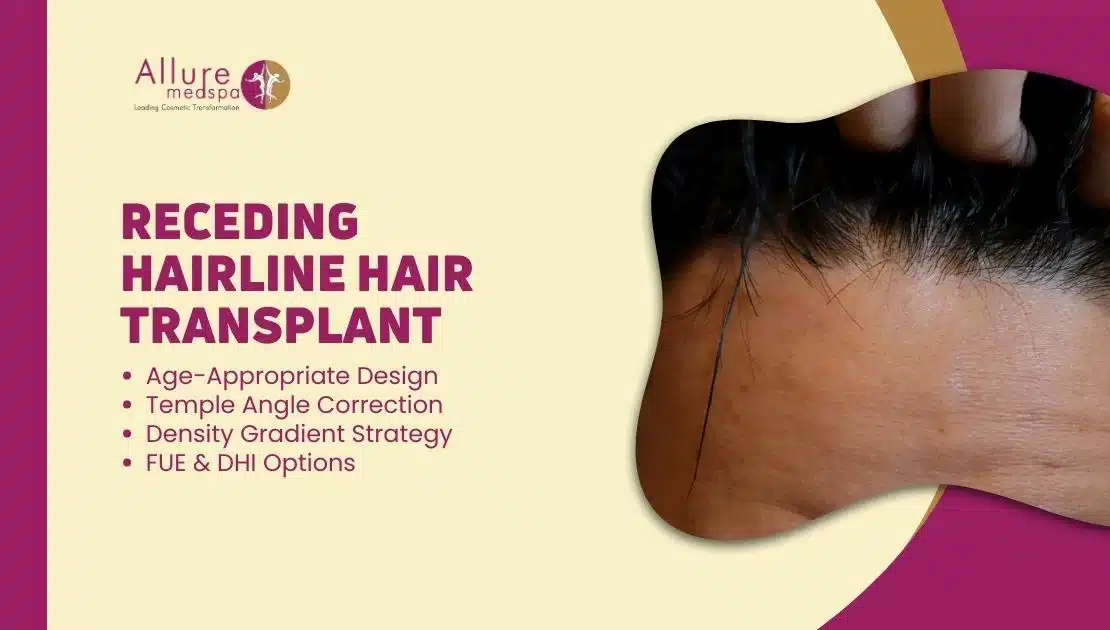
A receding hairline can make the face look older and the forehead look wider—even if your overall hair density is still decent. The good news: a hairline transplant in Mumbai can restore the front hairline and temples naturally, but only when it’s designed to match your age, face shape, and likely future hair loss.
At Allure Medspa (Mumbai), the approach is planning-first: we start with hairline position, temple angles, and a density strategy—then choose the right execution method (FUE/DHI) to deliver safe, believable results.
Quick Links: Hair Transplant Cost | Hair Loss Treatment | Hair Transplant Recovery Timeline
Want faster, denser hair growth after your transplant?
Hair Transplant Surgery Before and After Images
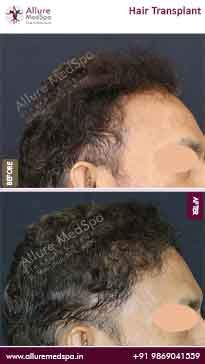
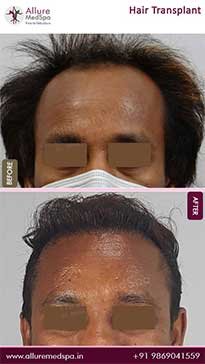
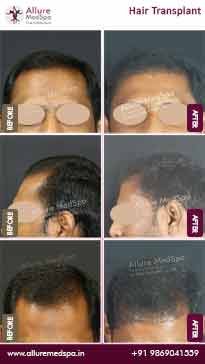
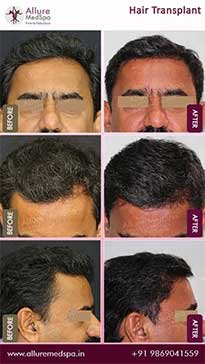
Hair Transplant Surgery Testimonials: Fine To Fabulous Journeys

Awarded by Google.com
Rating: 4.7
Reviews: 485+

Awarded by WhatClinic.com
Rating: 4.8
Reviews: 119+

Awarded by Realself
Rating: 4.9
Reviews:453+

Awarded by Facebook
Rating: 4.6
Reviews:105+
Dr Milan Doshi and his staff are very professional and committed as the centre is highly equipped with advanced technology. I had closed rhinoplasty 4 months back and I’m seeing the results as to how it becomes successful.
Deepika Shetty
The doctor explained everything clearly and the surgery was smooth. Recovery was faster than I expected and the team was very supportive.
Rahul Mehta
Very natural results and excellent staff. From consultation to follow-up, the experience was outstanding and boosted my confidence.
Sneha Kapoor
Who is the right candidate for a receding hairline hair transplant?
You’re usually a good candidate for a receding hairline hair transplant in Mumbai if your hairline recession is stable (or slowly progressing) and your donor area is strong. Even if hair loss is still progressing, surgery may still be possible—but it must be planned long-term, sometimes in stages, so you don’t end up with a “strong front” and thinning behind it later.
Good candidates usually have:
- Front/temple recession (commonly Norwood II–IV)
- Good donor density and decent hair thickness
- Realistic expectations about density and timeline
- Willingness to follow aftercare and protect native hair when appropriate
You may need postponement or deeper evaluation if you have:
- Uncontrolled scalp inflammation/infection
- Very unstable hair loss without a stabilization plan
- Unrealistic goals (example: a very low teenage hairline)
Why does a receding hairline change the face so much?
Because your hairline controls facial framing—especially the temple shadows. Even small temple recession can change proportion, making the forehead look broader and the face look older. A good hairline transplant Mumbai plan focuses on restoring balance, not just placing hair.
What does a “natural” hairline actually mean?
A natural hairline is soft, slightly irregular, and built with a density gradient—lighter at the very front and denser behind it. The most obvious “transplant look” comes from a sharp, straight, densely packed edge.
A natural plan typically includes:
- Controlled irregularity (micro + macro) so it doesn’t look drawn-on
- Single-hair grafts at the leading edge
- Gradual density increase behind the hairline
- Correct angle + direction at the temples (this is where poor work shows)
How many grafts are typically needed for a receding hairline?
Grafts depend on your recession pattern, forehead size, temple loss, hair thickness, and whether the mid-scalp needs support to avoid the “front island” effect. Two people with similar recession can still require different graft plans because hair caliber, donor strength, and scalp characteristics vary.
A proper plan should cover:
- Hairline placement that matches your age and face
- Temple strategy (subtle vs stronger closure)
- Density distribution (front edge vs behind)
- Donor safety so the back doesn’t look overharvested later
Which technique is better for a hairline transplant: FUE or DHI?
Both FUE and DHI can deliver excellent outcomes when planning and execution are strong. In real life, the technique matters less than: design accuracy, graft handling, sorting (single-hair units for the front), and angle control.
- FUE is widely used for hairline restoration and works well for most patients.
- DHI/implanter placement can help with controlled placement in some hands, but it’s not automatically “better.”
What is the step-by-step process on surgery day?
A hairline transplant is a design-driven procedure—your blueprint matters as much as the graft count. On surgery day, the process typically includes:
- Hairline design & marking (this decides how natural it will look)
- Donor area prep + local anesthesia
- Graft extraction (commonly FUE, depending on plan)
- Graft sorting (single-hair grafts for the edge, multi-hair units behind for density)
- Recipient site creation & implantation with correct angle, direction, and density gradient
- Aftercare instructions + follow-up plan (wash protocol, meds, activity limits, check-ups)
Quality markers you should expect:
- Surgeon involvement in planning + critical steps
- Careful graft hydration and minimal out-of-body time
- Strong angle control at the hairline + temples
- Safe extraction that preserves donor look long-term
Is a receding hairline transplant painful?
Most patients tolerate the procedure well. Discomfort is usually highest during local anesthesia injections, and after that it becomes manageable. Post-procedure soreness or tightness can occur, but proper technique, medications, and aftercare typically keep it controlled.
What is recovery like after a hairline transplant?
Early recovery is usually smooth, but because the hairline is front-facing, you should plan your social/work calendar.
Common early-phase experiences include:
- Mild forehead swelling in some patients (early days)
- Scabbing around implanted grafts that sheds gradually
- Temporary redness (varies by skin type)
When will I see growth—and what is shock loss?
Hair transplant results follow a predictable pattern:
- Early weeks: healing + scab shedding
- First months: shedding of transplanted hair may happen (often expected)
- Later months: gradual regrowth and maturation
Shock loss is temporary shedding of nearby native hair in some patients. It’s usually reversible, but it should be discussed clearly before surgery—especially when native hair behind the hairline is already weak.
Do I need minoxidil or finasteride after a hairline transplant?
Sometimes, yes—especially to protect existing hair behind the transplanted zone. Without a protection strategy, you can end up with a strong hairline and thinning behind it over time, which looks unbalanced.
Whether medication is recommended depends on:
- Your loss pattern and family history
- Degree of miniaturization behind the hairline
- Long-term stability and risk of progression
Will PRP help after a hairline transplant?
PRP can be a supportive add-on in selected patients—especially if native hair quality is weak or there is early thinning around the transplant zone. However, PRP is not a replacement for surgery and it cannot “create” follicles where none exist.
Related Link:
– PRP After Hair Transplant
What are realistic results for a receding hairline transplant?
The most realistic goal is a natural-looking, age-appropriate hairline that improves facial framing and looks believable in all lighting and angles. The aim is not a “wall of hair,” but a balanced hairline that still makes sense if hair loss progresses in the future.
Results vary based on donor quality, hair thickness, scalp characteristics, healing response, and ongoing native hair loss.
How much does a receding hairline hair transplant cost in Mumbai?
Cost depends on graft requirement, technique (FUE/DHI), surgeon involvement, OT and hygiene standards, graft handling protocols, and the follow-up system. Be cautious of “cheap deals”—hairline work is detail-sensitive, and poor planning can lead to unnatural results or donor damage that is hard to fix later.
What should you ask in consultation before booking?
A consultation should give you clarity on planning—not just pricing. You should leave knowing:
- Where your hairline should sit for your face + age
- Whether temples should be subtle or stronger
- The graft plan and donor limits
- What happens if hair loss progresses behind the hairline
- Who performs the critical steps
- Aftercare structure, check-ups, and support
Final Take — What Is YOUR Maximum Density?
Your personalised density depends on:
- Donor area strength
- Hair thickness
- Curl pattern
- Scalp vascularity
- Baldness grade
- Age & genetics
- Lifestyle factors
- Surgical technique
Absolute Truth:
Density is not a number.
It is a personalised equation.
My goal is always the same:
Create the densest natural result your scalp can safely support — for life.