
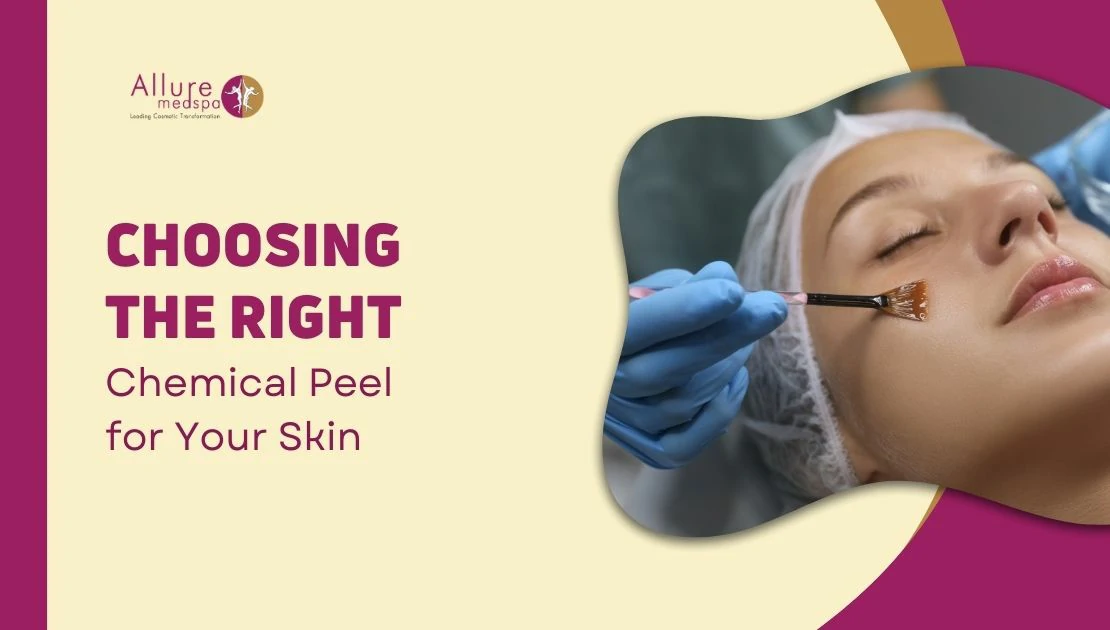
Many patients come to me confused about chemical peels because they hear terms like glycolic peel, salicylic peel, lactic peel, TCA peel, and pigmentation peel.
Some hesitate because they worry about irritation, peeling, downtime, or choosing the wrong treatment.
In my clinical experience, the safest results come from matching the peel to your skin type, concern, and lifestyle—not just selecting the most popular peel.
This guide will help you understand how I choose the right chemical peel safely and effectively at Allure Medspa, Mumbai.
How do I know which chemical peel is right for my skin?
The right chemical peel depends on your skin type, concern, sensitivity, pigmentation risk, and how much downtime you can manage.
- I first examine your skin closely before recommending any peel.
- The same peel does not suit every patient.
- Oily, acne-prone skin may need a different peel than dry, dull, or pigmented skin.
- Indian skin needs careful planning because pigmentation risk is higher if peels are done too aggressively.
- I also check:
- Active acne
- Dark spots
- Melasma tendency
- Skin sensitivity
- Past peel or laser history
- Current creams or medicines
- Sun exposure routine
For a detailed evaluation, I usually guide patients through our chemical peel treatment in Mumbai consultation so the peel is selected safely.
Dr. Milan Doshi’s Tip:
In my clinical experience, the best chemical peel is not the strongest one. It is the one your skin can tolerate safely and respond to naturally.
Which chemical peel is best for acne-prone oily skin?
Salicylic acid peel is commonly preferred for oily, acne-prone skin because it helps unclog pores and reduce excess oil.
- Salicylic peel works well for:
- Oily skin
- Blackheads
- Whiteheads
- Mild acne congestion
- Enlarged pores
- Recurrent breakouts
- It penetrates oily pores better than many superficial peels.
- It may help reduce acne-related congestion when used in a controlled treatment plan.
- In active acne, I do not rely only on peels.
- I may combine peels with:
- Medical acne treatment
- Oil-control skincare
- Sunscreen
- Scar prevention planning
- Follow-up sessions
Patients with acne marks may also benefit from related treatments like acne scar treatment in Mumbai once active acne is controlled.
Dr. Milan Doshi’s Tip:
In my OPD, I often see patients using harsh home peels for acne. Acne skin needs control, not over-drying.
Which chemical peel is better for pigmentation and dark spots?
Pigmentation peels are chosen based on the depth, cause, and stability of dark spots, not just skin colour.
- Pigmentation may be due to:
- Sun damage
- Post-acne marks
- Melasma
- Hormonal changes
- Tanning
- Post-inflammatory pigmentation
- For superficial pigmentation, I may consider:
- Glycolic peel
- Mandelic peel
- Lactic peel
- Combination brightening peels
- Medical depigmentation support
- For melasma-prone skin, I avoid aggressive peeling.
- Pigmentation treatment usually needs:
- Strict sunscreen
- Gentle home care
- Controlled peel strength
- Multiple sittings
- Maintenance plan
For deeper or resistant pigmentation, I may discuss hyperpigmentation treatment options beyond chemical peels.
Dr. Milan Doshi’s Tip:
In my clinical experience, pigmentation worsens when patients chase fast peeling. Safe brightening is gradual and planned.
Is glycolic peel good for dull skin and uneven texture?
Glycolic peel can improve dullness, mild uneven texture, tanning, and early superficial pigmentation when used correctly.
- Glycolic peel is often selected for:
- Dull skin
- Uneven tone
- Mild tanning
- Rough texture
- Early pigmentation
- Lack of glow
- It exfoliates superficial dead skin cells.
- It may help the skin look fresher over a series of sessions.
- The strength and contact time must be adjusted carefully.
- Sensitive skin may need a gentler peel first.
- I usually do not advise strong glycolic peels close to major events.
Patients looking for overall skin improvement may also explore our skin rejuvenation treatments in Mumbai after proper skin analysis.
Dr. Milan Doshi’s Tip:
A glow peel should never leave your skin irritated for days. Controlled improvement is safer than aggressive exfoliation.
Is lactic acid peel suitable for sensitive or dry skin?
Lactic acid peel is often gentler and may suit dry, sensitive, or mildly dull skin when planned carefully.
- Lactic peel may be considered for:
- Dry skin
- Sensitive skin
- Mild dullness
- Uneven tone
- Early pigmentation
- Skin that cannot tolerate stronger peels
- It is generally milder than many stronger exfoliating peels.
- It can help improve smoothness and brightness gradually.
- I still check for:
- Skin barrier damage
- Redness
- Recent steroid cream use
- Recent salon treatments
- Active irritation
- If the skin barrier is weak, I may delay the peel and first repair the skin.
Dr. Milan Doshi’s Tip:
In my clinical experience, sensitive skin should be prepared before peeling. A calm skin barrier gives better results.
When should I choose a TCA peel?
TCA peel may be considered for selected pigmentation, texture, or scars, but it needs expert planning and downtime awareness.
- TCA peel is stronger than many superficial peels.
- It may be used for selected cases such as:
- Certain pigmentation concerns
- Textural irregularity
- Superficial acne scars
- Localized skin refinement
- It is not suitable for every skin type.
- Indian skin needs extra caution with TCA because aggressive use may cause pigmentation.
- Recovery may include:
- Visible peeling
- Temporary dryness
- Mild redness
- Strict sun protection
- Careful aftercare
For acne scar concerns, I may combine or compare peels with laser skin resurfacing or acne scar correction depending on scar depth.
Dr. Milan Doshi’s Tip:
TCA peel should not be treated like a routine glow peel. It must be selected only after examining skin depth and risk.
Can chemical peels help with acne scars?
Chemical peels may improve mild marks and superficial texture, but deeper acne scars often need combination treatment.
- Peels can help with:
- Post-acne marks
- Mild roughness
- Superficial pigmentation
- Skin brightness
- Mild texture improvement
- Peels may not fully correct:
- Deep pits
- Ice-pick scars
- Boxcar scars
- Rolling scars
- Severe uneven skin surface
- For deeper scars, I may consider:
- Fractional CO2 laser
- Microneedling radiofrequency
- Subcision
- PRP support
- Combination scar revision plan
You can learn more through our acne scar treatment page if scars are your main concern.
Dr. Milan Doshi’s Tip:
In my OPD, many patients call acne marks “scars.” Correct diagnosis decides whether peel alone is enough.
How many chemical peel sessions will I need?
Most patients need multiple chemical peel sessions because skin improvement is gradual and depends on the concern.
- The number of sessions depends on:
- Skin concern
- Peel type
- Skin sensitivity
- Pigmentation depth
- Acne activity
- Aftercare discipline
- Commonly, patients may need a series of sessions spaced apart.
- Glow and dullness may improve earlier.
- Pigmentation, acne marks, and texture usually take longer.
- Maintenance may be needed for oily skin, pigmentation, or melasma-prone skin.
- Results are better when combined with:
- Sunscreen
- Correct cleanser
- Barrier repair
- Medical creams if required
- Lifestyle guidance
For personalized planning, I recommend meeting a qualified cosmetic surgeon or dermatologist at Allure Medspa, Mumbai.
Dr. Milan Doshi’s Tip:
One peel can refresh the skin, but a planned series gives more predictable improvement.
What should I avoid before and after a chemical peel?
Avoid harsh scrubs, active creams, waxing, threading irritation, and sun exposure before and after a chemical peel.
- Before a peel, I usually ask patients to avoid:
- Scrubbing
- Bleaching
- Waxing
- Strong exfoliating creams
- Unsupervised retinol use
- Salon facials close to treatment
- After a peel, follow:
- Gentle cleansing
- Moisturizer
- Sunscreen
- No picking or scratching
- No harsh actives until advised
- Avoid direct sun exposure
- Peeling may be mild or visible depending on the peel type.
- More peeling does not always mean better results.
- Aftercare is especially important for patients in Mumbai because heat, sweating, and sun exposure can affect healing.
Dr. Milan Doshi’s Tip:
In my clinical experience, aftercare decides the quality of peel results. Sunscreen is not optional after pigmentation peels.
Are chemical peels safe for Indian skin?
Chemical peels can be safe for Indian skin when the peel type, strength, timing, and aftercare are medically supervised.
- Indian skin can respond beautifully to peels when treated carefully.
- The main concern is avoiding:
- Over-exfoliation
- Irritation
- Pigmentation flare
- Wrong peel strength
- Poor sun protection
- I prefer a conservative and staged approach.
- Skin preparation may be needed before pigmentation peels.
- I assess Fitzpatrick skin type, sensitivity, and pigmentation history.
- Patients from Andheri, Goregaon East, Goregaon West, and nearby Mumbai areas often prefer peels because they are non-surgical and can be planned with minimal downtime.
You may also read more about Dr. Milan Doshi’s cosmetic surgery and aesthetic expertise before choosing any skin procedure.
Dr. Milan Doshi’s Tip:
Indian skin should not be rushed into aggressive peeling. Safety, patience, and correct selection give the most natural-looking glow.
How do I choose between chemical peel, laser, or facial treatment?
Choose based on diagnosis: peels improve surface concerns, lasers treat deeper texture, and facials mainly refresh the skin.
| Treatment Option | Best For | What It Mainly Improves | Downtime | When I Usually Recommend It |
|---|---|---|---|---|
| Chemical Peel | Dullness, tanning, mild pigmentation, oily skin, post-acne marks | Surface-level exfoliation, skin brightness, mild pigmentation, oil congestion | Usually minimal to mild | When the concern is mostly on the skin surface and the patient wants gradual improvement |
| Laser Treatment | Deeper scars, resistant pigmentation, texture irregularity, collagen stimulation | Skin resurfacing, deeper texture correction, scar improvement, collagen remodeling | Mild to moderate, depending on laser type | When peels are not enough or the concern is deeper than the surface layer |
| Facial Treatment | Temporary hydration, mild freshness, maintenance glow, relaxation | Hydration, freshness, skin softness, short-term glow | Minimal | When the skin needs maintenance, hydration, or pre-event freshness rather than correction |
How I decide the right option
In my clinical experience, I do not choose a treatment based on trend. I choose based on:
- Skin diagnosis
- Expected result
- Downtime comfort
- Safety profile
- Long-term maintenance
- Pigmentation risk
- Skin sensitivity
- Depth of the concern
For advanced concerns, I may suggest related options like Fractional CO2 laser treatment or pigmentation-focused skin programs.
Dr. Milan Doshi’s Tip:
The right treatment is not always the newest treatment. It is the one that solves your exact skin concern safely.
FAQs
Q1. What do patients usually ask me before choosing a chemical peel?
Ans. Patients usually ask about safety, downtime, peeling, pain, results, and whether the peel suits their skin type.
Q2. Will my skin peel visibly after a chemical peel?
Ans. Not always. Some peels cause mild flaking, while others may cause visible peeling. The amount of peeling depends on peel type and strength.
Q3. Is chemical peel painful?
Ans. Most superficial peels cause mild tingling or warmth. Stronger peels may feel more intense but are done with careful monitoring.
Q4. Can I do a chemical peel before an event?
Ans. For an event, I prefer gentle glow peels well in advance. Strong peels should not be done too close to important occasions.
Q5. Can chemical peels remove pigmentation permanently?
Ans. Peels can reduce pigmentation, but maintenance is important. Sun exposure, hormones, acne, and melasma tendency can bring pigmentation back.
Q6. Can I apply makeup after a peel?
Ans. It depends on the peel depth and skin response. I usually advise keeping the skin calm and avoiding makeup for the recommended period.
Q7. Are home chemical peels safe?
Ans. I do not recommend unsupervised home peels, especially for Indian skin. Wrong strength or timing can cause irritation and pigmentation.
Q8. Can men also do chemical peels?
Ans. Yes. Many men choose peels for oily skin, acne marks, tanning, and dullness. The peel is selected based on skin condition, not gender.
When should I consult a specialist for chemical peel selection?
Consult a specialist if you have pigmentation, acne, sensitive skin, melasma, scars, or previous reactions to skincare.
Choosing the right chemical peel is not about guessing from online trends. It is about understanding your skin, identifying the real concern, and selecting a safe treatment plan.
In my clinical experience, chemical peels can improve dullness, acne marks, oily skin, pigmentation, and texture when they are done with the correct diagnosis and aftercare. The condition is common, safe solutions exist, and early expert evaluation helps avoid irritation or unrealistic expectations.
At Allure Medspa, Mumbai, I guide patients from Andheri, Goregaon West, Goregaon East, and across Mumbai with a safety-first, evidence-based approach focused on natural-looking skin improvement and confidence restoration.
You can schedule a consultation with Dr. Milan Doshi at Allure Medspa, Mumbai to understand which chemical peel is right for your skin.