
Non-Surgical Rhinoplasty in Mumbai: What Fillers, Botox and Threads Can and Cannot Do

Indian Board Certified Plastic Surgeon
M.CH, MS, ISAPS Mentor
16000+ Cosmetic Surgeries
1500+ Rhinoplasties
Non-surgical rhinoplasty uses hyaluronic acid filler, botulinum toxin or threads to camouflage a small hump or low bridge in 30–45 minutes, lasting 9–18 months. It cannot make the nose smaller. You want a straighter, more balanced nose — not one that looks larger or obviously treated; that distinction matters, because injectables camouflage selected contour irregularities without surgery. It may soften the appearance of a small hump or add temporary bridge height. It cannot make the nose smaller, narrow the nasal bones, rebuild weak cartilage, or improve breathing. It is a non-surgical option within the wider rhinoplasty surgery family of procedures. The nose is also one of the highest-risk areas for filler injection. At Allure Medspa, Andheri West, Dr. Milan Doshi first assesses whether an injectable is appropriate — or whether surgery, observation, or no treatment would serve you better.
Non-Surgical Rhinoplasty Before & After Images
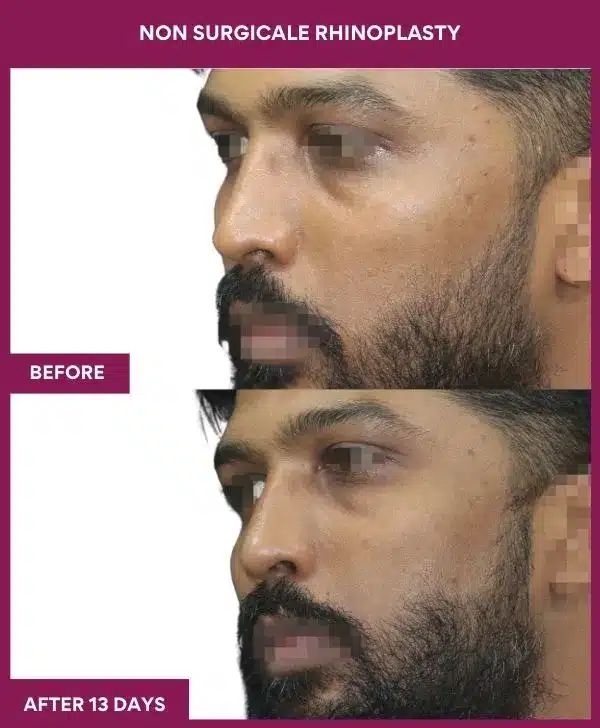
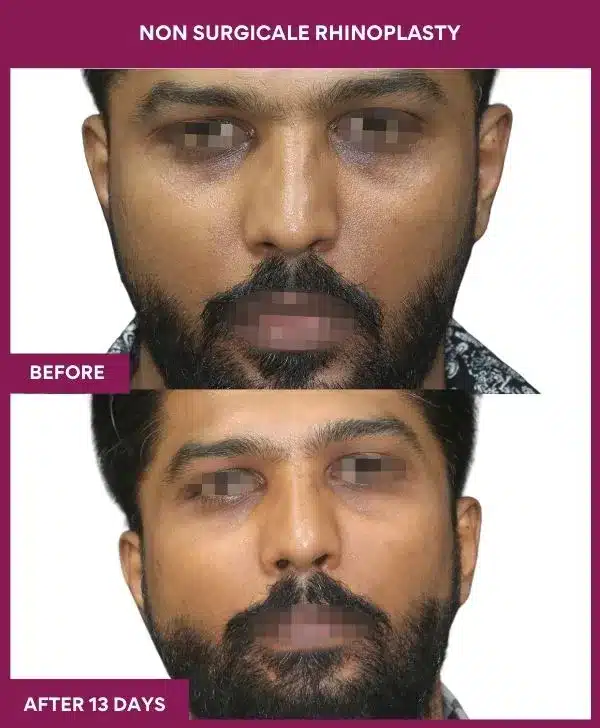
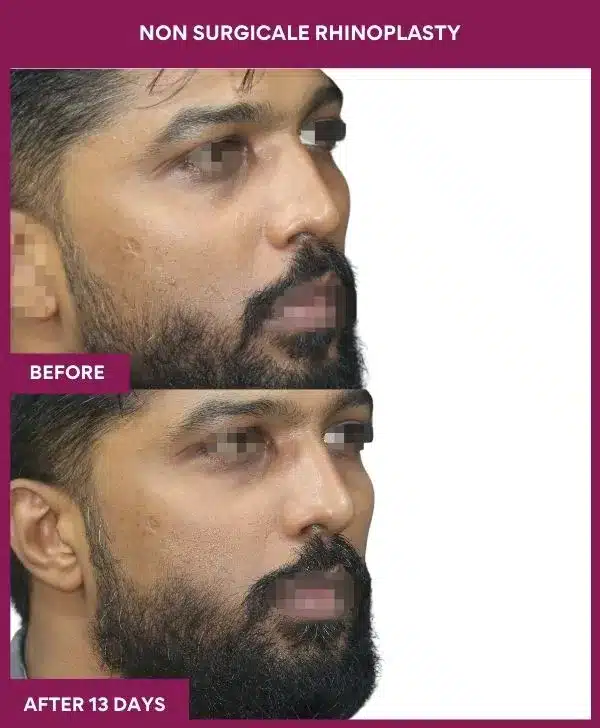
“New Look in 15 Minutes? See if Non-Surgical Rhinoplasty is right for you”
Non-Surgical Rhinoplasty Testimonials: Fine To Fabulous Journeys

Awarded by Google.com
Rating: 4.7
Reviews: 485+

Awarded by WhatClinic.com
Rating: 4.8
Reviews: 119+

Awarded by Realself
Rating: 4.9
Reviews:453+

Awarded by Facebook
Rating: 4.6
Reviews:105+
Dr Milan Doshi and his staff are very professional and committed as the centre is highly equipped with advanced technology. I had closed rhinoplasty 4 months back and I’m seeing the results as to how it becomes successful.
Deepika Shetty
The doctor explained everything clearly and the surgery was smooth. Recovery was faster than I expected and the team was very supportive.
Rahul Mehta
Very natural results and excellent staff. From consultation to follow-up, the experience was outstanding and boosted my confidence.
Sneha Kapoor
“New Look in 15 Minutes? See if Non-Surgical Rhinoplasty is right for you”
Video: Facelift Surgery Explained By Dr. Milan Doshi
Dr. Milan Doshi explains how a natural facelift is planned — technique, safety and realistic results.
Is Non-Surgical Rhinoplasty Right For Me?
(4 quick questions)
Quick Facts About Facelift Surgery
SESSION TIME
30–45 minutes
ANESTHESIA
Local
SESSIONS
1-2 per year
RESULTS SHOW
4–5 days
DOWNTIME
1–3 days
RESULTS LAST
9–18 months
SIDE-EFFECT RATE
Under 2–3%
COST
₹25,000 – ₹60,000
What Is The Cost Of Non-Surgical Rhinoplasty In Mumbai?
Non-surgical rhinoplasty at Allure Medspa is guided at ₹25,000–₹60,000 + 5% GST, confirmed after consultation by product, quantity and complexity.
| Cost factor | Why it matters |
|---|---|
| Product selected | Brand, formulation, and authorised source affect cost |
| Quantity required | Treatment should use the amount the anatomy requires, not a pre-decided volume |
| Treatment type | HA filler and botulinum toxin are priced separately |
| Previous procedures | Post-rhinoplasty or previously injected noses need more detailed assessment |
| Review or top-up | Any additional treatment is decided only after reassessment |
| Treatment | Estimated cost (₹) |
|---|---|
| HA filler — small hump / low bridge / minor dip | 25,000 – 60,000 by volume and product |
| Botulinum toxin — dynamic tip droop / nostril flare | Quoted at consultation 🩺 |
| Hyaluronidase dissolving (elective) | Quoted at consultation 🩺 |
| Surgical rhinoplasty (for comparison) | 1,00,000 – 3,50,000 → Rhinoplasty Cost |
- Included: consultation, product, procedure, and review policy
- Not included: repeat maintenance, additional products, or unrelated treatment
- +5% GST · confirmed after in-person examination · EMI options on our payment process page
- For a wider comparison, see rhinoplasty cost in Mumbai → Rhinoplasty Cost in Mumbai
Get your exact quote & surgery plan
Share your details — our team responds within working hours with cost, EMI options and next steps.
Most Common Question People Ask
Q1. Can non-surgical rhinoplasty make my nose smaller?
Ans. No. Filler adds volume. It may make a small hump look less obvious by smoothing the profile line, but reducing nasal size requires surgery.
Q2. Is non-surgical rhinoplasty permanent?
Ans. No. HA filler and botulinum toxin are temporary. Duration varies by product, dose, anatomy, and metabolism.
Q3. Is a liquid nose job safe?
Ans. It is usually tolerated without serious problems, but the nose is a high-risk injection area. Vascular occlusion can cause skin loss and, rarely, visual or neurological complications. Careful selection, qualified treatment, and emergency readiness matter.
Q4. Can nose filler be dissolved?
Ans. HA filler can be dissolved with hyaluronidase. Dissolution may not be complete or immediate, and it does not guarantee recovery from vascular or visual complications.
Q5. Does nose filler improve breathing?
Ans. No. It does not open the nasal airway. Breathing difficulty requires functional assessment.
Q6. Is nose filler painful?
Ans. Mild discomfort, tenderness, or pressure may occur despite topical anaesthesia. Severe or escalating pain is not expected and requires immediate assessment.
Q7. What is the difference between nose filler and nose Botox?
Ans. Filler adds volume to alter contour. Botulinum toxin relaxes selected muscles to change movement, such as a tip that drops only while smiling.

Why Choose Dr. Milan Doshi?
Dr. Milan Doshi, MCh, MS — Indian board-certified plastic surgeon with 27+ years and 1,500+ rhinoplasties, trusted by patients from 70+ countries for choosing the smallest safe intervention: filler, toxin, surgery or none. Consults and treats at Andheri West; surgeries at the NABH-accredited surgical centre, Goregaon West.
Dr Doshi Note: “My philosophy is to educate the patient first. Before any non-surgical nose treatment, the patient should understand the advantages, limitations, risks, and reality of their own nose. If filler or toxin can give a natural and safe improvement, we plan it carefully. If it is not suitable, I explain honestly. The right treatment begins when the patient understands and accepts what is safely possible.”
The Complete Guide About Non-Surgical Rhinoplasty
What Is Non-Surgical Rhinoplasty (Liquid Rhinoplasty)?
Non-surgical rhinoplasty reshapes the visible nasal contour with HA filler — adding volume to camouflage a hump or raise a low bridge, not removing.
- It changes how the nose looks by adding carefully placed volume; it does not remove tissue or correct the underlying framework
- Example: filler placed above and below a small dorsal hump may create a straighter profile line — the hump remains; the surrounding contour changes
- It can work well in a carefully selected nose, but it is the wrong approach when adding volume would make an already prominent nose look heavier
- Botulinum toxin has a narrower role — it may soften movement-related concerns, such as a tip that drops only while smiling
- Threads are marketed for nasal lifting, but the evidence supporting them is more limited and their complications require careful consideration
Synonyms for non-surgical rhinoplasty
Liquid rhinoplasty, non-surgical nose job, nose filler, 15-minute nose job and nose Botox all describe the same injectable camouflage treatment.
- Patient terms: liquid rhinoplasty, non-surgical nose job, nose filler, 15-minute nose job, filler nose job, nose Botox
- Medical terms: injectable rhinoplasty, non-surgical nasal contouring, hyaluronic acid dorsal augmentation, nasal filler camouflage, botulinum toxin for depressor septi nasi
| Non-surgical rhinoplasty | Surgical rhinoplasty |
|---|---|
| Adds volume to camouflage; 30–45 minutes; temporary (9–18 months); cannot reduce, narrow, support or open the airway | Reduces, repositions and supports; permanent; the honest comparison for structural change → Rhinoplasty Surgery |
What Can Non-Surgical Rhinoplasty Treat — And What Needs Surgery?
Filler camouflages a small hump, low bridge or minor dip; toxin softens a smiling tip droop; size, width, support and breathing need surgery.
| Concern | Role of injectables | More appropriate option when needed |
|---|---|---|
| Small dorsal hump | HA filler may camouflage it | Dorsal hump / reduction rhinoplasty if actual reduction is required → Reduction Rhinoplasty |
| Low or flat bridge | HA filler may add temporary height | Augmentation rhinoplasty for structural augmentation → Augmentation Rhinoplasty |
| Minor contour dip | HA filler may smooth the transition | Surgical assessment if structural or post-traumatic |
| Tip drops only on smiling | Botulinum toxin may reduce muscle pull | Drooping tip correction for a structural droop → Drooping Tip Correction |
| Nostril flare on animation | Botulinum toxin may give subtle reduction | Wide nostril correction for true base width → Wide Nostril Correction |
| Large or prominent nose | Not suitable; filler adds volume | Reduction rhinoplasty → Reduction Rhinoplasty |
| Wide nasal bones | Cannot narrow them | Osteotomy / structural rhinoplasty assessment → Broad Nose Correction |
| Crooked or deviated nose | May disguise a very minor difference only | Crooked nose correction → Crooked Nose Correction |
| Breathing difficulty | No functional benefit | Functional rhinoplasty → Functional Rhinoplasty |
- The practical rule: filler camouflages; surgery corrects structure
- Where structure is the real issue, the owner pages above carry the detail
Which nose shapes respond best to filler — and which do not?
Filler suits a small hump with a well-projected tip, a low radix or a minor dip; it suits a large, wide, crooked or collapsed nose poorly.
| Nose pattern | Filler response | Why |
|---|---|---|
| Small dorsal hump, tip already well projected | Good | Filler above and below the hump straightens the profile line without lengthening the nose |
| Low radix (flat area between the eyes) | Good | A small volume raises the start of the bridge and improves the profile angle |
| Minor dip or step after previous surgery | Good — specialist only | Small, precise camouflage; blood supply is altered, so planning is cautious |
| Tip that drops when smiling | Fair — toxin, not filler | Botulinum toxin to the depressor septi nasi reduces the pull-down; filler cannot lift the tip |
| Hump with a drooping, under-projected tip | Limited | Filler would need to add bridge height and tip projection — the nose looks larger from the side |
| Large or long nose | Poor | Only subtraction helps; filler enlarges — see reduction rhinoplasty → Reduction Rhinoplasty |
| Wide bony bridge or wide nostrils | Poor | Width is corrected by osteotomy or alar base reduction, not by adding volume |
| Crooked, deviated or collapsed nose | Poor | Deviation and collapse need structural repositioning and grafts; filler camouflage is unreliable here |
Can nose filler make my nose look smaller?
No — filler only adds volume; a nose can look straighter and more balanced, which some patients read as “smaller”, but it is never physically reduced.
- The illusion comes from straightening the profile line: when a hump no longer breaks the line, the eye reads a neater, more balanced nose
- Measured on the photograph, bridge height and nasal length are the same or slightly greater after filler
- A prominent nose treated to hide a hump can look bigger — the reason Dr. Doshi declines filler in this pattern
- Patients who want a smaller nose are candidates for surgical reduction, where bone and cartilage are actually removed → Reduction Rhinoplasty
What Are The Benefits Of A Non-Surgical Nose Job?
A controlled, temporary contour change in 30–45 minutes without incisions or general anaesthesia — immediate, adjustable and, with HA, dissolvable.
| Benefit | What it means |
|---|---|
| Immediate visual feedback | HA filler changes the contour during the appointment |
| Limited interruption | Many patients resume routine activity quickly, although visible swelling or bruising is possible |
| No general anaesthesia | Treatment is usually performed with topical anaesthesia |
| Adjustable treatment | Small volumes can be placed and reassessed rather than pursuing a large change at once |
| Temporary result | May suit someone who is not ready for a structural or lasting change |
| HA can be dissolved | Hyaluronidase provides an important management option for HA filler, although it does not remove treatment risk or assure full reversal |
- Its value lies in precision and restraint — not in trying to imitate what surgery does
- These advantages disappear when filler is used for the wrong nose; speed is useful only after sound patient selection
Am I A Suitable Candidate — And When Is Surgery The More Logical Discussion?
You may be suitable if the concern is minor, the goal is camouflage and a temporary result is acceptable; size, width or breathing need surgery.
| You may be suitable if you have | You may not be suitable — or may need specialist assessment — if you have |
|---|---|
| A small dorsal hump you want camouflaged, not removed | A large nose you want reduced, a broad bony bridge, or a wide nostril base |
| A low bridge where temporary augmentation is acceptable | Significant deviation, collapse, or weak cartilage support |
| A minor contour dip or selected post-treatment irregularity | Nasal obstruction or breathing difficulty |
| A tip that drops only during smiling and may respond to botulinum toxin | Previous rhinoplasty, which may alter tissue planes and blood supply |
| Realistic expectations about subtlety, duration, and risk | Previous nasal filler or threads of uncertain product, amount, or date |
| No active infection or inflammation in the treatment area | Active skin infection near the nose, or an expectation of a permanent, surgery-like result |
| Pregnancy, breastfeeding, medical conditions, allergies, and medications — must be discussed during consultation |
Who should wait, and who should not have nose filler at all?
Wait if you have an active skin infection, a cold sore, a recent dental procedure or an upcoming surgery; avoid it entirely if the goal is reduction.
| Situation | Advice |
|---|---|
| Active acne, cold sore or skin infection near the nose | Postpone until fully healed — infection can track along the injection path |
| Dental treatment in the past 2 weeks or planned in the next 2 weeks | Reschedule; dental bacteraemia is linked to biofilm around filler |
| Pregnancy or breastfeeding | Defer; HA filler and botulinum toxin are not tested in these groups |
| Blood thinners, high-dose fish oil or aspirin | Discuss stopping only with the prescribing doctor; otherwise expect more bruising |
| Autoimmune disease or recent vaccination | Case-by-case assessment; inflammatory nodules are more likely in some patients |
| Rhinoplasty planned within 6 months | Avoid filler — it obscures the anatomy the surgeon must see; dissolve any existing filler 4–6 weeks before surgery |
| Previous filler of unknown product or date | Imaging or dissolving may be advised before adding more |
| Wants a smaller, narrower or straighter nose | Not a filler patient at all — see the surgical pages |
What Are The Limitations Of Non-Surgical Rhinoplasty?
Filler is temporary, additive and cosmetic: it cannot reduce, narrow, straighten, support or open the airway, and it needs repeat treatment.
| Limitation | Why it matters |
|---|---|
| It adds volume | A prominent nose can look larger if filler is used simply to hide a hump |
| It camouflages rather than removes | The underlying bump or deviation remains |
| It cannot narrow the nose | Bone width and nostril width need structural assessment |
| It does not strengthen support | Collapse, saddle deformity, and weak cartilage are not corrected |
| It does not improve breathing | Airway concerns require a functional examination |
| It needs maintenance | Repeat treatment adds cumulative cost and repeated exposure to injection risk |
| It may affect future surgery | Previous filler, inflammation, or scarring must be disclosed to the operating surgeon |
- If the desired change requires subtraction, repositioning, or support, adding filler is not a clever shortcut — it is the wrong tool
Why Is A Consultation Essential Before Nose Filler?
The consultation decides whether the nose should be injected at all — assessing concern, anatomy, vascular risk, treatment history and alternatives.
| What Dr. Doshi assesses | Detail |
|---|---|
| Your actual concern | Contour, size, width, movement, support, or breathing |
| Nasal anatomy | Skin thickness, projection, symmetry, structural stability |
| Vascular and tissue risk | Especially after previous surgery, filler, or threads |
| Treatment history | Product, quantity, date, and any previous complication |
| The expected change and the alternatives | Injectable, surgery, staged treatment, observation, or no treatment |
| Emergency readiness | Hyaluronidase on site; protocol for vascular compromise |
What should I bring — and can I start online?
Bring your medical history, medication list and details of every previous nasal procedure; an online consultation can start the assessment.
- Your medical history, medication and allergy list, and details of every previous nasal procedure
- Clear photographs if the concern appears differently in photographs and mirrors
- A reference image may help explain a preference, but another person’s nose is not a surgical blueprint
- An online consultation may help an outstation patient decide whether to travel; final injectable suitability requires an in-person examination
Which questions should I ask any injector before nose filler?
Ask who injects, which product, how much, how vessels are avoided, whether hyaluronidase is in the room, and the plan if something goes wrong.
- Who will inject — a plastic surgeon, a doctor or a technician? Nose filler is a medical procedure with a vascular emergency pathway; the injector should be able to manage it
- Which product and how much? A CE/FDA-cleared HA gel suited to the nose, typically well under 1 ml
- Needle or cannula, and why? Both are used; the choice should be explained for your anatomy
- Is hyaluronidase stocked in the clinic today — and has the injector used it for an occlusion?
- What happens if I notice blanching or pain at home at 11 pm? You need a number that answers
- What would you do instead of filler for my nose? An honest injector will sometimes answer “nothing” or “surgery”
- May I see before-and-after photographs of noses like mine, taken at 2 weeks and 6 months?
What Is The Difference Between Filler, Botulinum Toxin And Nose Threads?
HA filler adds volume to change contour, botulinum toxin relaxes muscle to change movement, threads attempt a mechanical lift — not interchangeable.
| Feature | HA filler | Botulinum toxin | Nose threads |
|---|---|---|---|
| Primary effect | Adds volume, alters contour | Reduces selected muscle activity | Attempts mechanical lift |
| May suit | Small hump, low bridge, minor dip | Dynamic tip droop, nostril flare, bunny lines | Position / indications to confirm |
| Changes bone / cartilage | No | No | No |
| Duration | Temporary; ~9–18 months, variable | ~4–6 months | Variable |
| Reversal | HA dissolvable (not assured full) | Not immediate; wears off | Not readily reversible |
| Key concerns | Occlusion, necrosis, rare vision loss | Asymmetry, altered smile | Infection, visibility, migration, extrusion |
Hyaluronic acid filler
HA filler is preferred in the nose because hyaluronidase can dissolve it — a safety option, not a guarantee that every complication reverses.
- Small amounts may be placed to smooth the transition around a hump, raise a low bridge, or refine a selected contour depression
- The plan must respect skin thickness, vascular anatomy, previous procedures, and the extra volume being added
- Permanent or semi-permanent fillers remove the option of enzymatic dissolution and may complicate both emergency management and future surgery
- If vascular occlusion is suspected, treatment is an emergency; hyaluronidase is part of the management of HA filler-related vascular compromise, but it cannot guarantee recovery, particularly when vision is affected
Source: PMC8211329
Botulinum toxin
Botulinum toxin changes movement, not structure — useful only when a hyperactive depressor septi nasi pulls the tip down on smiling.
- If the tip droops at rest, the problem is usually structural and needs a surgical assessment
- It may also soften bunny lines (diagonal creases when scrunching the upper nose), dynamic nostril flare, and selected smile-related tip movement where examination confirms a muscular component
- Unintended spread may alter the smile, upper-lip movement, or nasal symmetry, so the change should be measured in millimetres, not marketed as a substitute for rhinoplasty
Sources: IntechOpen – Botulinum Toxin in Facial Aesthetics · PMC12828243 · PubMed 39376434
Nose thread lifts
Nose threads are widely promoted but nose-specific evidence is limited; they do not correct the framework and risk infection, migration and extrusion.
- Complications such as infection, visibility, migration, dimpling, and extrusion have been reported in facial thread-lifting literature
- Facial thread-lift studies cannot automatically be applied to the nose, so nose-specific effectiveness, duration, and complication claims should not be published without direct evidence
Sources: PubMed 33821308 · PMC11702150
Which Products And Volumes Are Used For Nose Filler?
A high-G-prime, CDSCO-approved hyaluronic acid filler, typically 0.3–1 ml in total, placed in small aliquots at the radix, dorsum and supratip.
| Area | Typical volume | Purpose | Caution |
|---|---|---|---|
| Radix (root between the eyes) | 0.1–0.3 ml | Raises the start of the bridge to blend a hump | Highest vascular risk zone — glabellar vessels |
| Dorsum above / below a hump | 0.2–0.4 ml | Straightens the profile line | Adds height; never in a nose that is already prominent |
| Supratip | 0.1–0.2 ml | Smooths the transition to the tip | Over-filling creates a pollybeak look |
| Tip | 0.1–0.2 ml | Minor projection or rotation | Thin skin, end-artery territory — minimal volumes only |
| Columella | 0.1–0.2 ml | Supports tip rotation | Rarely needed |
- Only HA fillers are used; permanent and semi-permanent products are declined
- Brand and lot are recorded; you receive the product name for any future surgeon
- Total volume is decided by anatomy, not by syringe size — unused product is not “used up”
How Is Non-Surgical Rhinoplasty Performed? (Step By Step)
After photographs and marking, the nose is cleansed and numbed, small HA aliquots are placed slowly with circulation checks; aftercare is written.
| Stage | What happens |
|---|---|
| Before treatment | Medical history and previous nasal treatments are reviewed; the nose is examined from front, profile, base, and three-quarter views; standardised photographs are taken; benefit, limitations, alternatives, and emergency risks are discussed; written consent is completed |
| During treatment | The skin is cleansed and topical anaesthetic is used if appropriate; treatment points are planned for the individual nose; small amounts of HA filler or botulinum toxin are placed using the chosen technique; the contour and skin response are reassessed throughout |
| Before you leave | The treated area is reviewed; aftercare and warning signs are provided in writing; you receive clear instructions for urgent contact if pain, skin-colour change, or visual symptoms develop |
When Will I See The Result — And How Long Will It Last?
HA filler shows immediately and settles in 4–5 days, lasting about 9–18 months; botulinum toxin builds over 4–7 days and lasts 4–6 months.
| Treatment | Onset | Settling / full effect | Duration |
|---|---|---|---|
| HA filler | Visible immediately | Commonly 4–5 days as swelling settles | ~9–18 months |
| Botulinum toxin | Begins over 4–7 days | About 1 week | About 4–6 months |
- Longevity varies with anatomy, product, dose, metabolism, and movement
- A top-up should never be automatic; the nose should be reassessed before each treatment
- If your priority is a structural, lasting change, the honest comparison is with rhinoplasty surgery, not with repeated filler
What does the result look like week by week?
Immediate change on the day, mild swelling for 1–3 days, the true result at 2 weeks, softening from month 6, and reassessment at 9–18 months.
| Time | What you see | What to do |
|---|---|---|
| Day 0 | Immediate contour change; slight redness at entry points | Keep hands off; no glasses on the bridge; sleep slightly elevated |
| Days 1–3 | Mild swelling may exaggerate the bridge; small bruise possible | No heat, alcohol or hard exercise; paracetamol if needed |
| Days 4–5 | Swelling settles; contour looks as intended | Resume normal routine; glasses usually fine |
| 2 weeks | Final early result; review photographs | Review appointment — any small asymmetry is corrected now or left alone |
| 3–6 months | Stable | Nothing; no “maintenance” top-up is needed yet |
| 6–12 months | Gradual softening as HA is metabolised | Reassess; many patients choose not to repeat |
| 9–18 months | Most or all effect gone | Fresh assessment before any repeat — the nose is examined again, never injected on a schedule |
What affects how long nose filler lasts?
Duration depends on the product’s cross-linking, the volume placed, your metabolism, how much the area moves and whether it has been treated before.
| Factor | Effect on longevity |
|---|---|
| Product cross-linking and G-prime | Firmer, highly cross-linked gels built for structure last longer on the dorsum than soft gels |
| Volume and placement | Deep placement on bone (supraperiosteal) in small boluses outlasts superficial threads of product |
| Area | The dorsum and radix move little and hold filler longest; the tip is softer and riskier, so less is placed |
| Metabolism and lifestyle | High-intensity exercise, smoking and a fast metabolism shorten the result |
| Repeat treatments | Second and third treatments often last longer as some product persists |
| Botulinum toxin | Independent of the above — 4–6 months, shorter in strong smilers |
What Aftercare Is Required After Nose Filler?
Protect the nose from pressure for 24–48 hours — no massage, glasses, heat, alcohol or hard exercise — and report pain, colour or vision change now.
| Do / avoid | Why |
|---|---|
| Do not press or massage the nose unless specifically instructed | Prevents displacement |
| Avoid pressure from glasses if advised for your treatment area | Protects the dorsal contour |
| Delay strenuous exercise, heat exposure, and alcohol according to the clinic’s instructions | Limits swelling and bruising |
| Keep the area clean and avoid applying unapproved products | Reduces infection risk |
| Mild redness, swelling, tenderness, or bruising may occur | Routine swelling generally softens rather than worsens |
| Do not ignore increasing pain or colour change; report any visual symptom immediately | Increasing pain, pale or dusky skin, blistering, or visual disturbance requires urgent assessment |
Link: For surgical aftercare, see the rhinoplasty recovery timeline
What Are The Risks Of Nose Filler — And What Are The Warning Signs?
The defining risk is vascular occlusion — filler blocking skin or eye vessels — causing necrosis or, rarely, vision loss; the nose is high-risk.
| Risk level | Possible problems |
|---|---|
| Expected / common | Redness, swelling, tenderness, bruising |
| Less common | Asymmetry, lumps, visible product, prolonged swelling |
| Uncommon | Infection, inflammatory nodules, delayed reaction |
| Serious emergency | Vascular occlusion, ischaemia, skin necrosis, ulceration, scarring |
| Rare but severe | Visual impairment or vision loss; cerebral vascular complications |
- Filler can obstruct blood flow to the skin and, rarely, enter vessels connected to the eye or brain; the nasal and glabellar regions are treated as high-risk filler zones because their vessels communicate with the ophthalmic circulation
- Risk cannot be eliminated by a single device, injection plane, or technique
- Previous rhinoplasty may increase complexity because surgery changes tissue planes, scarring, and vascular patterns; previous filler can remain longer than expected or be difficult to identify — these cases should not be treated as routine injections
- “HA filler can be dissolved” is not adequate safety counselling — hyaluronidase may help manage HA-related vascular compromise, but time matters and full tissue or visual recovery is not assured
Sources: JCAD – Filler Complications · Scientific Reports (Nature) · PMC4298868 · PMC12922461
⚠ Warning signs after nose filler — seek urgent medical care immediately
Severe or increasing pain, blanching, dusky or mottled skin, any vision change, blistering or neurological symptoms are emergencies — do not wait.
- Severe or disproportionate pain, or pain that increases rather than settles
- Blanching — skin becoming white or unusually pale
- Dusky, mottled, grey, or blue colour change
- Any visual change, eye pain, double vision, or drooping eyelid
- Blistering, ulceration, or skin darkening
- Neurological symptoms: weakness, difficulty speaking, confusion, or severe sudden headache
- If the clinic cannot be reached immediately, attend the nearest emergency department without delay; do not massage, heat, or self-treat the area
Source: PMC8211329
Why is the nose a high-risk filler zone? (the vascular anatomy)
The nasal arteries connect directly with the ophthalmic artery, so filler forced into a vessel can travel backwards to the eye or forward to the skin.
- The dorsal nasal artery and the angular artery run along the sides and bridge of the nose and join the ophthalmic system at the inner corner of the eye
- The lateral nasal and columellar arteries supply the tip; after rhinoplasty their course and the scar planes are altered
- Filler injected under pressure into any of these vessels can flow retrograde into the ophthalmic artery — the mechanism of filler-related vision loss
- Forward flow blocks skin vessels, producing blanching, mottling and, without treatment, necrosis of the nasal skin
- This is why the nose, the glabella and the nasolabial fold are the three “danger zones” in filler safety literature
Sources: PMC4298868 · PMC8211329 (filler-related vascular complications).
How is the risk reduced at Allure Medspa?
Midline, on-bone placement in small slow aliquots, low-pressure technique, continuous colour checks and hyaluronidase in the room are the safeguards.
| Safeguard | What it means for you |
|---|---|
| Surgeon-only injection | Dr. Doshi, a rhinoplasty surgeon, injects every nose himself — no delegation |
| Midline, supraperiosteal placement | Filler stays on the bone in the centre of the nose, away from the paired side arteries |
| Small aliquots, slow push | 0.05–0.1 ml at a time with a low-pressure technique; total volume typically under 1 ml 🩺 |
| Needle or micro-cannula by anatomy | Chosen per patient; neither is risk-free, so the technique matters more than the tool |
| Watch, pause, ask | Skin colour, capillary refill and your pain are checked after every aliquot; any doubt stops the treatment |
| Hyaluronidase on the tray | The dissolving enzyme is opened before the first injection, not fetched from a cupboard |
| Written emergency pathway | You leave with a number that answers after hours and clear instructions on blanching, pain and vision change |
Can Nose Filler Be Dissolved — And When Should It Be?
HA nose filler dissolves with hyaluronidase within 24–48 hours — the emergency treatment for occlusion, and the fix for lumps, asymmetry or regret.
| Reason to dissolve | Timing |
|---|---|
| Suspected vascular occlusion | Immediately — high-dose, repeated; every minute matters |
| Over-correction or a heavier-looking nose | After 2 weeks, once swelling has settled |
| Lumps, visible product, asymmetry | After 2 weeks |
| Before planned rhinoplasty surgery | Usually 4–6 weeks before surgery so the surgeon sees the true anatomy |
| Unknown product from another clinic | Only after assessment — non-HA products do not dissolve |
- Dissolution may not be complete or immediate
- Only HA dissolves; permanent and semi-permanent fillers cannot be reversed enzymatically
- Hyaluronidase is kept on site at Allure Medspa for every nose-filler session
Is Nose Filler Safe After Rhinoplasty — Or Before It?
Filler after rhinoplasty is higher-risk because surgery alters blood supply; filler before surgery is dissolved 4–6 weeks ahead to show true anatomy.
| Situation | What changes | Dr. Doshi’s approach |
|---|---|---|
| Filler after previous rhinoplasty | Scar tissue, altered tissue planes and vascular patterns raise occlusion risk | Not a routine injection — assessed as a revision-type case; minimal volumes; sometimes declined |
| Rhinoplasty after filler | Residual product can distort the surgical plan and healing | Tell the surgeon the product, amount and date; HA is usually dissolved 4–6 weeks before surgery |
| Filler to refine after surgery | Small post-operative contour steps may be smoothed | Only after 12 months, once swelling has fully settled → Revision Rhinoplasty |
How Does Non-Surgical Rhinoplasty Compare With Surgery On Cost And Value?
Filler after rhinoplasty is higher-risk because surgery alters blood supply; filler before surgery is dissolved 4–6 weeks ahead to show true anatomy.
| Situation | What changes | Dr. Doshi’s approach |
|---|---|---|
| Filler after previous rhinoplasty | Scar tissue, altered tissue planes and vascular patterns raise occlusion risk | Not a routine injection — assessed as a revision-type case; minimal volumes; sometimes declined |
| Rhinoplasty after filler | Residual product can distort the surgical plan and healing | Tell the surgeon the product, amount and date; HA is usually dissolved 4–6 weeks before surgery |
| Filler to refine after surgery | Small post-operative contour steps may be smoothed | Only after 12 months, once swelling has fully settled → Revision Rhinoplasty |
(FAQs) Frequently Asked Question About Non-Surgical Rhinoplasty
Q1. Do nose threads work?
Ans. Nose-specific evidence is limited, and threads do not rebuild the nasal framework. Infection, visibility, dimpling, migration, and extrusion are recognised concerns in thread-lift literature.
Q2. Can I have rhinoplasty after nose filler?
Ans. Often, yes. Tell the surgeon the product, amount, and treatment date. The surgeon may advise waiting, imaging, or dissolving HA filler before planning surgery.
Q3. Is filler safe after previous rhinoplasty?
Ans. It may carry greater complexity because surgery changes scarring, tissue planes, and blood supply. Assessment by an experienced nasal surgeon is essential.
Q4. How quickly will I see a result?
Ans. HA filler is visible immediately, although swelling may temporarily affect the contour. Botulinum toxin develops over several days.
Q5. Who should avoid non-surgical rhinoplasty?
Ans. It is generally unsuitable for patients seeking a smaller or narrower nose, structural straightening, better breathing, or a lasting result. Active infection and certain medical circumstances also require treatment to be deferred.
Q6. What should I bring to consultation?
Ans. Bring your medical history, medication and allergy list, details of every previous nasal treatment, and a clear description of the concern you want assessed.
Q7. How long does the appointment take?
Ans. About 30–45 minutes including photographs, numbing and review; the injection itself takes around 15 minutes.
Q8. Will there be swelling or bruising?
Ans. Mild swelling for 1–3 days is common and settles by day 4–5; bruising is possible at the injection points. Book at least two weeks before an event.
Q9. Can I wear glasses afterwards?
Ans. Avoid pressure on the bridge for the period advised — usually a few days — so the filler settles where it was placed.
Related Links
- Rhinoplasty Surgery (Hub)
- Rhinoplasty Cost in Mumbai
- Rhinoplasty Before & After Gallery
- Cosmetic Rhinoplasty
- Augmentation Rhinoplasty
- Reduction Rhinoplasty
- Drooping Tip Correction
- Wide Nostril Correction
- Broad Nose Correction
- Crooked Nose Correction
- Functional Rhinoplasty
- Revision Rhinoplasty
- Rhinoplasty Recovery Timeline
- AI Nose Simulator
- Dermal Fillers
- Lip Fillers
- Anti-Wrinkle Injections
- Dr. Milan Doshi
- Outstation Patients
- Online Consultations