

Why Density Is the “Make or Break” Factor in Hair Transplant
Future patients often ask me the same question:
“Doctor, how dense can my hair transplant actually look?
Will it match natural hair density?”
The truth is — density determines the naturalness, not graft numbers alone.
Even 3,000 grafts can look thin if not placed with proper spacing, angle, or planning.
And even 2,000 grafts can look dense when placed strategically with modern dense packing.
This guide breaks down the science, limits, and reality of density based on:
- 27+ years surgical experience
- 1100+ successful Hair Transplant procedures
- Evidence from peer-reviewed literature
- Real-world anatomy & vascular safety
- My own density protocol used at Allure Medspa
Want faster, denser hair growth after your transplant?
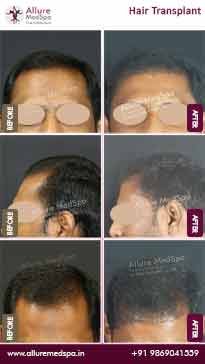
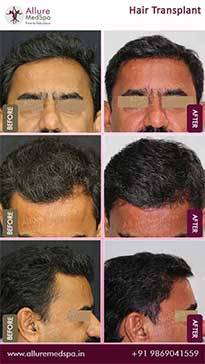
Hair Transplant Surgery Before and After Images


Hair Transplant Surgery Testimonials: Fine To Fabulous Journeys

Awarded by Google.com
Rating: 4.7
Reviews: 485+

Awarded by WhatClinic.com
Rating: 4.8
Reviews: 119+

Awarded by Realself
Rating: 4.9
Reviews:453+

Awarded by Facebook
Rating: 4.6
Reviews:105+
Dr Milan Doshi and his staff are very professional and committed as the centre is highly equipped with advanced technology. I had closed rhinoplasty 4 months back and I’m seeing the results as to how it becomes successful.
Deepika Shetty
The doctor explained everything clearly and the surgery was smooth. Recovery was faster than I expected and the team was very supportive.
Rahul Mehta
Very natural results and excellent staff. From consultation to follow-up, the experience was outstanding and boosted my confidence.
Sneha Kapoor
What Exactly Is Hair Transplant Density?
Hair transplant density is the number of grafts placed per cm², while fullness depends on hair count per graft and perceived density (thickness + angle).
Density = number of grafts per square centimeter (grafts/cm²)
Types of Density You Should Know:
- Graft density: 30–60 grafts/cm²
- Hair density: 60–120 hair strands/cm² (each graft may contain 1–4 hairs)
- Perceived density: how full the area appears based on hair thickness + angle
Your eyes “see” perceived density, not the actual graft count.
Authentic Medical Source: NCBI – Human scalp density & follicular distribution
What Is the Natural Density of Human Hair?
Natural hair is ~70–100 FU/cm² (100–150 hairs/cm²), but transplants target ~35–55 FU/cm² for cosmetic density; higher is select.
Natural density (by nature):
- ~70–100 follicular units (FU) per cm²
- ~100–150 hairs per cm² (varies by ethnicity and individual)
Why transplants can’t recreate 100% natural density:
- The scalp’s blood supply is limited
- Overpacking can reduce oxygen/nutrients → lower graft survival
Realistic transplant targets:
- 35–55 grafts/cm²: Looks cosmetically dense for most people
- >55 grafts/cm²: Only in selected cases with excellent vascularity and surgeon expertise
Medical Authority Link: Cleveland Clinic – Hair biology & structure
How Much Density Can Be Achieved in One FUE Session?
In 1 FUE session, most achieve 35–45 grafts/cm² safely; 45–55 is high density; 55–65 only in select cases—>65 risks graft loss.
Safe dense packing range (1 session):
- 35–45 grafts/cm²: Standard safe density
- 45–55 grafts/cm²: High density (experienced surgeon)
- 55–65 grafts/cm²: Ultra-dense (special cases only)
- >65 grafts/cm²: Higher risk of vascular compromise + graft death
What sets your maximum achievable density:
- Scalp thickness + blood supply
- Existing native hair (risk of shock loss)
- Donor hair caliber (thicker hair = better coverage)
- Surgeon’s planning + experience
- Implanters vs slit technique
- Angle & direction control (natural look + survival)
- Smoking / diabetes (lower safe limits)
- Prior surgery/scarring (reduced vascularity)
Medical Backlink: ISHRS – Surgical density standards
Is 60–70 Grafts/cm² Possible? (Truth From a Surgeon)
Yes—60–70 grafts/cm² is possible, but only in select patients and usually only in small zones; most scalps can’t safely take that density over large areas.
High-density packing demands perfect vascular supply.
I offer 60–70 graft/cm² only under these conditions:
Ideal Candidate:
- Young (25–40)
- Thick, strong donor hair
- Healthy, non-smoker
- Normal scalp laxity
- No prior surgery in that region
But even then:
It is only for small zones like:
- Hairline
- Central forelock
- Small temple triangle
Large zones cannot safely handle >50 grafts/cm² in one go.
Medical Authority Link: NCBI – Scalp vascular anatomy
Hairline Density vs Crown Density – Why They Are Different
Hairlines use fine single grafts for natural “looks-dense” framing, while crowns need more grafts for a swirl pattern and mature later (12–18m).
Hairline Needs:
- Single-hair grafts
- Irregular micro-zigzag pattern
- High perceived density
- Lower actual density than people think
Crown Needs:
- Whorl pattern (spiral)
- Multi-directional angle
- Needs more grafts
- Achieves density later (12–18 months)
The crown consumes the most grafts but shows density last.
Medical Backlink: Cambridge University Press – Hairline anatomy
What Is ‘Perceived Density’ (The Real Secret)?
Perceived density = hair shaft thickness + curl pattern + angle + light reflection
Example:
- 40 grafts/cm² with curly hair looks much denser
- 50 grafts/cm² with thin, straight hair may still look less dense
Factors That Boost Perceived Density:
- Thicker hair shaft
- Dark hair over light scalp
- Lower hairline design
- Slanted implantation angles
- PRP improving shaft thickness
Medical Backlink: Plastic Surgery Key – Aesthetic hair restoration
Dr. Doshi’s Density Protocol (My 10-Step Method)
Here’s the method I personally follow to safely achieve high density:
Vascular assessment
Checking scalp blood flow and thickness
Donor hair calibration
Microscopic measurement for singles/doubles/triples
Zone-based density planning
High in the front → moderate midscalp → blended crown
Ultra-thin blades or implanter pens
0.8–1.0 mm for dense packing
Angle consistency
15–25-degree natural direction
Micro-slit staggering
Avoids vascular strangulation
Graft handling time under 20–30 minutes
Prevents ischemia
Density gradient rule
Front: higher
Middle: moderate
Crown: natural whorl pattern
PRP support during recovery
Enhances shaft growth
Follow-up protocols for 18 months
Ensures maturation completion
Medical Backlink: NCBI – Follicular survival & implantation technique
How Many Grafts Do You Need for Natural Density? (Area-wise Chart)
Here’s a quick, natural-density graft guide (area-wise) — actual needs vary with baldness grade, hair caliber, curl, skin–hair contrast, and donor supply.
Area | Typical Grafts Needed | Density Target |
|---|---|---|
Hairline | 800–1200 | 40–55 graft/cm² |
Frontal Zone | 1500–2500 | 35–45 graft/cm² |
Midscalp | 1000–1500 | 30–40 graft/cm² |
Crown | 1200–2500 | 30–45 graft/cm² |
Full Scalp | 3500–4500 | Depends on donor |
Note: Crown usually needs more grafts to look dense because of the swirl pattern and light reflection.
Medical Backlink: AHRS India – Density & graft planning
Does Higher Density Increase Hair Transplant Cost?
Yes—higher density usually costs more because it needs more grafts, longer OT time, more staff, finer instruments, more consumables, and slower precision packing with higher surgeon involvement.
- More grafts
- More surgical time
- More staff
- Smaller blades / implanters
- Slower precision packing
- More consumables
- Higher surgeon involvement
High density = high precision = higher cost.
Medical Backlink: NCBI – Global hair transplant economics
Can PRP, Minoxidil & Finasteride Improve Density After Surgery?
Yes—PRP, minoxidil & finasteride can boost post-op density by strengthening native hair and supporting grafts for a fuller look.
PRP:
- Thickens existing hair
- Supports graft survival
- Improves perceived density
Read More: PRP After Hair Transplant
Finasteride:
- Prevents further hair loss
- Preserves surrounding density
Minoxidil:
- Improves blood flow
- Increases hair shaft diameter
Read more: Minoxidil & Finasteride After Hair Transplant
Density = transplanted hair + strengthened native hair.
Medical Authority Links: PRP Evidence – NCBI
How Long Does Density Take to Show? (Timeline)
Visible density usually starts 4–6 months post-op for patients, looks noticeably fuller by 7–9 months, peaks at 10–12, and matures by 12–18 months.
Timeline (what you typically see):
- Month 1–3: Shock loss
- Month 4–6: Early growth begins
- Month 7–9: Clear density improvement
- Month 10–12: Major density change
- Month 12–18: Final thickening + hair maturity
Important: The crown commonly matures 3–6 months later than the hairline.
Medical Backlink: Harvard – Hair growth cycle
Final Take — What Is YOUR Maximum Density?
Your personalised density depends on:
- Donor area strength
- Hair thickness
- Curl pattern
- Scalp vascularity
- Baldness grade
- Age & genetics
- Lifestyle factors
- Surgical technique
Absolute Truth:
Density is not a number.
It is a personalised equation.
My goal is always the same:
Create the densest natural result your scalp can safely support — for life.


