
Breast Asymmetry Correction Surgery in Mumbai: Achieve Balanced, Natural Results Safely
Breast asymmetry correction surgery balances differences in the size, shape or position of the breasts, using a tailored combination of implants, lift, reduction or fat transfer. Almost everyone has some natural asymmetry. One important point first: asymmetry you’ve had since your breasts developed is benign, but a new or changing asymmetry in an adult should be medically assessed before any cosmetic surgery.
What Is Breast Asymmetry Correction Surgery?
Breast asymmetry correction surgery is a customised procedure that balances uneven breasts — differences in size, shape, or nipple position — using whichever combination of techniques best suits your anatomy.
Tailored, not one operation — it may use implants, a lift, a reduction, or fat transfer, on one or both sides
Corrects volume, shape and position — from a size mismatch to a difference in height or projection; see breast augmentation, reduction, lift and fat grafting
Often operates on both breasts — the ‘normal’ side is frequently adjusted too, so the two match in shape, not just size
Also called — uneven breast correction, mammary asymmetry correction, asymmetrical breast surgery, breast imbalance surgery
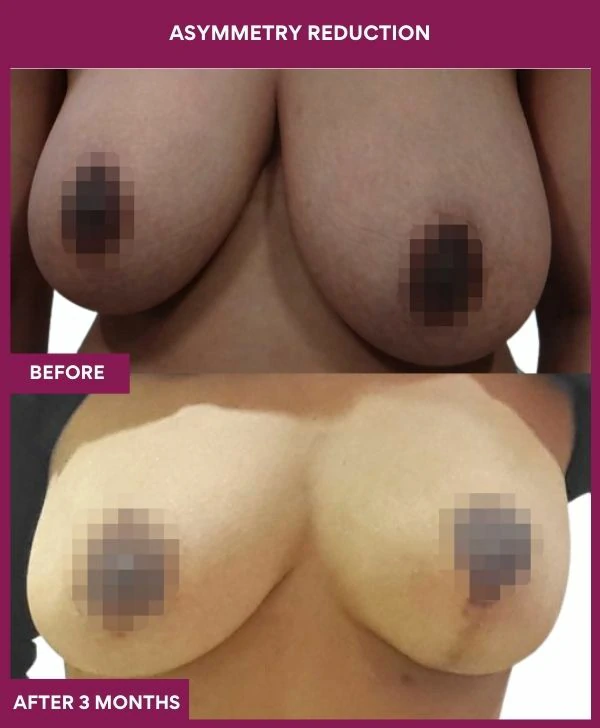
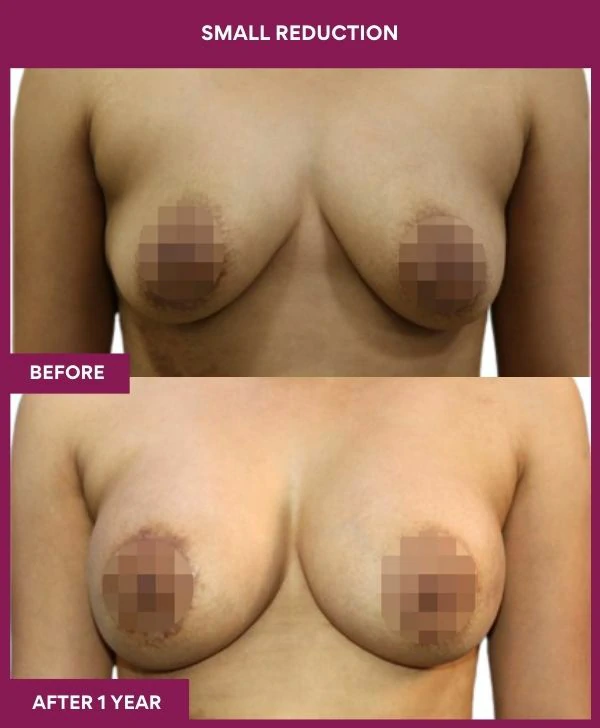
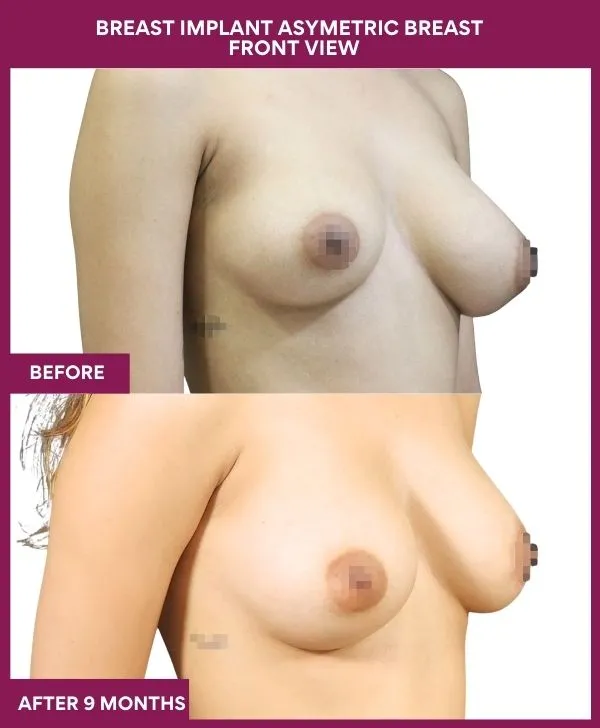
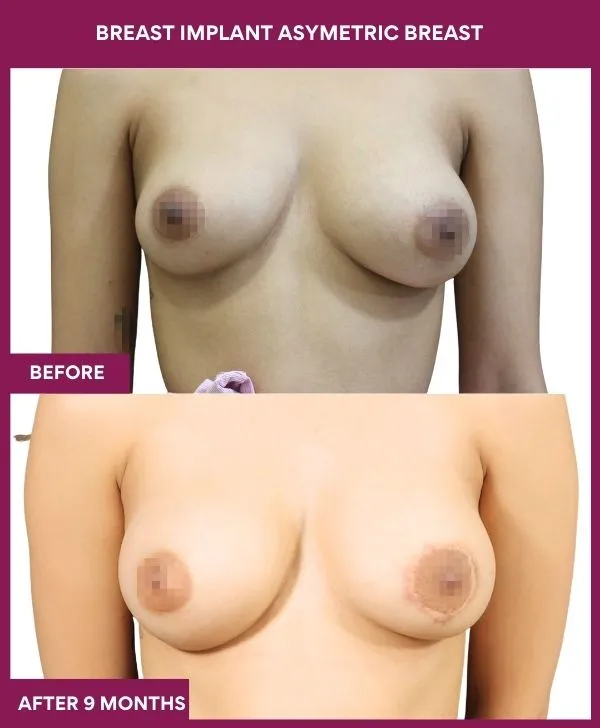
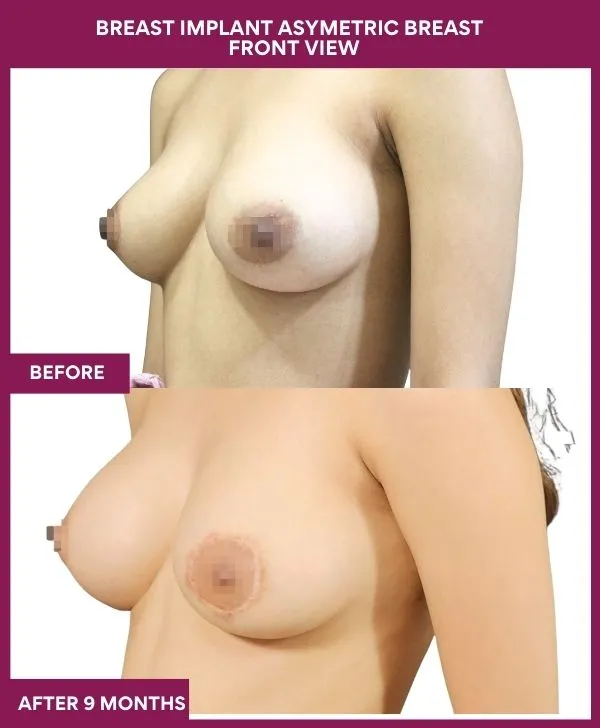
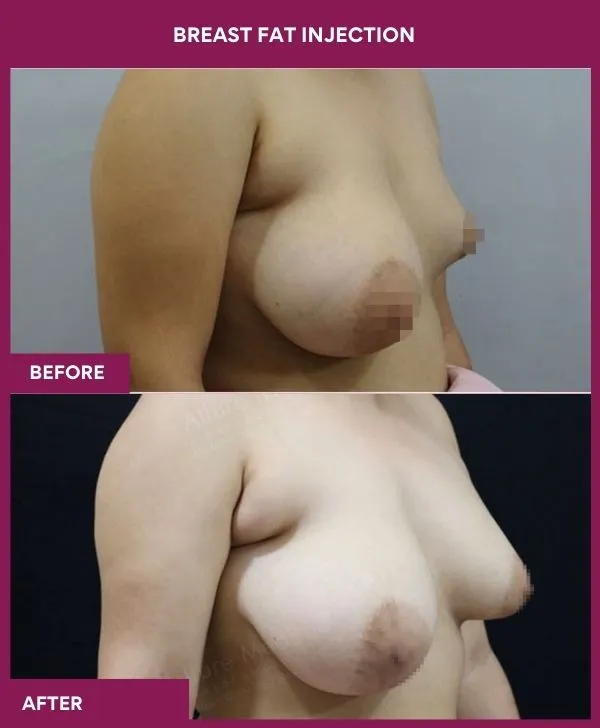
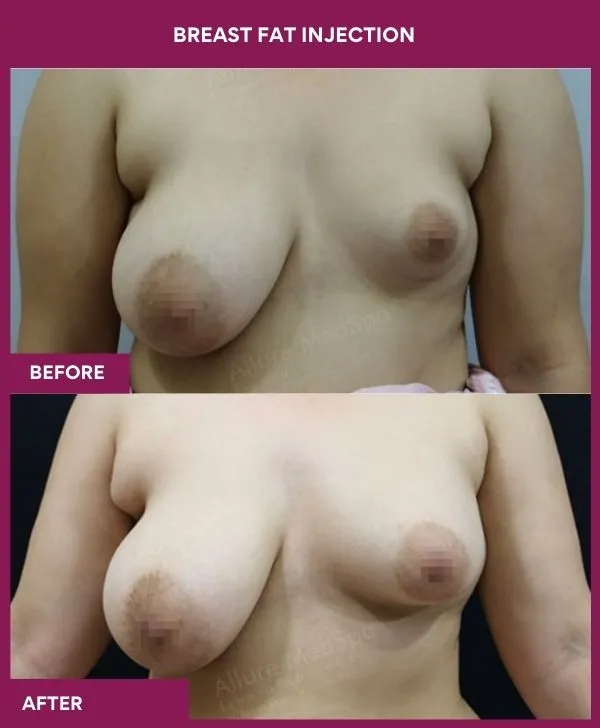
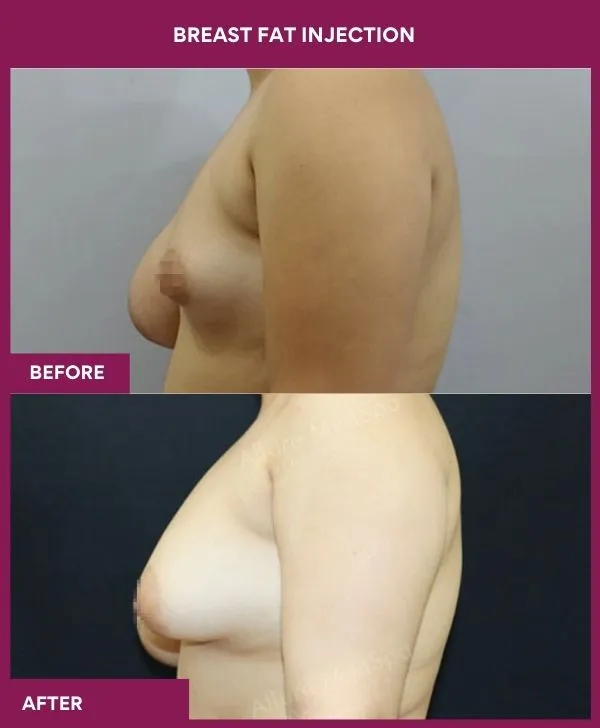
Breast Asymmetry Correction Surgery Before and After Images
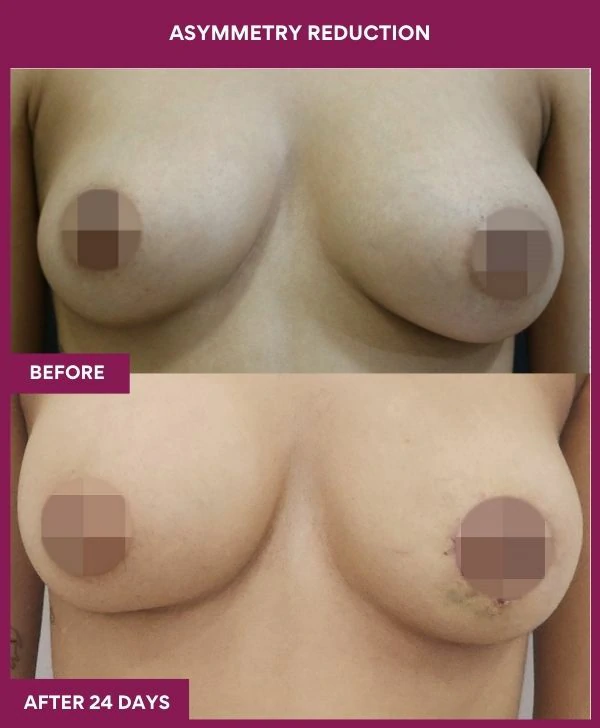
“Liked the results? Let's plan yours.”
Breast Asymmetry Correction Surgery Testimonials: Fine To Fabulous Journeys

Awarded by Google.com
Rating: 4.7
Reviews: 485+
Awarded by WhatClinic.com
Rating: 4.8
Reviews: 119+
Awarded by Realself
Rating: 4.9
Reviews:453+
Awarded by Facebook
Rating: 4.6
Reviews:105+
Dr Milan Doshi and his staff are very professional and committed as the centre is highly equipped with advanced technology. I had closed rhinoplasty 4 months back and I’m seeing the results as to how it becomes successful.
Deepika Shetty
The doctor explained everything clearly and the surgery was smooth. Recovery was faster than I expected and the team was very supportive.
Rahul Mehta
Very natural results and excellent staff. From consultation to follow-up, the experience was outstanding and boosted my confidence.
Sneha Kapoor
Do Uneven Breasts Affect Your Confidence?
If a noticeable difference between your breasts affects how you feel or dress, breast asymmetry correction surgery can restore balance — once any medical cause has been ruled out.
Do your breasts appear uneven in size, shape, or nipple position?
Do you struggle to find clothes, lingerie or swimsuits that fit properly because of the imbalance?
Do you feel self-conscious in intimate situations, or avoid certain outfits because of visible asymmetry?
Breast asymmetry is more common than most women realise — in fact, almost every woman has slight differences between her breasts. But when the asymmetry is significant, it can affect not just your appearance but your confidence and emotional wellbeing. Many women feel frustrated, embarrassed, or limited in their choices because of uneven breasts.
The good news is that breast asymmetry correction surgery offers a safe and effective solution. Using techniques such as implants, reduction, fat transfer or a lift, an experienced plastic surgeon can restore balance and give natural-looking, proportionate results tailored to your anatomy and goals — helping you feel comfortable in your own skin again. Because almost everyone has some asymmetry, the aim is natural balance, not identical breasts.
Global & Indian trends (2024)
Over 2.2 million breast augmentation and reduction procedures were performed worldwide, many of which address asymmetry.
In India, breast surgeries — including asymmetry correction — continue to rise with growing demand for proportionate, natural results.
Source: ISAPS Global Survey 2024
“Ready to reshape your body? ”
Quick Facts about Breast Asymmetry in Women?
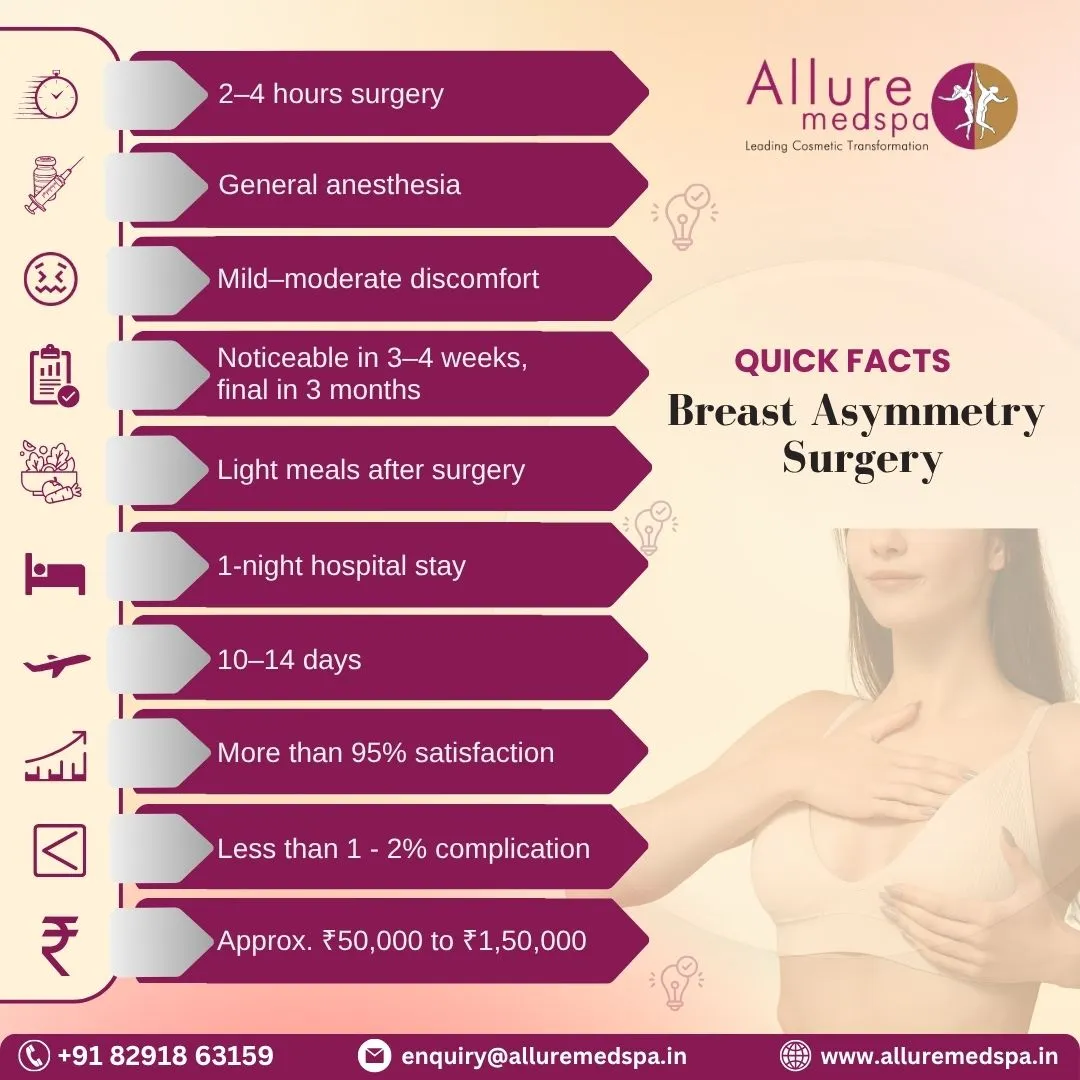
| Time Required | 2–4 Hours |
| Anesthesia | General Anesthesia |
| Pain Level | Mild -Moderate Discomfort |
| Hospital Stay | 1–2 Days |
| Flyback | 5–7 Days |
| Success Rate | 97% to 98% |
| Result | Major improvement in 3-4 weeks; final result in 3 months |
| Diet | Light meals after surgery |
| Complication Rate | Less than 1–2% |
| Cost | INR 50,000 to 1,50,000 Approx. |
When Is Breast Asymmetry a Warning Sign You Shouldn't Ignore?
Most breast asymmetry is harmless — but a new or changing asymmetry in an adult who previously had even breasts should be medically assessed before any cosmetic surgery, because it can occasionally signal a breast problem, including cancer. Asymmetry you’ve had since your breasts developed is almost always benign.
Developmental vs new-onset — the key distinction
Developmental (since puberty) — differences present since your breasts grew; a normal variation, and what cosmetic surgery safely corrects
New-onset or changing — one breast that has recently changed in size, shape or contour when it was previously even. This needs assessment first
See a doctor before cosmetic surgery if you notice:
A recent change — one breast becoming larger, smaller, or differently shaped after years of being even
A lump or thickening — anything new in the breast or armpit
Skin changes — dimpling, puckering, redness, or an orange-peel texture
Nipple changes — new inversion, or bloody or clear one-sided discharge
Family history or age — extra reason to have a new change checked, especially over 40
Why this matters
Imaging comes first — ultrasound and/or mammography confirm the cause is benign before any elective operation
The numbers — a new asymmetry found on a screening mammogram carries roughly a 12% chance of being cancer, rising to about 27% if confirmed on follow-up imaging — which is exactly why a new change is investigated, not operated on
Then, safely, cosmetic correction — once a medical cause is excluded, asymmetry surgery is a safe, appropriate choice
Sources: Cleveland Clinic: new asymmetry on mammogram ~12% cancer risk (27% if confirmed); rule out cancer first, Breast asymmetry and cancer risk — concern when previously even breasts become uneven as an adult, Developing asymmetry needs further tests (mammogram, ultrasound, sometimes biopsy)
🩺 Dr. Milan Doshi’s note: “I first confirm whether breast asymmetry has been present since puberty or is a recent change. New or progressive asymmetry, especially with a lump, nipple change, discharge, or skin change, must be evaluated with appropriate imaging before cosmetic surgery. I proceed only after an underlying medical cause has been excluded.”
What Are the Common Causes and Types of Breast Asymmetry?
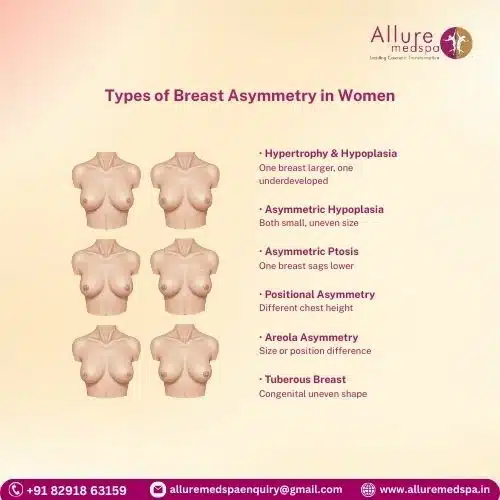
Breast asymmetry can involve differences in size, shape, or nipple position, and arises from development, hormones, pregnancy, weight change, or congenital conditions. Identifying the cause and type is what determines the right correction.
Common types
Volume difference — one breast larger (hypertrophy) or one underdeveloped (hypoplasia)
Ptosis (sagging) asymmetry — one breast sits lower due to laxity or a volume difference
Positional asymmetry — similar volume, but the breasts sit at different heights on the chest wall
Areola asymmetry — nipple or areola differ in size, projection or position
Tuberous (constricted) breast — a congenital shape difference with a narrow base and herniated areola
Common causes
Normal development — uneven growth during puberty; the most common cause, and benign
Hormonal changes — puberty, menstrual cycle, pregnancy, breastfeeding, menopause
Weight change — gain or loss can shift the balance
Congenital conditions — Poland syndrome (underdevelopment of chest muscle and breast on one side), tuberous breast, chest-wall differences such as scoliosis or pectus excavatum
Previous surgery or trauma — including after breast-cancer surgery, injury or burns
A new medical cause — less common, but the reason a recent change is assessed first; see the warning-signs section above
Source: Causes and types of breast asymmetry, incl. Poland syndrome and tuberous breast
What Are the Benefits of Breast Asymmetry Correction Surgery?
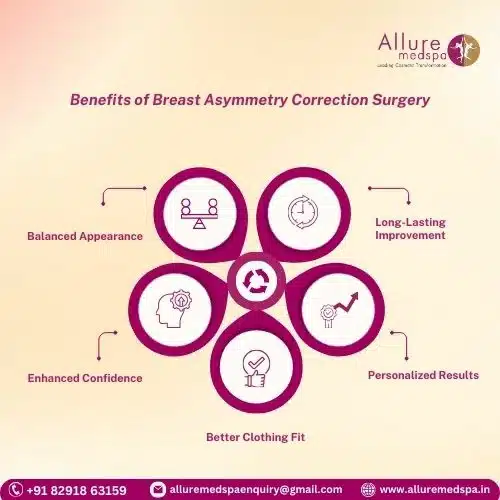
Breast asymmetry correction restores balance, improves confidence, and is tailored to your specific type of unevenness — with benefits that are both aesthetic and practical.
Improved symmetry — a lift, reduction, implant or fat transfer brings the breasts into balance in size, shape and position
Greater confidence — less self-consciousness in social and intimate settings
Better clothing fit — more comfortable, better-fitting bras, tops and swimwear
Personalised results — techniques matched to your anatomy and goals, not a single template
Corrects significant cases — even marked or congenital asymmetry (Poland syndrome, tuberous breast) can be substantially improved
Who Is an Ideal Candidate for Breast Asymmetry Correction Surgery?
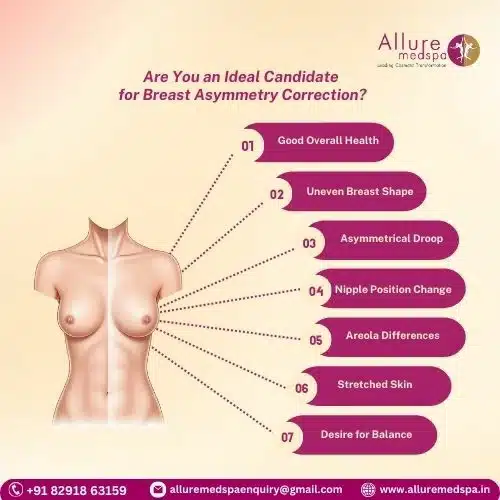
You are a good candidate for breast asymmetry correction if you are in good health, your breasts have finished developing, any medical cause has been excluded, and you have realistic expectations of natural — not identical — balance.
Physically healthy — with a stable weight and no uncontrolled medical conditions
Bothered by the asymmetry — in size, shape, height or nipple position
Development complete — breasts have finished growing and their size is stable
Any recent change assessed — a new or changing asymmetry has been medically evaluated first
Realistic expectations — understanding that the goal is natural balance, and that minor differences may remain
A note on teenagers and still-developing breasts
Usually wait for stability — operating while the breasts are still developing risks a poor long-term result, so surgery is generally deferred until growth has settled (often late teens or early twenties)
Exceptions are individualised — significant congenital asymmetry causing real distress may be managed earlier, sometimes in stages, and is a specialist decision
Psychological wellbeing matters — the emotional impact on a young person is taken seriously and factored into timing
Source: Patients still developing, with unstable weight, pregnant or breastfeeding may be advised to wait
Why Is Consultation Important Before Breast Asymmetry Surgery?
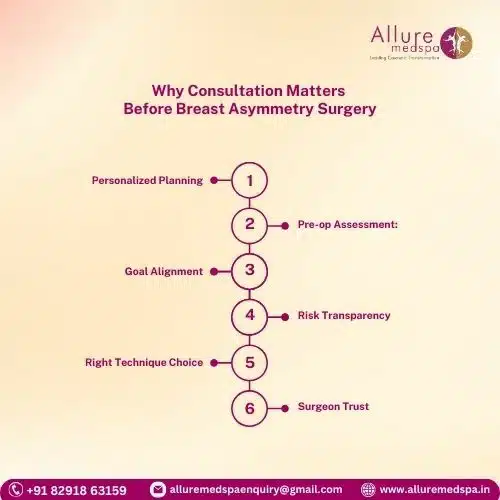
A consultation confirms the cause of your breast asymmetry, excludes anything medical, and matches the surgical plan to your specific type of unevenness — so the result is safe and right for your body.
Confirms the cause — developmental, congenital, or a recent change that needs assessment first
Personalised plan — measuring volume, shape, nipple position and chest-wall anatomy on each side
Technique selection — lift, augmentation, reduction, fat transfer, or a combination
Pre-op assessment — health, breast tissue and skin quality reviewed for surgical readiness
Honest expectations — benefits, limits, scars and the small chance of revision explained before you decide
How Should I Prepare Before Breast Asymmetry Correction Surgery?
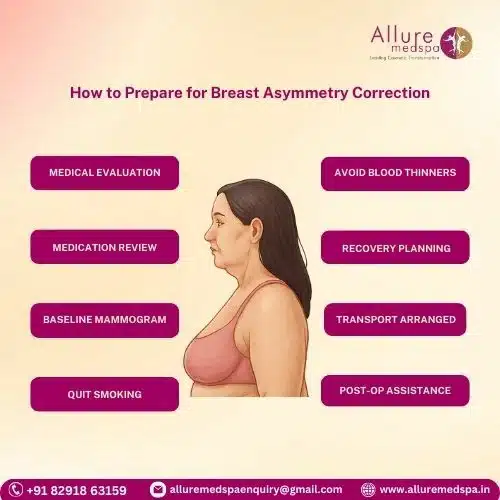
Preparing for breast asymmetry correction involves medical tests, a baseline breast assessment, stopping smoking and certain medicines, and arranging help for the first day or two at home.
Medical evaluation — lab tests and a fitness assessment for anaesthesia
Baseline breast imaging — a mammogram and/or ultrasound, both to check the breasts are healthy before surgery and to give a baseline for future comparison
Adjust medications — stop aspirin, anti-inflammatories and herbal supplements as advised, as they increase bleeding
Stop smoking — well in advance, because it impairs healing
Plan recovery — time off work, and someone to drive you home and stay for the first 24 hours
What Is the Procedure for Correcting Breast Asymmetry?
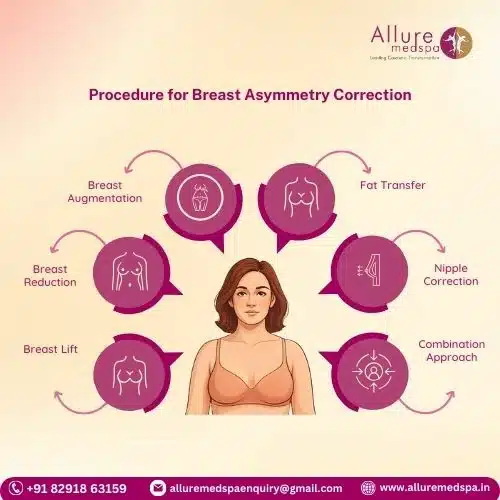
Breast asymmetry correction is customised: the surgeon combines a lift, reduction, augmentation or fat transfer to match the two breasts in size, shape and position — often operating on both sides.
Breast lift (mastopexy) — reshapes and raises a sagging or lower breast
Breast reduction — reduces the larger breast to match the smaller one
Breast augmentation — an implant (often a different size on each side) adds volume to a smaller breast
Fat transfer — your own fat is used to add modest volume and refine shape naturally
Inverted nipple or areola correction — where nipple position or inversion contributes to the asymmetry
Combination approaches — most corrections use more than one technique, and frequently adjust the ‘normal’ side too, so the breasts match in shape as well as size
Anaesthesia — usually general; occasionally local for a minor single-side adjustment
What Post-operative Care Is Needed After Breast Asymmetry Correction Surgery?
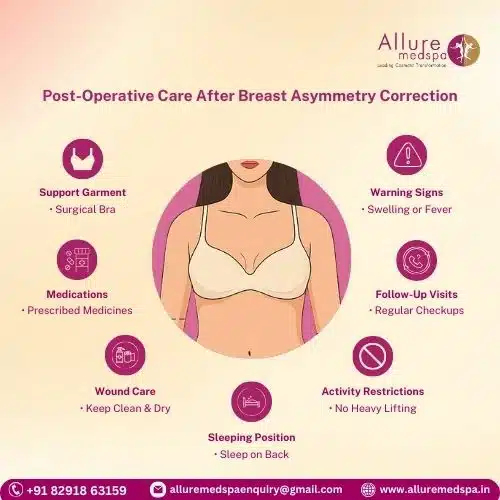
Good post-operative care — a support garment, wound care, rest and follow-up — is what protects the result and ensures safe healing after asymmetry correction.
Support garment — wear the surgical bra as advised to reduce swelling and support the tissues
Medications — take prescribed antibiotics and pain relief exactly as directed
Wound care — keep incisions clean and dry; follow dressing instructions
Sleep on your back — elevated, to reduce swelling and pressure
Restrict activity — no heavy lifting or strenuous exercise for 4–6 weeks
Watch for warning signs — call the clinic for excessive swelling, redness, discharge, fever or one-sided swelling
How Long Is the Recovery After Breast Asymmetry Correction Surgery?
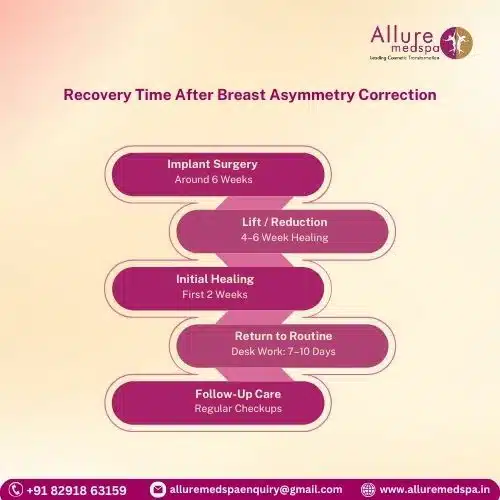
Most people recover from breast asymmetry correction in about 4–6 weeks, returning to desk work within 7–10 days, with swelling settling over the first couple of weeks.
First 2 weeks — swelling and bruising reduce noticeably; take it easy
Desk work — usually back within 7–10 days
Strenuous activity — avoid for 4–6 weeks
Implant vs lift/reduction — similar 4–6 week healing, with the exact course depending on the techniques used
Follow-ups — regular reviews to monitor healing and the settling result
How Long Do the Results of Breast Asymmetry Correction Surgery Last?
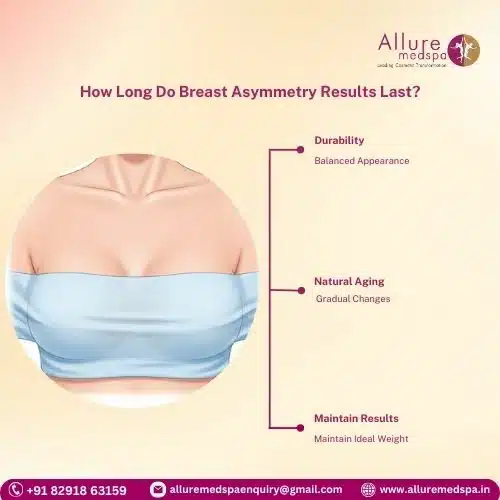
The results of breast asymmetry correction are long-lasting, especially with a stable weight and healthy lifestyle — though natural ageing, pregnancy and weight change can still affect the breasts over time.
Durable balance — the reshaped, matched breasts hold their improved appearance for years
Natural changes still happen — gravity, hormones and ageing continue, but the symmetry is generally preserved
Protect the result — maintain a stable weight, avoid big fluctuations, and follow aftercare
Implants aren’t lifetime devices — if implants are used, they may eventually need monitoring or replacement; your surgeon will explain the long-term plan. See breast implants
What Are the Risks and Complications of Breast Asymmetry Correction Surgery?
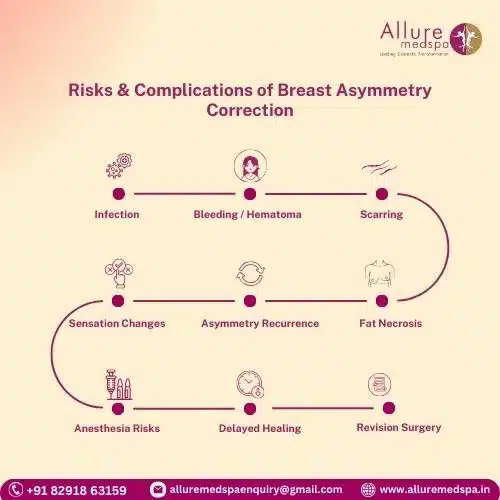
Like all surgery, breast asymmetry correction carries some risk. It is generally safe in experienced hands, but you should understand the possibilities before deciding.
Infection — uncommon; prevented with sterile technique and antibiotics
Bleeding or haematoma — a collection of blood that occasionally needs draining
Scarring — some scarring is expected; it usually fades with proper care
Changed sensation — temporary or, less often, permanent numbness of the nipple or breast skin
Residual or recurrent asymmetry — perfect symmetry is not achievable; some difference may remain or return with healing
Fat necrosis — with fat transfer, some grafted fat can form firm lumps as it settles
Implant-related issues — if implants are used: capsular contracture, malposition, or eventual need for revision
Anaesthesia risks — and slower healing in smokers or people with diabetes
Possible revision — occasionally a second, smaller procedure fine-tunes the result
Lower your risk — choose a board-certified plastic surgeon and an accredited centre, and follow aftercare closely
What Is the Cost of Breast Asymmetry Correction Surgery in Mumbai, India?
The cost of breast asymmetry correction surgery in Mumbai is typically ₹50,000 to ₹1,50,000, depending on which techniques are needed — an implant, lift, reduction, fat transfer, or a combination. A 5% GST applies to cosmetic procedures. EMI options are on our payment process page.
What changes the price — whether one or both breasts are operated on, and the combination of techniques used
Usually included — surgeon’s fee, OT and anaesthesia, hospital stay, compression garments and follow-ups
Implants add cost — if an implant is used, the device adds to the total; fat transfer avoids a device but has volume limits
GST — 5% applies to cosmetic procedures, as per regulation
Exact quote at consultation — because the plan is individual; book online or in person
Who Is the Best Surgeon for Breast Asymmetry Correction in Mumbai?

Dr. Milan Doshi, a board-certified plastic surgeon and founder of Allure Medspa, is widely trusted for breast asymmetry correction — combining careful assessment with a tailored, natural-looking surgical plan.
Board-certified — M.Ch, MS; member of ISAPS, APSI, IAAPS and ASPS; ISAPS Mentor; 27+ years
Experienced in breast reshaping — augmentation, lift, reduction and asymmetry correction [clinic to confirm the case number; see flag]
Assesses before operating — distinguishes longstanding developmental asymmetry from a recent change that needs checking first
Tailored technique — the right combination of lift, implant, reduction or fat transfer for your anatomy
Patient-centric — personalised care, discreet handling, and clear follow-up
Which Is the Best Cosmetic Centre for Breast Asymmetry Correction in Mumbai?

Allure Medspa is a NABH-accredited, ISO-certified cosmetic surgery centre in Mumbai offering breast asymmetry correction with a personalised, safety-first, discreet approach.
Led by Dr. Milan Doshi — board-certified plastic surgeon, 27+ years [reconcile with ’26+’ used here]
Accredited facility — ISO-certified and NABH-compliant, with modern operating theatres and monitoring
Customised plans — each correction designed around the patient’s anatomy and goals
One-stop care — consultation to recovery under one roof, with hospital-grade hygiene
Discreet and supportive — private, confidential care; outstation and overseas patients are supported via our outstation patients guide

Medical Codes For Breast Asymmetry
ICD-10 Codes for Breast Asymmetry Correction Surgery
| ICD-10 Code | Description |
|---|---|
| N64.89 | Other specified disorders of breast (used for acquired breast asymmetry) |
| Q83.8 | Other congenital malformations of breast (if asymmetry is congenital) |
| Q83.9 | Congenital malformation of breast, unspecified |
| Z41.1 | Encounter for cosmetic surgery (when surgery is for aesthetic reasons) |
| Z42.1 | Encounter for breast reconstruction following surgery/trauma |
CPT Codes for Breast Asymmetry Correction Surgery
| CPT Code | Description |
|---|---|
| 19316 | Mastopexy (breast lift – often used in asymmetry correction) |
| 19325 | Augmentation mammaplasty with implant (for smaller breast correction) |
| 19318 | Reduction mammaplasty (for larger breast correction) |
| 19328 | Removal of intact breast implant (if required during asymmetry correction) |
| 19340 | Immediate insertion of breast prosthesis following mastectomy/augmentation |
| 19380 | Revision of reconstructed breast (used for fine-tuning asymmetry corrections) |
(FAQs) Frequently Asked Question About Breast Asymmetry Surgery
Q1. When is breast asymmetry a sign of something serious?
Ans. Asymmetry you’ve had since your breasts developed is almost always harmless. But a new or changing asymmetry in an adult — one breast that has recently changed size, shape or contour, or that comes with a lump, skin change or nipple change — should be checked by a doctor with imaging before any cosmetic surgery, as it can occasionally signal a breast problem including cancer.
Q2. Can surgery fix breast asymmetry?
Ans. Yes. Asymmetry is corrected by combining techniques — an implant, reduction, lift or fat transfer — to balance the breasts in size, shape and position. The plan depends on your specific type of asymmetry.
Q3. Can breast asymmetry be fixed without surgery?
Ans. Mild asymmetry can be managed with a padded or custom bra or a partial prosthesis. Surgery is the only way to achieve a lasting correction of significant asymmetry.
Q4. What’s the best age for asymmetry surgery?
Ans. Usually after the breasts have finished developing — often late teens or early twenties — because operating while they are still growing risks a poor long-term result. Significant congenital asymmetry causing real distress may sometimes be managed earlier, in stages, as a specialist decision.
Q5. Is it normal for one breast to be bigger than the other?
Ans. Yes — minor asymmetry is very common and usually harmless. Correction is considered when the difference is noticeable or causes distress. A recent change in a previously even breast, however, should be checked.
Q6. What causes breast asymmetry?
Ans. Normal uneven development at puberty is the commonest cause. Others include hormonal changes, pregnancy and breastfeeding, weight change, congenital conditions (Poland syndrome, tuberous breast), and previous surgery or trauma.
Q7. Will the surgery make my breasts identical?
Ans. The goal is natural balance, not perfect symmetry — which isn’t achievable, since almost everyone has some natural difference. A good result looks even in clothing and proportionate unclothed, but small differences may remain.
Q8. Can implants fix asymmetry?
Ans. Yes — using different-sized implants, or an implant on one side only, is a common way to correct a volume difference. Often the larger side is adjusted too, so the shapes match.
Q9. Can fat transfer correct asymmetry?
Ans. Fat transfer can add modest volume and refine shape naturally using your own fat, avoiding an implant. It has volume limits and some of the grafted fat is reabsorbed, so it suits smaller corrections or works alongside other techniques.
Q10. Is the surgery painful?
Ans. Most patients have mild to moderate discomfort that settles within a few days and is well controlled with medication.
Q11. How long is recovery?
Ans. Desk work in about 7–10 days; strenuous activity avoided for 4–6 weeks. Swelling settles over the first couple of weeks and the final shape over about 3 months.
Q12. Are the results permanent?
Ans. Long-lasting, though ageing, weight change and pregnancy can still affect the breasts over time. If implants are used, they may eventually need monitoring or replacement.
Q13. Will I be able to breastfeed afterwards?
Ans. It depends on the techniques used. Many procedures preserve breastfeeding, but some (particularly reduction or surgery around the nipple) can affect it. Tell your surgeon if future breastfeeding is important to you.
Q14. Will there be visible scars?
Ans. Some scarring is unavoidable, but incisions are placed as discreetly as possible — around the areola, in the breast crease, or along natural contours — and usually fade over time.
Q15. Can losing weight fix asymmetry?
Ans. Weight change can shift the balance a little but rarely eliminates true asymmetry, which is usually structural.
Q16. Is uneven development common during puberty?
Ans. Very — many girls develop unevenly, and it often evens out with time. If a significant difference persists into adulthood, correction is an option once development is complete.
Q17. Will I need revision surgery?
Ans. Usually not, but occasionally a small second procedure fine-tunes the result. Your surgeon will discuss this possibility beforehand.
Q18. Does asymmetry surgery affect future mammograms?
Ans. Tell your radiographer about any breast surgery or implants, as it affects how the mammogram is done. Continue routine screening as advised — surgery doesn’t remove the need for it.
“Ready to reshape your body? ”
Related Links
Note: The author of this content is Dr. Milan Doshi, An Indian board-certified plastic & cosmetic Surgeon wholly & solely confirms the authenticity of the information & knowledge delivered by this write-up.