
Facial Fat Grafting (Fat Transfer) in Mumbai — Natural Volume, Honestly Explained

Indian Board Certified Plastic Surgeon
M.CH, MS, ISAPS Mentor
16000+ Cosmetic Surgeries
1500+ Fat Injection
Facial fat grafting (fat transfer, lipofilling) restores lost facial volume using your own fat — gently harvested from the abdomen or thighs, processed, and placed in tiny parcels into hollow temples, flattened cheeks, under-eye hollows or the pre-jowl groove. It takes 1–2 hours, usually under local anaesthesia as day care, and most people return to desk work in 4–5 days. At Allure Medspa it costs about ₹40,000–₹1,10,000 per area. Not all transferred fat survives — about half on average, ranging from a quarter to four-fifths — so results settle over 3–4 months and a top-up is sometimes needed. A facelift repositions; fat grafting restores volume. Dr. Milan Doshi’s job is to work out which you need, or both.
A face does not age only by sagging. It can also lose volume. Temples become hollow, cheeks flatten, the transition beneath the eyes changes, and hollows can appear around the jawline. In some patients, lifting descended tissue without addressing genuine volume loss leaves part of the ageing pattern untreated. Sometimes you need one. Sometimes you need both.
Fat Grafting/Injections Before and After
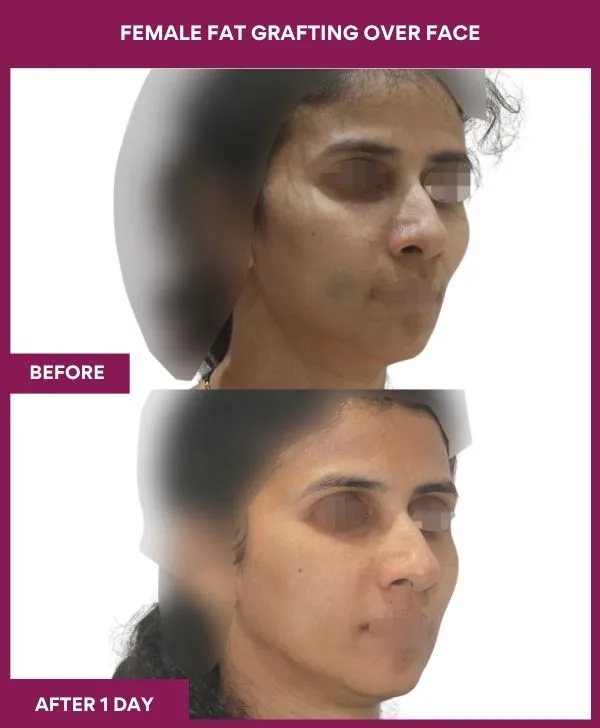
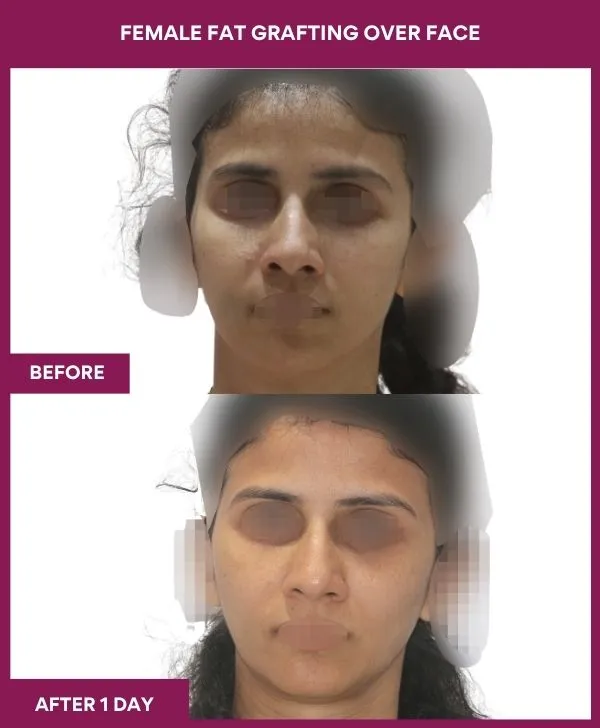
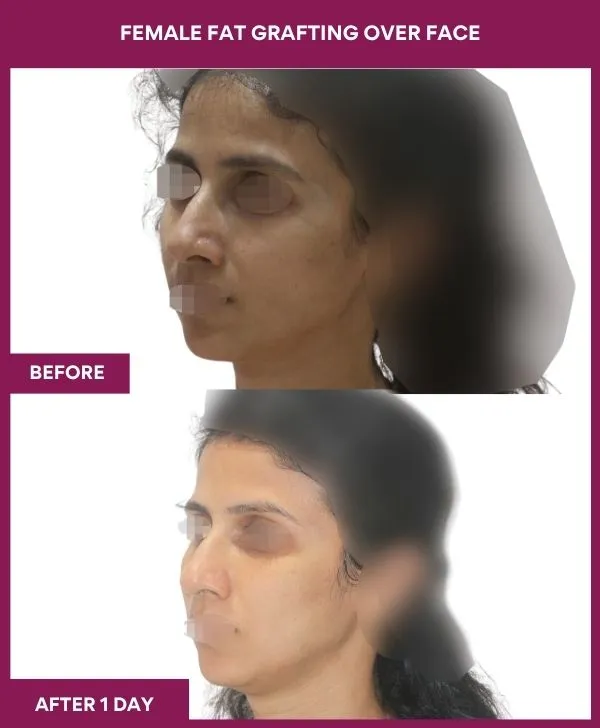
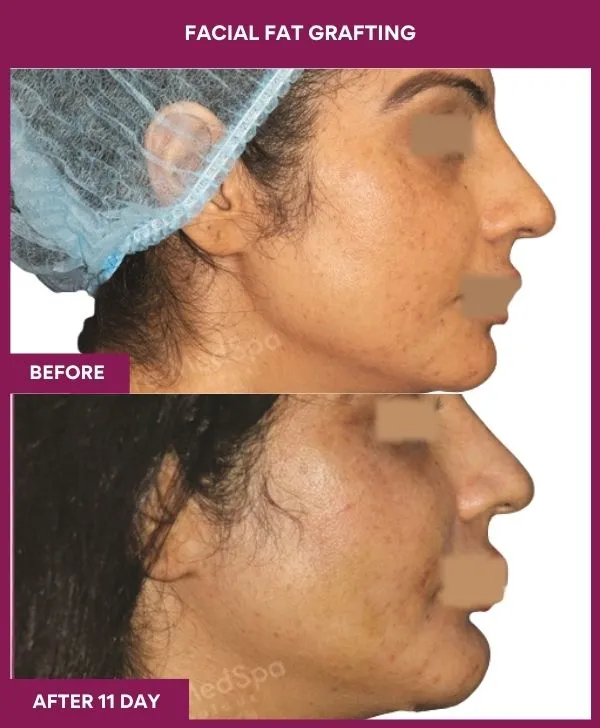
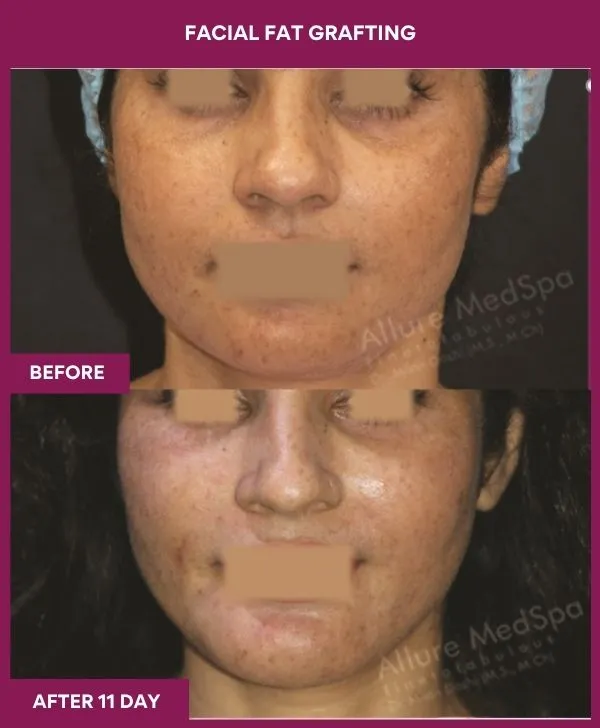
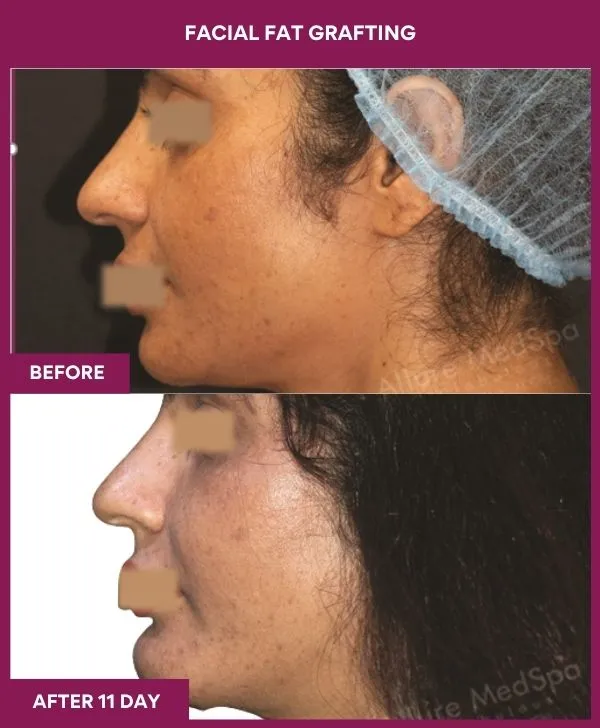
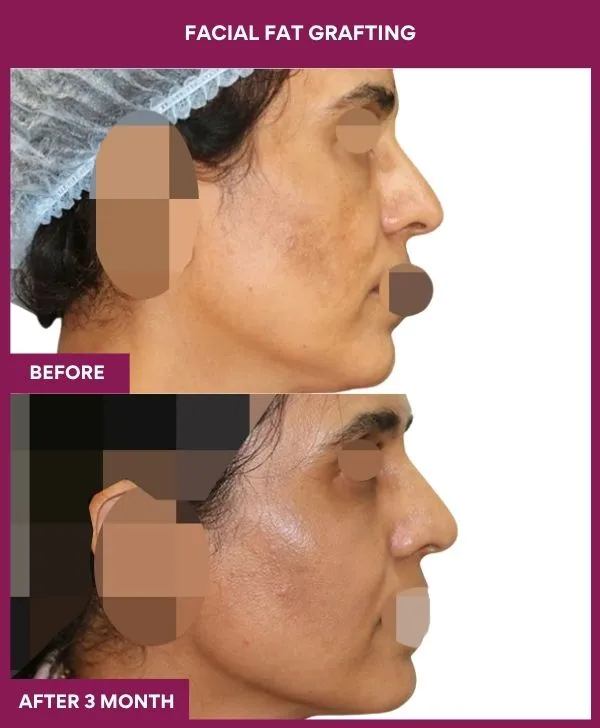
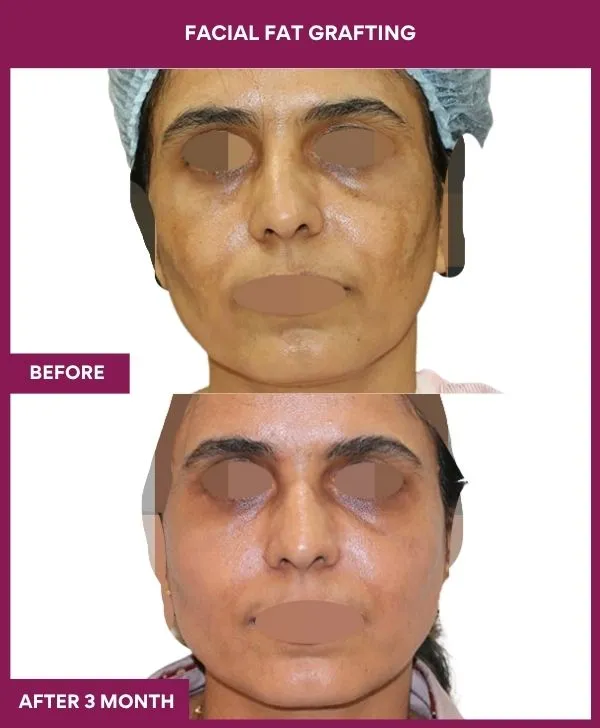
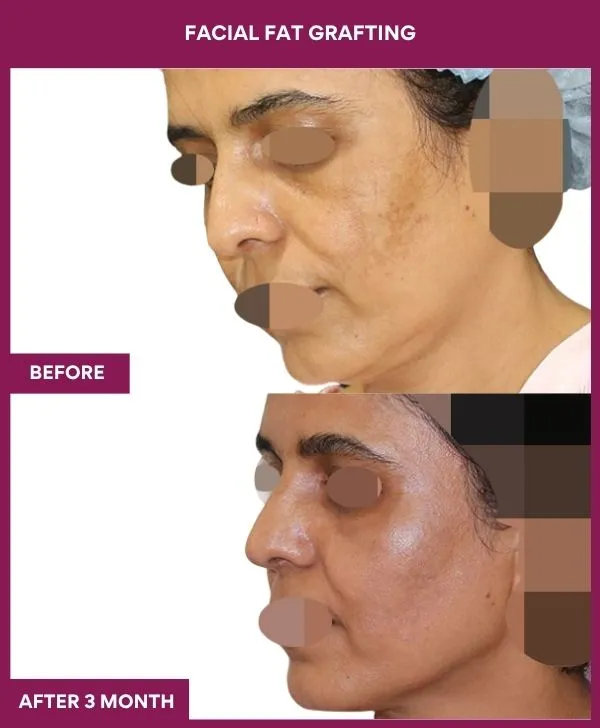
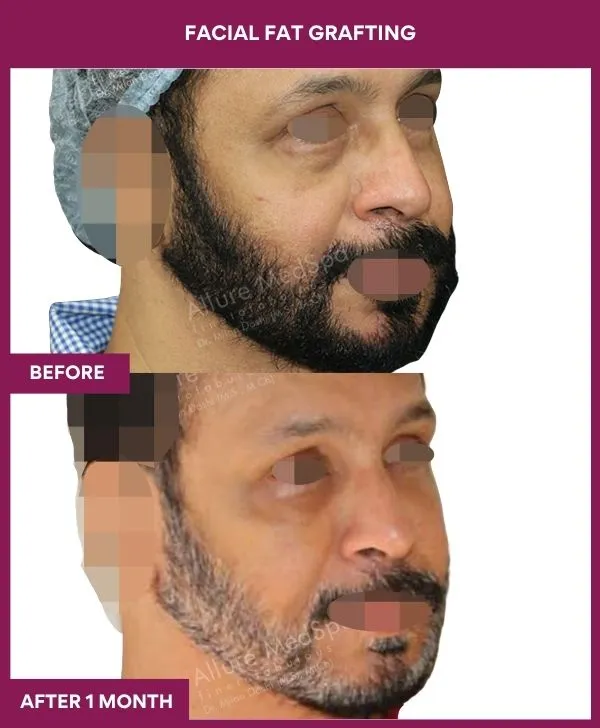
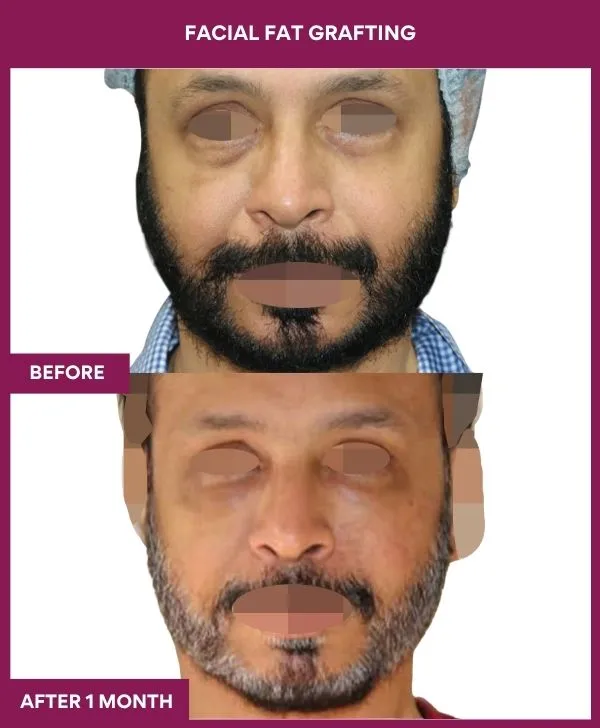
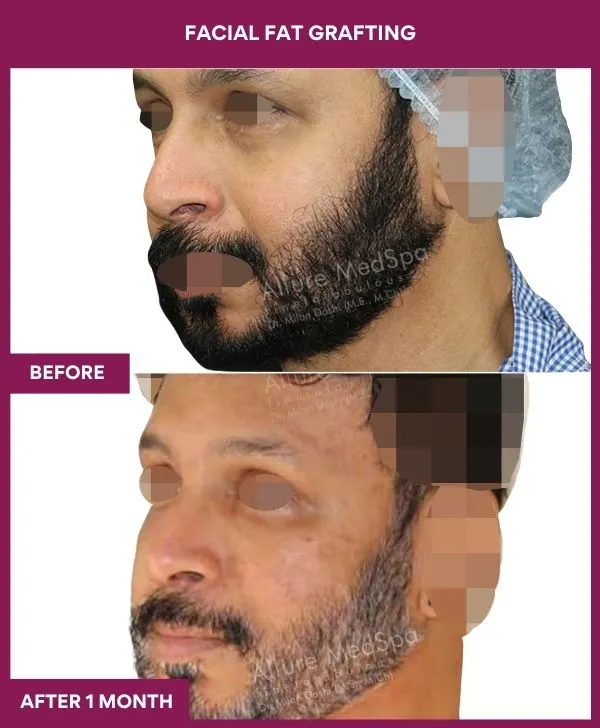
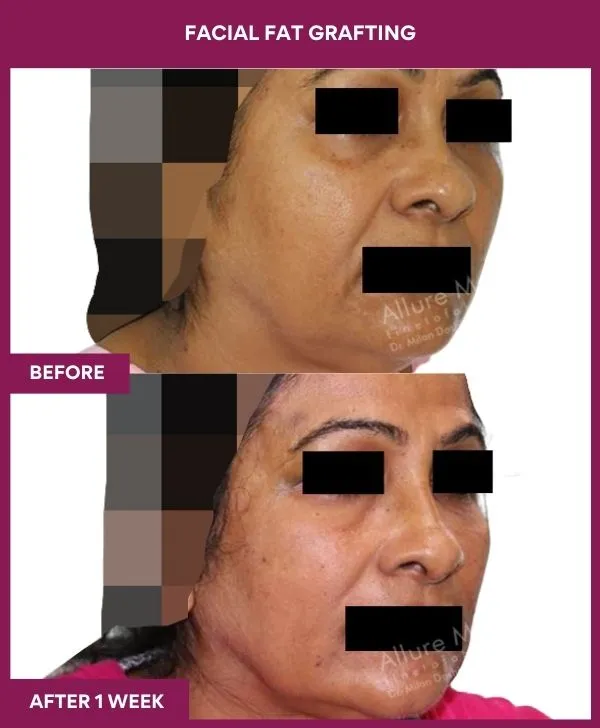
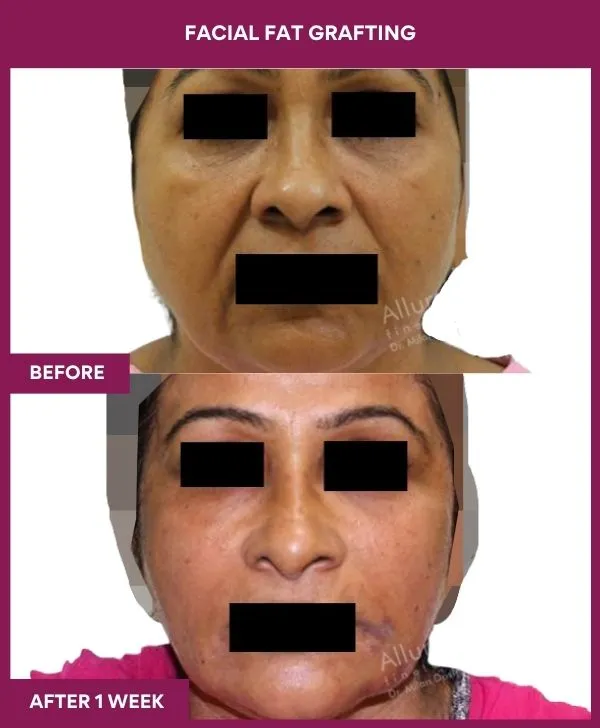
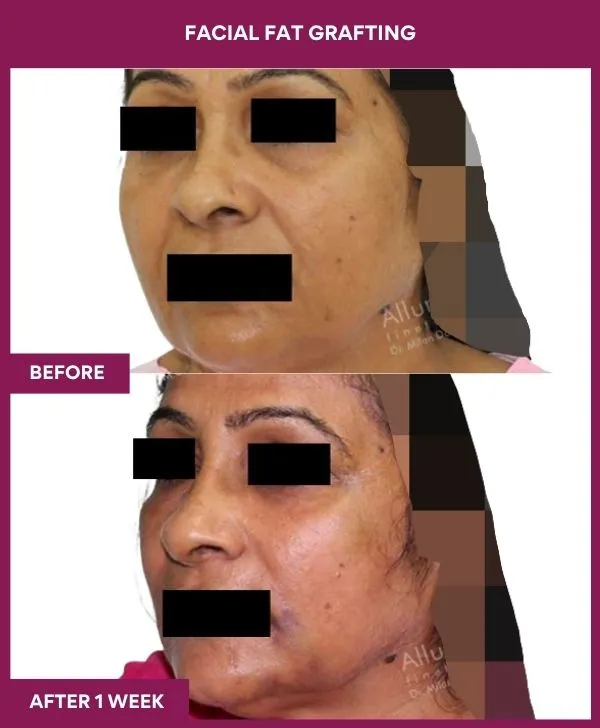
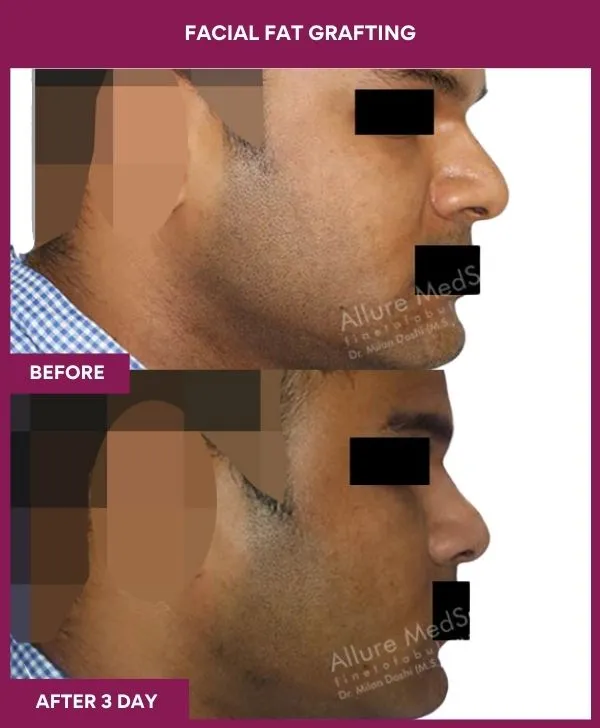
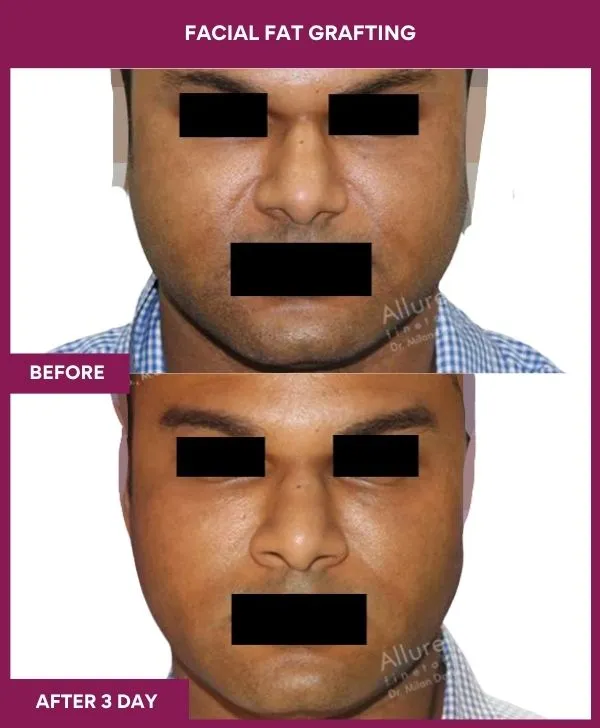
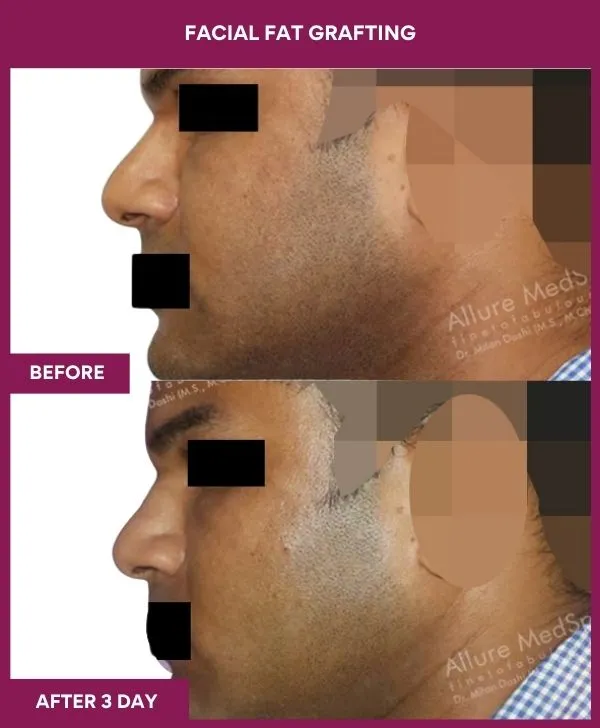
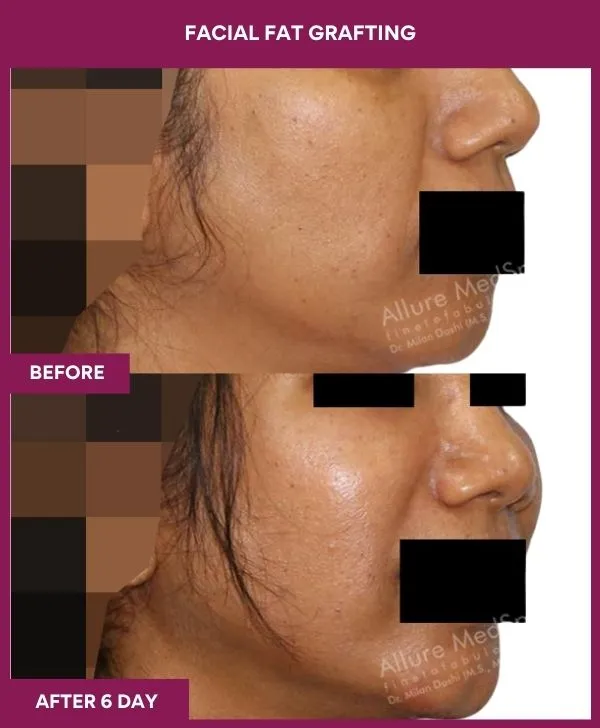
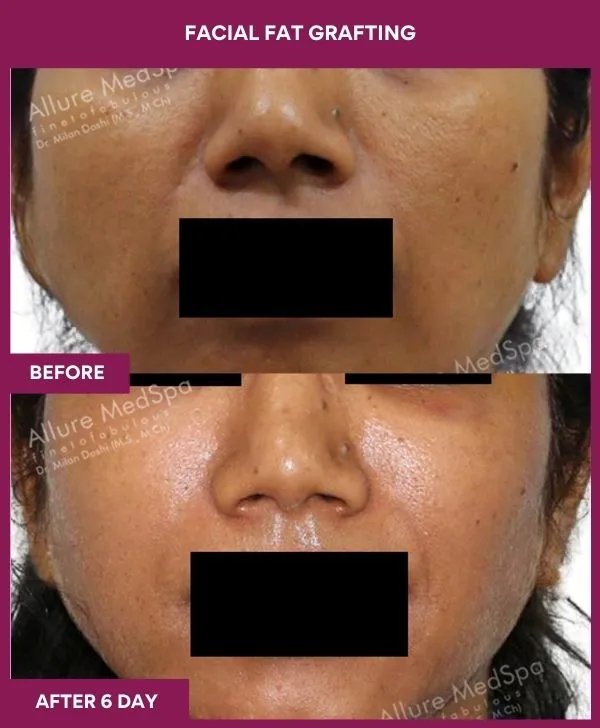
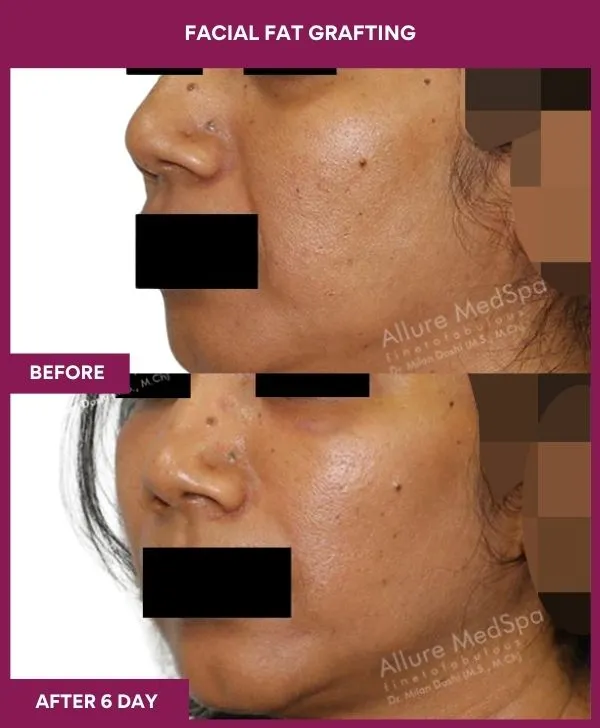
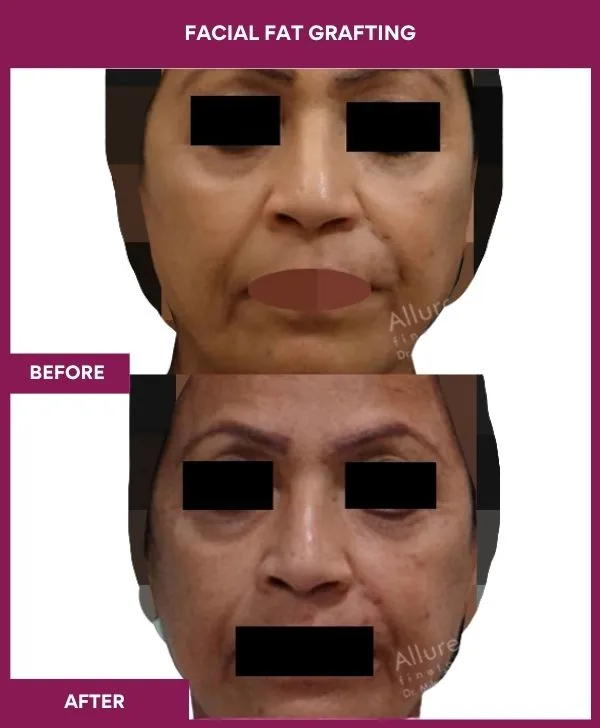
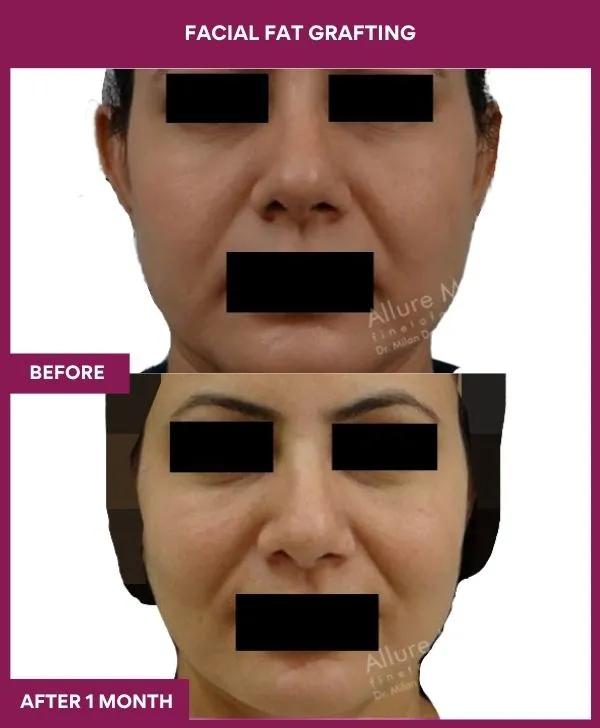
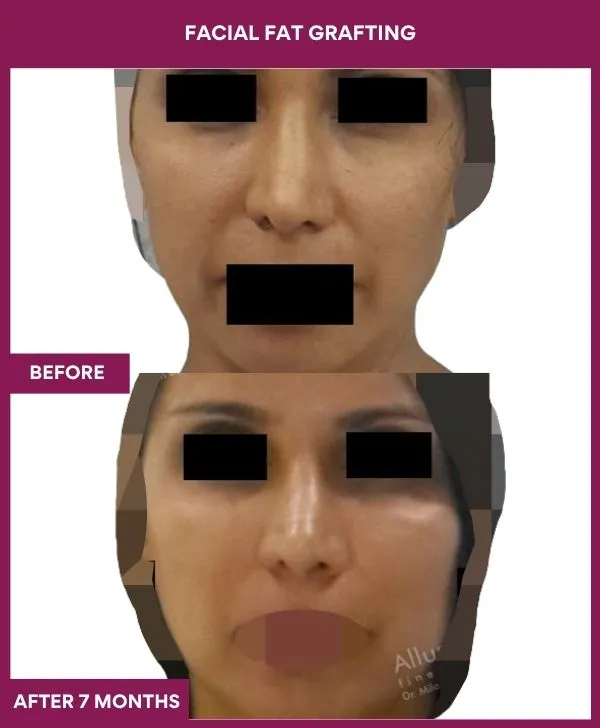
“Fat Injection Surgery Cost in Mumbai”
Fat Grafting/Injections Testimonials: Fine To Fabulous Journeys

Awarded by Google.com
Rating: 4.7
Reviews: 485+

Awarded by WhatClinic.com
Rating: 4.8
Reviews: 119+

Awarded by Realself
Rating: 4.9
Reviews:453+

Awarded by Facebook
Rating: 4.6
Reviews:105+
Dr Milan Doshi and his staff are very professional and committed as the centre is highly equipped with advanced technology. I had closed rhinoplasty 4 months back and I’m seeing the results as to how it becomes successful.
Deepika Shetty
The doctor explained everything clearly and the surgery was smooth. Recovery was faster than I expected and the team was very supportive.
Rahul Mehta
Very natural results and excellent staff. From consultation to follow-up, the experience was outstanding and boosted my confidence.
Sneha Kapoor
“Fat Injection Surgery Cost in Mumbai”
Do I Need Volume, Lifting, Or Both?
(4 quick questions)
Quick Facts About Facial Fat Grafting
TIME REQUIRED
1–2 hours
ANESTHESIA
Local/General
HOSPITAL STAY
1–2 days
PAIN LEVEL
Mild–moderate
BACK TO WORK
4–5 days
RESULTS LAST
Long Lasting
SUCCESS RATE
97–98%
COMPLICATIONS
Under 2–3%
How Much Does Facial Fat Grafting Cost in Mumbai?
Facial fat grafting at Allure Medspa costs about ₹40,000–₹1,10,000 per area; multiple areas or grafting with a facelift are quoted after assessment.
| Option | Typical cost (Mumbai) | Note |
|---|---|---|
| Single facial area | ₹40,000 – ₹1,10,000 | Live figure |
| Multiple facial areas | Quoted after assessment 🩺 | Confirm a band |
| With a facelift | Added to the facelift quote → Facelift Cost | Facelift cost page lists fat grafting as “See page”, no price |
| Top-up session | Quoted at consultation 🩺 | Writer: ask before the first operation |
| Consultation | ₹1,500 (writer CTA 9) | Personal assessment with Dr. Doshi |
| Usually included | Not included |
|---|---|
| Surgeon’s and anaesthetist’s fees, OT, consumables, harvesting and injection technology, immediate follow-ups | Pre-op tests, take-home medicines and 5% GST; cosmetic fat grafting is not insured |
Cost depends on the number of facial areas treated, the harvesting and processing required, anaesthesia, and whether fat transfer is performed alone or during facelift surgery. The quotation should follow examination and an individual plan rather than a standard per-area promise.
- EMI → Cosmetic Surgery Payment Process
- Exact quote after assessment
Get your exact quote & surgery plan
Share your details — our team responds within working hours with cost, EMI options and next steps.
Most Common Question People Ask
Q1. What is facial fat grafting or fat transfer?
Ans. It transfers your own harvested fat into selected facial areas to restore volume — harvested, processed and re-injected in small parcels, alone or alongside facial-rejuvenation surgery.
Q2. How long does facial fat transfer last?
Ans. Fat that integrates can remain for years, but the result is not frozen: some graft is resorbed, ageing continues, and retained fat changes with body weight.
Q3. How much of the transferred fat survives?
Ans. It varies. A meta-analysis of 27 studies found about 47% pooled retention, with individual reports from 26% to 83%. Slight planned overcorrection may be used, but overfilling is itself a complication.
Q4. Is facial fat grafting safe?
Ans. Most complications are minor, but rare vascular events can cause vision loss or stroke. Their exact incidence is unknown, and unlike hyaluronic-acid filler, fat has no dissolving agent.
Q5. Fat transfer or fillers — which is better?
Ans. Neither is universally better. Fat suits larger, longer-lasting restoration with a donor procedure and variable retention; fillers are more controlled immediately but many are temporary.
Q6. Can fat grafting be combined with a facelift?
Ans. Yes, when ageing includes both descent and genuine volume loss — the facelift repositions, fat restores selected areas. It should not be added routinely.
Q7. Will I lose my result if I lose weight?
Ans. Weight change can alter retained grafted fat, because it remains living tissue. A five-year study linked facial volume to weight gain; stable weight improves predictability.
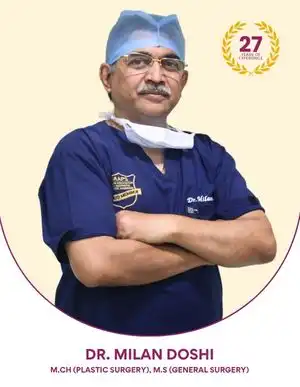
Why Choose Dr. Milan Doshi?
Dr. Milan Doshi, MCh, MS — Indian board-certified plastic surgeon with 27+ years who adds fat only where volume has genuinely gone, places it in small parcels in the correct plane with controlled, low-pressure technique, and explains the rare vascular risk before any decision. Consults at Andheri West; surgery at the NABH-accredited Vardan Hospital, Goregaon West.
Dr Doshi Note: “Fat grafting must be performed conservatively, with fat placed in the correct anatomical plane using controlled, low-pressure technique. I explain the rare embolism risk and that fat survival varies. For buttock transfer, subcutaneous-only placement with real-time ultrasound guidance is essential for safety.”
The Complete Guide About Facial Fat Grafting
What Is Facial Fat Grafting Or Fat Transfer?
Fat is harvested from your body, processed, and placed in small parcels into selected facial areas — a grafting procedure, not simply filling.
- Autologous — your own tissue, so allergy or rejection is not the usual concern, though surgical and injection risks remain
- Donor areas — abdomen, flank, thighs
- Coleman principles — atraumatic harvest, processing and small-parcel placement, because fat survives only if it gains a blood supply
- Also called lipofilling, autologous fat transfer, structural fat grafting
Sources: Vasavada A, Raggio BS. Autologous Fat Grafting for Facial Rejuvenation. StatPearls (PMID 32491783) ✔
What types of fat graft are there?
By particle size: macro fat for volume, micro fat for delicate areas such as tear troughs, and nano fat for skin quality, not volume.
| Type | Use |
|---|---|
| Macro / structural fat | Larger-volume facial areas — cheeks, temples |
| Micro fat | Delicate areas — tear troughs, lips, fine contours |
| SNIF (sharp-needle intradermal fat) | Superficial lines |
| Nano fat | Emulsified; skin texture, fine lines — little volume |
Why Is Facial Ageing Deflation As Well As Descent?
The face ages by losing and shifting volume as well as sagging; a facelift repositions tissue but does not replace every area of lost volume.
- Causes of volume change — dermal thinning, muscle change, fat-compartment change, skeletal ageing
- Two patients, one midface — one mostly descended, one descended AND hollow; the same operation does not treat both
- Not everyone having a facelift needs fat — unnecessary volume looks overfilled
Sources: Vasavada A, Raggio BS. Autologous Fat Grafting for Facial Rejuvenation. StatPearls (PMID 32491783) ✔
What Areas Can Facial Fat Grafting Restore?
Temples, cheeks, selected under-eye hollows, the pre-jowl groove, nasolabial and perioral areas, lips, chin and jawline — each with its own technique.
| Area | What it helps | Caution |
|---|---|---|
| Temples | Hollow, skeletal-looking temples | Vascular danger zone (Moellhoff); ~10.7 mL per side in studies (Nasim) |
| Cheeks / midface | Flattened, deflated cheeks | Most common facial site |
| Under-eyes / tear trough | Hollows at the lid–cheek junction | Thin skin — small excess shows; ~8% complications (Yang) → Laser Eyelid Surgery · Dark Circle Removal |
| Pre-jowl / jawline | Hollow in front of the jowl | Fills the groove; does not lift a jowl → Facelift Surgery |
| Nasolabial / perioral / lips | Volume loss around the mouth | Lumps more visible in mobile areas |
| Chin | Mild chin deficiency | Bony deficiency → Chin Augmentation Surgery · Facial Implants |
| Glabella / forehead / nose | — | Highest-risk sites for arterial embolism — approached with great caution 🩺 |
Why Are Fat Grafting And A Facelift Often Combined?
They treat different parts of ageing: the facelift repositions descended tissue and excess skin, fat restores areas that have genuinely deflated.
- Most relevant when there is — lower-face descent with temple hollowing · jowls with loss of cheek volume · laxity with periorbital hollowing
- The goal is not a fuller face everywhere — restore where volume has gone, lift what has descended
- Facelift → Facelift Surgery · mini facelift → Mini Facelift · recovery → Facelift Recovery
How Much Fat Survives After Facial Fat Transfer?
About half on average — 47% pooled across 27 studies — but individual studies ranged from 26% to 83%, so no surgeon can promise a fixed figure.
- Retention depends on — recipient area, harvesting and processing, injection technique, tissue blood supply, patient factors, follow-up interval and the measuring method
- Measurement method alone significantly changed reported retention (Lv)
- A second large review found mean retention of 41.6% at about 14 months (Gornitsky)
- Why the face looks fuller at first — swelling plus slight planned overcorrection; excessive overfilling is itself a complication
- Honest expectation — some resorption is normal, survival varies, a top-up may be considered
What are the limitations of fat grafting?
Variable survival, possible top-ups, volume without lift, and sensitivity to weight change — fat does not tighten loose skin or fix sagging.
- Partial, variable survival
- May need a second session
- Volume, not lift → Facelift Surgery
- Weight-dependent — retained fat grows or shrinks with body weight
Is Facial Fat Grafting Safe?
Usually — reviews report 2–3% complications, mostly asymmetry or irregularity — but rare fat embolism into an artery can cause blindness or stroke.
| Commoner, usually minor | Rare but serious |
|---|---|
| Swelling and bruising — face and donor site | Arterial embolism — fat entering an artery and blocking blood to the eye or brain |
| Asymmetry or contour irregularity — the commonest specific issue | Vision loss — permanent in every reported ophthalmic-artery occlusion (Moellhoff) |
| Under- or over-correction; lumps, oil cysts, fat necrosis | Stroke or neurological injury; deaths have been reported |
| Infection, haematoma — uncommon | Highest-risk sites: glabella, temples, forehead, nose |
- Exact incidence of embolism is unknown — the evidence is reported cases, not population surveillance
- Unlike hyaluronic-acid filler, fat has no dissolving agent
- Prevention — blunt cannula, low pressure, small parcels, correct plane, knowledge of vascular anatomy
Am I A Good Candidate For Facial Fat Grafting?
You may be if you have genuine facial volume loss, some harvestable donor fat, good health, a stable weight and realistic expectations about survival.
- Assessment considers — where volume was lost · volume vs descent · donor fat · previous fillers or surgery · healing risks · nicotine · expected weight change · realistic goals
- Lean patients — may still have enough fat for small-volume facial grafting; established clinically, not assumed
- Smokers — stop well before (live: ideally 6 weeks) — nicotine impairs graft survival
- 18 or older, in good health (live)
How Is Facial Fat Grafting Performed?
Three stages: harvest fat with a fine cannula, process it to remove fluid and oil, then place it in many small parcels in the right facial planes.
| Step | What happens |
|---|---|
| 1. Harvest | Liposuction-style harvest from the abdomen, flank or inner thigh with a blunt cannula |
| 2. Process | Usable graft separated from fluid, oil and debris — no one method is proven best |
| 3. Graft | Small parcels placed in several passes at the right depth; never one large bolus |
| Allure protocol (writer) | Detail | Live page says |
|---|---|---|
| Processing method | Decanting | Centrifugation or filtration — CONFLICT 🩺 |
| Harvesting | — | Gentle, tissue-sparing (e.g. VASER, Body-Jet) 🩺 |
| Typical donor area | Abdomen | Abdomen, thighs or flanks |
| Anaesthesia | Mostly local; general if large area or preference | Same |
| Duration | 1–2 hours | Same |
| Standalone | Day care | Same |
| Combined with facelift | General anaesthesia, 1–2 days in hospital, ~5–7 days initial recovery | — |
How should you prepare?
Medical check, stop smoking (ideally 6 weeks), pause blood thinners only as advised, arrange an escort, and fast if general anaesthesia is planned.
What Is Facial Fat Grafting Recovery Like?
Both the face and the donor site heal: swelling and bruising for 1–2 weeks, desk work in about 4–5 days, and the retained volume judged at 3–4 months.
| Allure protocol (writer) | Detail |
|---|---|
| Return to desk work | About 4–5 days |
| Donor-site garment | Yes |
| Facial massage | Avoid for 7 days |
| Exercise | Resume after 7 days |
| When retained volume is assessed | Around 4 months |
| Follow-ups (live) | 3 days, 1, 2 and 4 weeks, then 3 and 6 months |
- Looking fuller than expected early does not mean too much survived — and flatness in week 2 is not the final result
- If combined with a facelift, follow the facelift recovery guide → Facelift Recovery Guide
How Long Do Facial Fat Transfer Results Last?
Fat that takes can last for years, longer than most absorbable fillers — but it changes with weight and ageing, so it is long-lasting, not permanent.
- A five-year study (12 patients) found facial volume tracked weight gain rather than the volume injected
- The same study found satisfaction drifted back to pre-operative levels by five years — repeat grafting may be needed for lasting satisfaction
- Small study — not a universal durability prediction
Fat Transfer Or Dermal Fillers — Which Suits Your Case?
Fat is your own tissue and lasts longer but needs a harvest and survives unpredictably; fillers are quicker, adjustable and (HA) dissolvable.
| Factor | Facial fat transfer | Dermal filler |
|---|---|---|
| Material | Your own fat | Manufactured injectable |
| Harvest procedure | Required | No |
| Immediate predictability | Lower — some graft resorbs | Easier to titrate |
| Downtime | Greater | Usually shorter |
| Longevity | Retained fat can be long-lasting | Depends on material; many temporary |
| Weight responsiveness | Changes with body weight | Does not behave like body fat |
| Repeat treatment | Sometimes for under-retention | Often, as filler wears off |
| If a vascular event occurs | No dissolving agent exists for fat | Hyaluronic acid can be dissolved with hyaluronidase |
| Cost at Allure (live) | ₹40,000 – ₹1,10,000 per area | ₹17,000 – ₹30,000 per syringe → Dermal Fillers |
Can Fat Grafting Be Used Outside The Face?
Yes — for breasts, buttocks and hands — but those are separate procedures with different risks, covered on their own pages.
- Buttock fat transfer (BBL) — the highest-risk use; subcutaneous-only placement with ultrasound guidance → Brazilian Butt Lift · Buttock Augmentation Surgery
- Breast — modest volume or implant camouflage → Implant vs Fat Grafting · asymmetry → Breast Asymmetry Surgery
- Hands, scars and post-surgical dents → Scar Revision Surgery
Medical Codes for Facial Fat Grafting
Cosmetic facial fat grafting uses ICD-10 Z41.1 with CPT 15773 (face, first 25 cc) and 15774 for each additional 25 cc.
| Code | Description |
|---|---|
| ICD-10 Z41.1 | Encounter for cosmetic surgery |
| ICD-10 L90.5 | Scar conditions and fibrosis of skin (depressed scars) |
| CPT 15773 | Autologous fat by liposuction to face, eyelids, mouth, neck, ears, orbits, genitalia, hands and/or feet; ≤25 cc |
| CPT 15774 | Each additional 25 cc (face group) |
| CPT 15771 / 15772 | Trunk, breasts, scalp, arms and/or legs; ≤50 cc / each additional 50 cc (body pages only) |
(FAQs) Frequently Asked Question About Facial Fat Grafting
Q1. Does fat transfer look natural?
Ans. Yes, when done conservatively — your own fat blends with surrounding tissue. Overfilling is what looks unnatural.
Q2. Can fat grafting fail?
Ans. Partial loss is expected; occasionally more is lost than hoped and a second session is needed. Complete failure is uncommon with good technique.
Q3. Am I awake during fat grafting?
Ans. Usually it is done under local anaesthesia, sometimes with sedation; general anaesthesia is used for larger areas or when combined with a facelift.
Q4. Can I walk after fat grafting?
Ans. Yes — the same day. Activity is limited for about a week depending on the donor area.
Q5. What should I avoid afterwards?
Ans. Pressure and massage on the face for 7 days, smoking, alcohol, strenuous exercise for a week, and big weight changes.
Q6. Can my body reject a fat transfer?
Ans. No true rejection occurs because it is your own tissue — but some fat cells do not survive and are reabsorbed.
Q7. Does fat transfer change face shape?
Ans. It restores volume and softens hollows; the aim is your own face with its lost fullness back, not a new shape.
Q8. What is the success rate?
Ans. In facial reviews most patients are satisfied (about 91% around the eyes), but satisfaction can fade over years as volume changes — top-ups help.
Q9. How painful is it?
Ans. Usually mild to moderate, more at the donor site than the face, and well controlled with medication.
Q10. How long does the fat take to settle?
Ans. Swelling settles over 2–4 weeks; retained volume is judged at about 3–4 months.
Q11. Fat transfer or implants — which is better?
Ans. Fat restores soft-tissue volume; implants add bony structure. A weak chin or jaw may suit an implant → Facial Implants.
Q12. Will I need a top-up?
Ans. Sometimes — because survival varies. Ask about the top-up policy and cost before the first operation 🩺.
Q13. Can fat fix dark circles?
Ans. It can soften a hollow that casts a shadow, but not pigment — dark-circle treatment addresses pigment → Dark Circle Removal.
Q14. I live outside Mumbai — how long should I stay?
Ans. Plan about 4–5 days for the standalone procedure and first review, with online follow-ups → Outstation Patients.
Do You Need Lifting, Filling, Or Both?
A hollow face does not automatically need a facelift, and a sagging face does not automatically need volume — combine them only when both are present.
- The assessment identifies — what has descended · what has genuinely lost volume · which areas should stay lean · how much change fat can realistically give
- Book a facial-volume assessment at Andheri West, or request a preliminary WhatsApp review; surgery, when appropriate, at the NABH-accredited surgical centre in Goregaon
- The aim is not to fill every hollow — it is to restore volume where it improves proportion, keeping a natural, recognisable result