
Non-Surgical Fat Reduction in Mumbai: Lipolysis Options Compared, Honestly

Indian Board Certified Plastic Surgeon
M.CH, MS, ISAPS Mentor
16000+ Cosmetic Surgeries
1000+ Non Surgical Lipolysis
Non-surgical fat reduction (non-surgical lipolysis) uses controlled cooling, laser, ultrasound, radiofrequency or injections to destroy fat cells in small, pinchable pockets — no cuts, no stitches, no general anaesthesia, with results that build over 3–6 months across 3–6 sessions. It is a contouring treatment, not a weight-loss one: best for people near their goal weight with a BMI under 30. It is generally safe but not risk-free — this page explains why, including paradoxical adipose hyperplasia (PAH), the complication most clinics leave out. For larger volumes, surgical liposuction remains more predictable, and Dr. Milan Doshi at Allure Medspa, Andheri West, offers both, so the recommendation follows your anatomy rather than the clinic’s equipment.
Non-Surgical Lipolysis Before And After Images
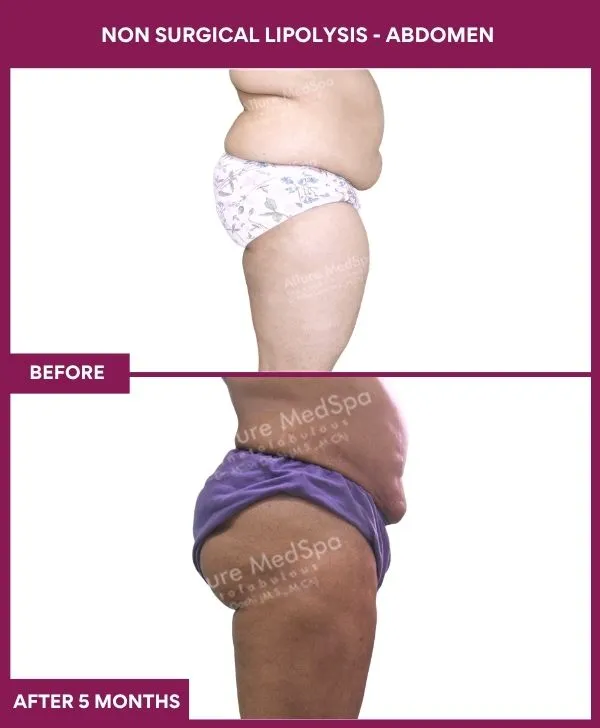
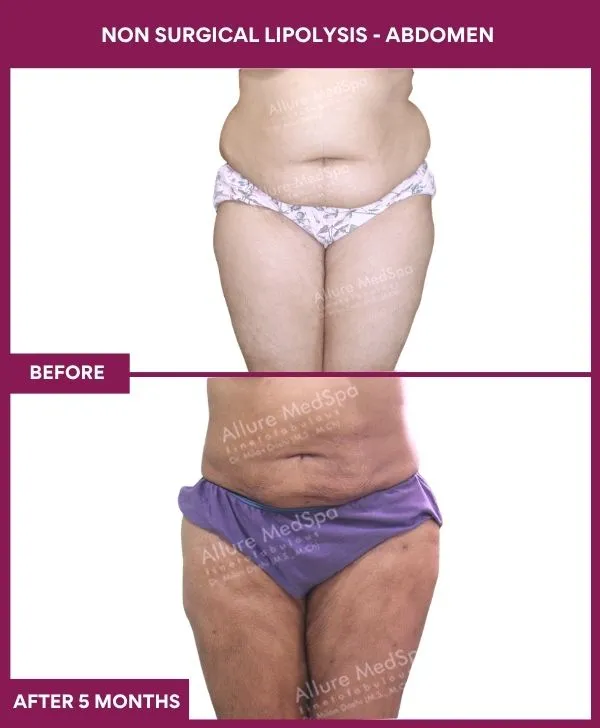
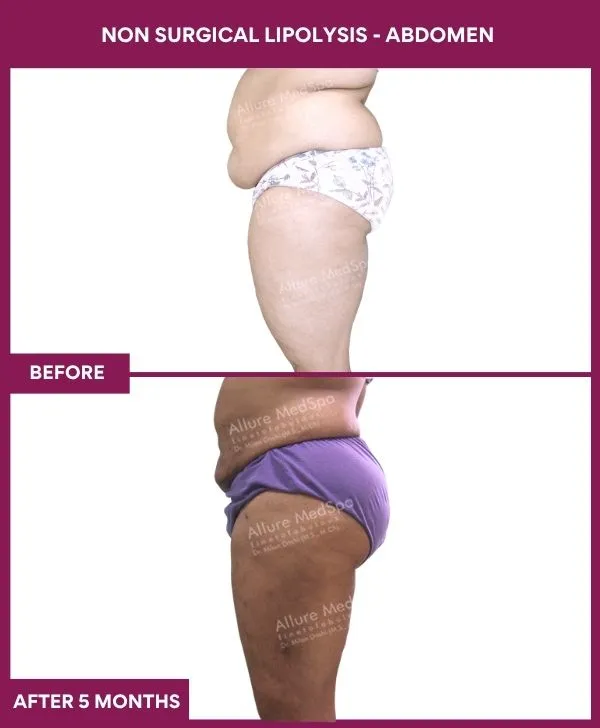
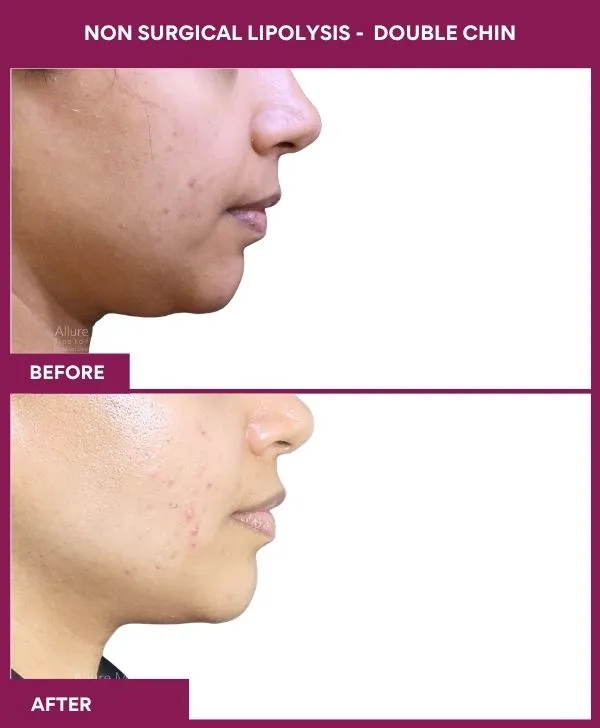
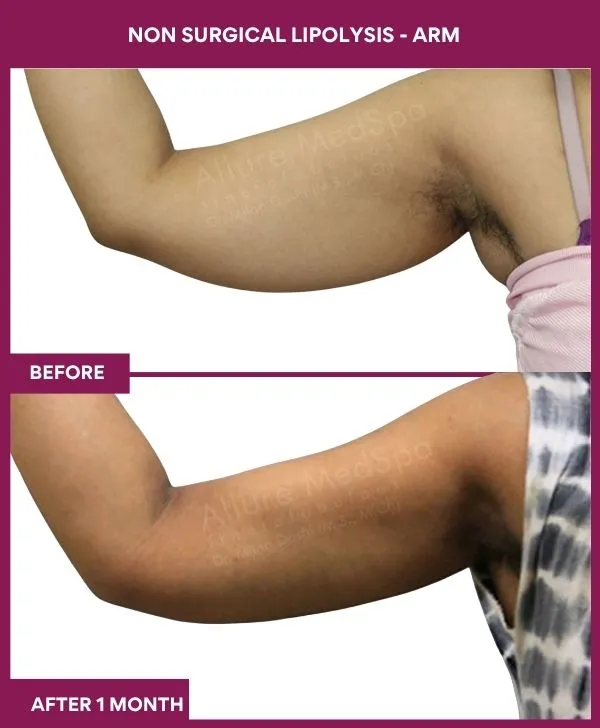
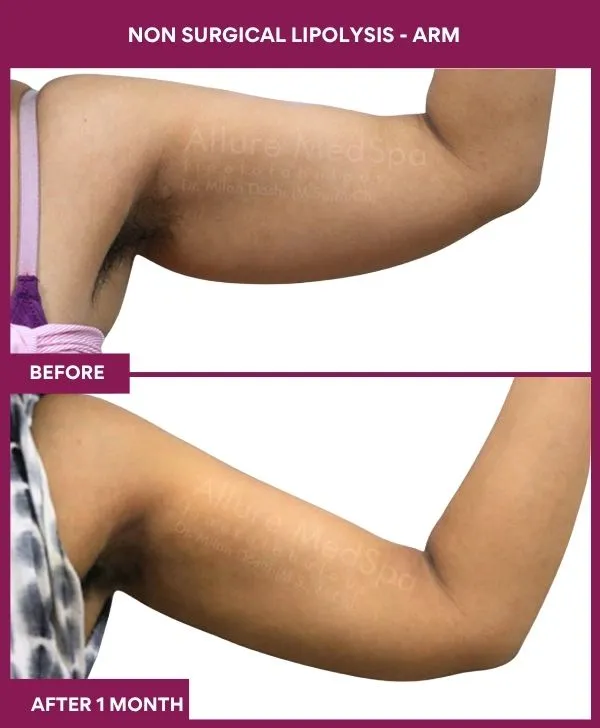
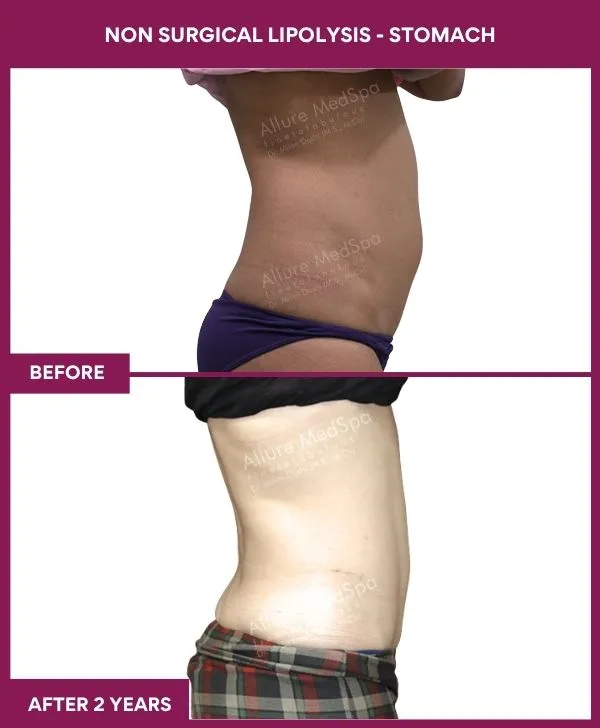
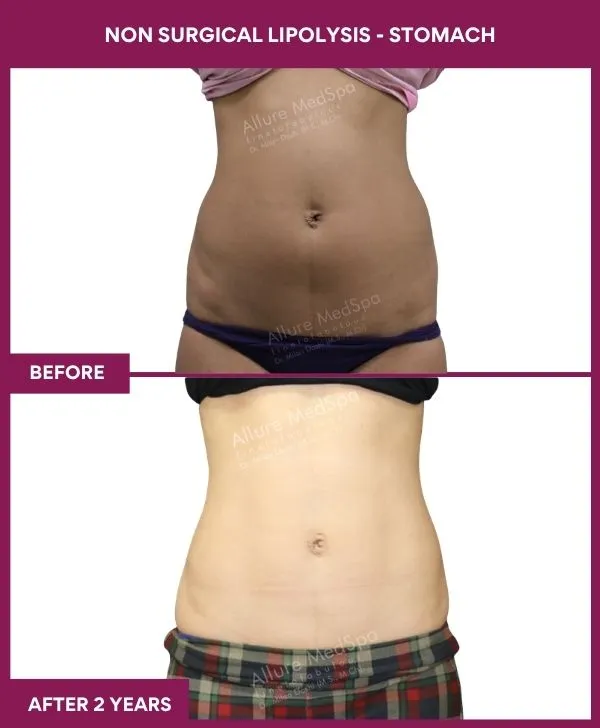
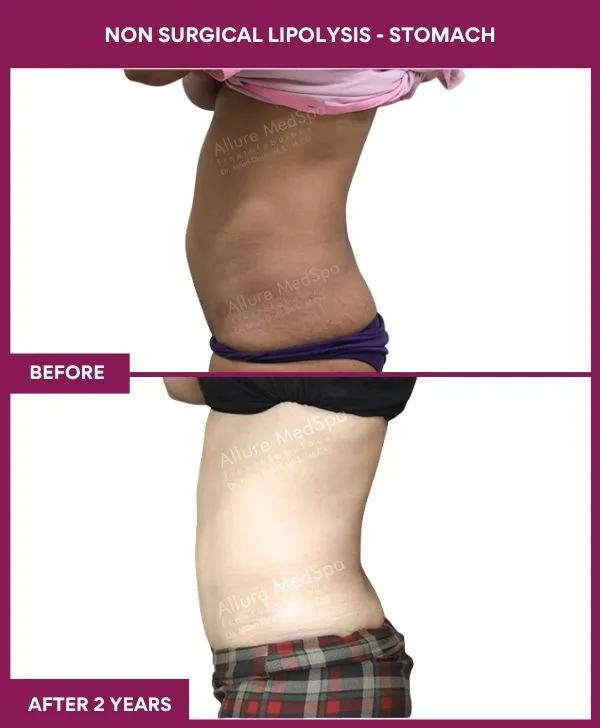
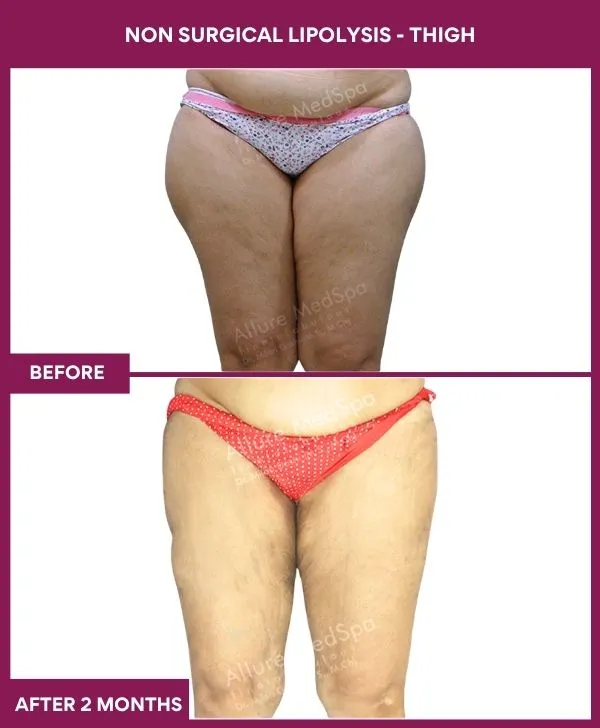
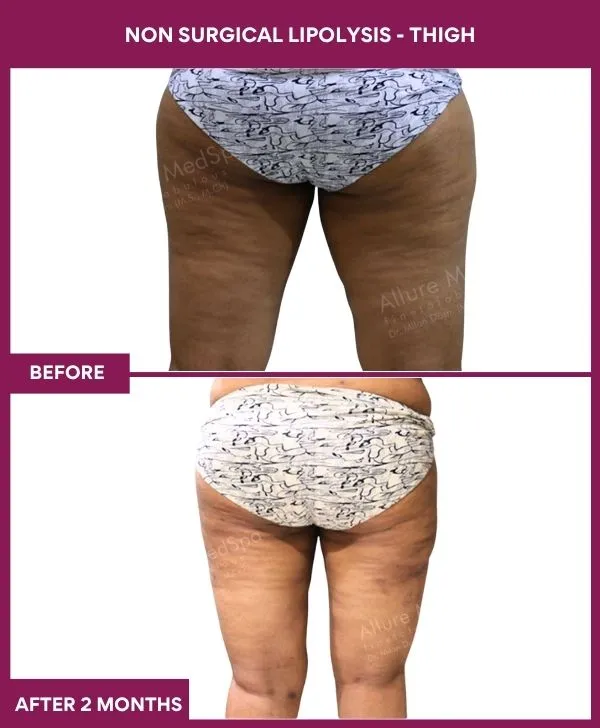
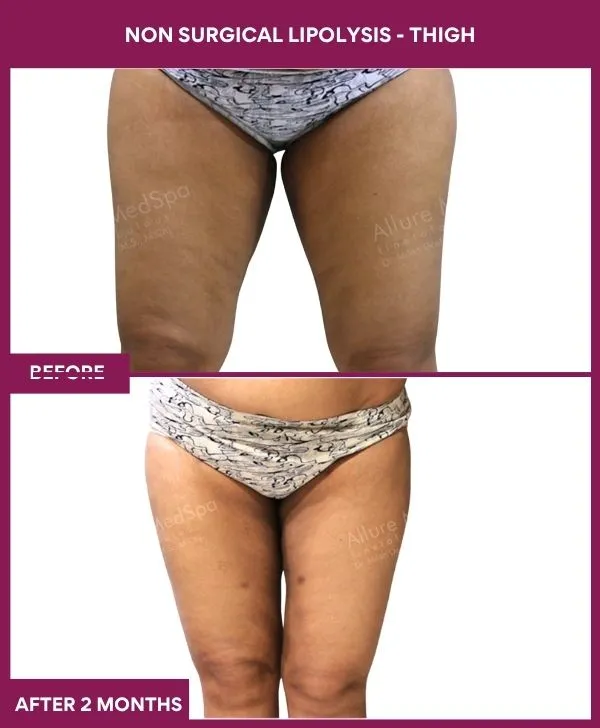
See real transformations from fine to fabulous — achieved with precision and care.
Non-Surgical lipolysis Testimonials: Fine To Fabulous Journeys

Awarded by Google.com
Rating: 4.7
Reviews: 485+

Awarded by WhatClinic.com
Rating: 4.8
Reviews: 119+

Awarded by Realself
Rating: 4.9
Reviews:453+

Awarded by Facebook
Rating: 4.6
Reviews:105+
Dr Milan Doshi and his staff are very professional and committed as the centre is highly equipped with advanced technology. I had closed rhinoplasty 4 months back and I’m seeing the results as to how it becomes successful.
Deepika Shetty
The doctor explained everything clearly and the surgery was smooth. Recovery was faster than I expected and the team was very supportive.
Rahul Mehta
Very natural results and excellent staff. From consultation to follow-up, the experience was outstanding and boosted my confidence.
Sneha Kapoor
Is Non-Surgical Lipolysis right for you?
Is Non-Surgical Fat Reduction Right For Me?
(4 quick questions)
Four answers, one honest route — device, injection or surgery.
Check My SuitabilityHonest opinion, zero pressure
Quick Facts About Non-Surgical Fat Reduction
SESSION TIME
45–90 minutes
ANESTHESIA
Topical / Local
SESSIONS
Courses of 3–6
FIRST CHANGE
3 weeks
BACK TO ROUTINE
Same day
FULL RESULT
3–6 months
PER-SESSION REDUCTION
Roughly 20–25%
COST
₹4,000 – ₹40,000
What Is The Cost Of Non-Surgical Fat Reduction In Mumbai?
Non-surgical fat reduction in Mumbai costs ₹4,000–₹40,000 per session at Allure Medspa by area and method; 3–6 sessions are usual.
| Cost factor | Why it matters |
|---|---|
| Method | Cryolipolysis cycles cost more than RF or laser passes; injections are priced per vial |
| Area and fat thickness | Larger or thicker pockets need more cycles or more product per session |
| Number of sessions | Usually 3–6 — the biggest driver of true cost |
| Add-ons | Skin tightening (HIFU / RF) or contouring add-ons |
| Expertise and follow-up | Surgeon-led assessment, safety protocols and review visits |
| Method / area (per session) | Estimated cost (₹) 🩺 PROPOSED rows |
|---|---|
| Cryolipolysis — per applicator cycle (flank, abdomen) | 15,000 – 40,000 |
| Laser or RF lipolysis — per area | 8,000 – 25,000 |
| Ultrasound (HIFU body) — per area | 10,000 – 30,000 |
| Fat-dissolving injections — double chin / small pocket | 8,000 – 40,000 → Fat Dissolving Injections |
| Small area (arms, bra roll) — any device | 4,000 – 15,000 |
| Surgical liposuction (for comparison) | See Liposuction Surgery (cost section) 🩺 |
- Compare honestly: 3–6 sessions can approach the cost of a single liposuction with a less predictable result — a good surgeon tells you which is better value for your anatomy
- EMI options → Cosmetic Surgery Payment Process · online pre-assessment → Online Consultations
Get your exact quote & surgery plan
Share your details — our team responds within working hours with cost, EMI options and next steps.
Most Common Question People Ask
Q1. What is non-surgical fat reduction (lipolysis)?
Ans. A group of treatments — cryolipolysis, laser, radiofrequency, ultrasound and fat-dissolving injections — that destroy fat cells in small, stubborn pockets without surgery. The body clears the damaged cells over weeks to months.
Q2. Is it a weight-loss treatment?
Ans. No. It is a contouring treatment for pinchable fat in people near their goal weight. It cannot reduce visceral fat and will not move the scale meaningfully.
Q3. How many sessions will I need?
Ans. Usually 3 to 6, depending on the area and method. Ask for the total course cost, not the per-session price.
Q4. When will I see results?
Ans. Early changes from about 3 weeks; the full result at 3 to 6 months after the last session. If you expect visible change at 4 weeks, you will be disappointed at exactly the point it starts to work.
Q5. Are the results permanent?
Ans. The destroyed fat cells do not return, but the remaining cells enlarge with weight gain, so results last only if your weight stays stable.
Q6. Does it hurt?
Ans. Discomfort is mild. Cryolipolysis feels like intense cold and suction and can ache for up to two weeks afterwards; laser and RF feel warm; injections sting briefly.
Q7. Is non-surgical lipolysis better than liposuction?
Ans. Neither is better — they answer different questions. Lipolysis suits small pockets and people avoiding downtime; liposuction gives a predictable, one-time result for larger volumes.

Why Choose Dr. Milan Doshi?
Dr. Milan Doshi, MCh, MS — Indian board-certified plastic surgeon with 27+ years and 16,000+ cosmetic surgeries who offers every route — device, injection and liposuction — so the recommendation follows your anatomy, and who can surgically correct PAH if it ever occurs. Consults and treats at Andheri West; surgeries at the NABH-accredited surgical centre, Goregaon West.
Dr Doshi Note: “Before cryolipolysis, I explain that PAH is uncommon but possible and may appear months later. If a firm bulge develops, repeat cooling should be avoided and the area assessed promptly. When PAH is confirmed, liposuction or surgical correction may be required. For larger or more predictable fat reduction, I may recommend liposuction instead.”
The Complete Guide About Non-Surgical Fat Reduction
What Is Non-Surgical Fat Reduction (Lipolysis) And How Does It Remove Stubborn Fat?
Non-surgical lipolysis damages fat cells with cold, heat, sound or a chemical so the body clears them over weeks — shaping pockets without surgery.
- Works through cryolipolysis (controlled cooling), laser, ultrasound, radiofrequency — or injectable deoxycholic acid, covered on its own page → Fat Dissolving Injections
- Targets stubborn subcutaneous fat in the abdomen, flanks, thighs, arms, back and under the chin
- Fat is cleared by the body’s own metabolism and lymphatics over several weeks to months
- Zero cuts, stitches or general anaesthesia — done in-clinic (OPD)
- Best for people near ideal weight with a BMI under 30; not a weight-loss treatment — for significant weight loss see bariatric surgery → Bariatric Surgery
Synonyms for non-surgical fat reduction
Non-surgical lipolysis, non-invasive fat reduction, fat freezing, body sculpting without surgery and lipo without surgery all describe this group.
- Patient terms: non-surgical fat reduction, fat freezing, CoolSculpting (a brand of cryolipolysis), lipo without surgery, non-surgical body sculpting
- Medical terms: non-surgical lipolysis, non-invasive fat reduction, cryolipolysis, laser lipolysis, radiofrequency lipolysis, high-intensity focused ultrasound body contouring
- NOT listed here — fat dissolving injections, injection lipolysis, lipolytic injections, deoxycholic acid / Kybella: these are the head terms of the injections page → Fat Dissolving Injections
Which Five Methods Of Non-Surgical Fat Reduction Exist — And How Do They Compare?
Cryolipolysis freezes, laser and RF heat, ultrasound disrupts and deoxycholic acid dissolves fat cells; they differ in evidence, sessions and risks.
| Method | How it works | Best for | Sessions | Evidence & key risk |
|---|---|---|---|---|
| Cryolipolysis (fat freezing) | Applicator cools fat to ~4 °C; fat cells crystallise and die | Pinchable flanks, abdomen, bra roll, inner thigh | 1–3 cycles per area | Best-studied device; aching up to 2 weeks; PAH (see below) |
| Laser lipolysis | Low-level or heat laser disrupts fat beneath the skin | Thin layers — arms, abdomen | 4–6 | Moderate evidence; warmth, redness |
| Radiofrequency (RF) | Deep heating shrinks fat cells; tightens skin a little | Mild laxity + small pockets | 4–6 | Moderate evidence; not with pacemakers or metal implants |
| Focused ultrasound (HIFU body) | Focused sound energy disrupts fat; different from facial HIFU → HIFU Treatment | Abdomen, flanks | 1–3 | Moderate evidence; tenderness, bruising |
| Fat-dissolving injections | Deoxycholic acid ruptures fat-cell membranes | Double chin (approved); small pockets off-label | 2–6 | Approved for chin only; irreversible; nerve-related risks — full detail → Fat Dissolving Injections |
- Each method is selected on fat location, thickness, skin quality and goals — and on whether a non-surgical approach is realistic at all
- Injections are summarised here only; contents, FDA status, nerve-injury rates and aftercare live on the fat dissolving injections page (2–3 lines + link is the owner pattern)
How does each method feel on the day?
Cryolipolysis feels like intense cold and suction that numbs in minutes; laser and RF feel like deep warmth; ultrasound tingles; injections sting.
| Method | Sensation | Session | Immediately after |
|---|---|---|---|
| Cryolipolysis | Intense cold and pulling for 5–10 minutes, then numbness | 35–60 min per applicator | 2-minute massage of the frozen tissue; redness, firmness |
| Laser / RF | Deep warmth, like a hot stone | 30–45 min | Pink skin for an hour |
| Ultrasound | Tingling, mild heat | 30–60 min | Mild tenderness |
| Injections | Stinging at each point despite numbing | 20–30 min | Swelling that peaks at day 2–3 → Fat Dissolving Injections |
Sources: Cryolipolysis mechanism and evidence — systematic review · Cryolipolysis adverse-event profile — systematic review · Deoxycholic acid safety profile — REFINE-1 Phase 3 trial.
Which Areas Of The Body Can Be Treated — And With Which Method?
Abdomen, flanks, thighs, arms, bra rolls, back, knees and double chin — the method must match the area, and only the chin has an approved injectable.
| Area | Suited methods | Note |
|---|---|---|
| Abdomen (pinchable, not visceral) | Cryolipolysis · RF · ultrasound · laser | Visceral fat sits behind the muscle and cannot be treated |
| Love handles / flanks | Cryolipolysis · ultrasound | The classic cryolipolysis area |
| Inner and outer thighs | Cryolipolysis (flat applicator) · RF | Combined thighs page for surgery → Liposuction Body Areas |
| Upper arms (“bat wings”) | Laser · RF · small cryo applicator | Loose skin → arm lift, not fat reduction |
| Double chin (submental) | Small cryo applicator · deoxycholic acid injections | The only area with an approved injectable → Fat Dissolving Injections · surgical option → Double Chin Liposuction |
| Back fat / bra rolls | Cryolipolysis · RF | Small, discrete pockets |
| Hips and buttocks | Reduction only | For enhancement see fat grafting → Brazilian Butt Lift or body contouring fillers → Body Contouring Fillers |
| Knees and lower legs | Select cases — small applicators | Ankle fullness is often swelling, not fat |
Global and Indian demand
ISAPS recorded 702,836 non-surgical fat reduction procedures worldwide in 2024, including 21,560 procedures in India.
- Globally, 84.5% of non-surgical fat reduction procedures were performed on women and 15.5% on men
- By age, 40.8% were performed in people aged 18–34 and 39.8% in those aged 35–50
- Source: ISAPS Global Survey 2024
What Are The Benefits Of Non-Surgical Fat Reduction?
No cuts, scars, anaesthesia or downtime; gradual natural-looking change; permanent loss of treated cells at a stable weight; refinement after lipo.
- Outpatient — no hospital stay
- No anaesthesia or sedation for devices — no cuts, stitches or bleeding
- Scar-free — nobody sees an overnight transformation to explain
- Most people return to work the same day
- Long-lasting when paired with a stable weight and regular activity
- Can refine minor irregularities after surgical liposuction → Liposuction Surgery
Am I A Suitable Candidate — And When Is Surgery The More Logical Discussion?
You suit it if you are near goal weight with pinchable pockets and modest goals; large volume, loose skin, BMI ≥ 30 or glandular tissue need another.
| You may be a good candidate if | You should avoid it, or seek an alternative, if |
|---|---|
| You are at or near goal weight — BMI under 30 | Your BMI is 30 or above — medically supervised weight loss or bariatric surgery first → Bariatric Surgery |
| You have localised, pinchable fat resistant to diet and exercise | You have a large fat volume or loose skin — liposuction, tummy tuck or body lift will serve you far better → Liposuction Surgery · Tummy Tuck Surgery · Body Lift Surgery |
| You do not need major contouring or significant weight loss | You have cryoglobulinaemia, cold agglutinin disease or paroxysmal cold haemoglobinuria — contraindications to cryolipolysis |
| You are in good general health and not pregnant or breastfeeding | You have a pacemaker, metal implant or heart valve — rules out radiofrequency treatments |
| You expect a gradual, modest result over several sessions | You have a hernia at the treatment site or an active skin infection |
| You are a man with firm chest tissue — likely glandular gynaecomastia, which no fat-reduction technology treats → Gynecomastia Surgery |
Sources: deoxycholic acid contraindications · cryolipolysis serious adverse events.
What Are The Limitations Of Non-Surgical Fat Reduction?
It reduces only small pockets, approximately, over several sessions; it cannot touch visceral fat, tighten skin or reshape — refinement, not change.
| Limitation | Why it matters |
|---|---|
| Small, localised pockets only | Not suited to large areas |
| Fat loss is approximate | Not precise like surgical liposuction; response varies between individuals |
| Multiple sessions | Usually 3–6 — affects the true total cost |
| Not weight loss | Cannot touch visceral fat |
| Cannot tighten loose skin | Removing fat can make laxity more apparent |
| Larger bulges need surgery | Liposuction gives a single, more predictable result → Liposuction Surgery |
| Device restrictions | No RF with pacemakers, metal implants or heart valves; no cryolipolysis with cold-related blood disorders |
| Limited reshaping | This is refinement, not contouring |
What Are The Risks And Complications Of Non-Surgical Fat Reduction?
Redness, swelling, bruising, numbness and aching are expected; uncommon risks are paradoxical adipose hyperplasia, dysesthesia and contour steps.
| Category | What is reported |
|---|---|
| Common and expected | Redness, swelling, bruising at the site · numbness or altered sensation after cryolipolysis for days to weeks · aching or tenderness for up to about two weeks · firmness or tingling as tissue settles |
| Uncommon but documented | Paradoxical adipose hyperplasia (PAH) — own section below · dysesthesia and nerve injury · contour irregularities (“shelf” or “stick of butter” shape) · skin blanching, hyperpigmentation, vasovagal reaction with cryolipolysis · burns with laser / RF if settings or contact are wrong |
| Specific to injections | Marginal mandibular nerve weakness (~4% in trials, all resolved), dysphagia (~2%), ulceration — detailed on the injections page → Fat Dissolving Injections |
| When to call the clinic | Escalating pain · a firm, growing lump weeks or months later · blistering or skin breakdown · facial asymmetry or swallowing trouble after chin treatment |
Sources: Adverse Events Associated With Cryolipolysis: A Systematic Review of the Literature · REFINE-1 Phase 3 Trial of ATX-101 (Deoxycholic Acid) · DailyMed — KYBELLA (Deoxycholic Acid) Prescribing Information
What Is Paradoxical Adipose Hyperplasia (PAH) After Cryolipolysis?
PAH is a cryolipolysis complication in which treated fat enlarges instead of shrinking — a painless, firm bulge in the applicator’s shape at 2–4.
| Question | Answer |
|---|---|
| What it looks like | A painless, firm, sharply outlined swelling matching the applicator’s rectangular footprint |
| When | Generally 2–4 months after treatment |
| How common | A multicentre review of 8,658 cycles in 2,114 patients found 0.05%–0.39% — above the manufacturer’s 0.025% (about 1 in 4,000 cycles); StatPearls notes estimates up to ~2% (1 in 50); a recent systematic review concluded PAH is under-recognised and under-reported |
| Is it weight gain? | No — PAH develops without weight change and does not resolve on its own |
| Does more cooling help? | No — repeat cryolipolysis has been reported to aggravate PAH |
| Treatment | Surgical — liposuction or excision; a submental case needed a deep-plane neck lift → Liposuction Surgery |
| Newer devices | One study found a 75% reduction in PAH incidence with newer units; another found little difference between generations |
| What to do | A firm lump appearing months later → see your surgeon; diagnosable on examination and imaging |
Sources: Nikolis et al., multicentre evaluation of PAH (8,658 cycles, 2,114 patients) · StatPearls — Paradoxical Adipose Hyperplasia · systematic review & meta-analysis (under-reporting) · submental PAH corrected with deep-plane neck lift —
How Does Non-Surgical Fat Reduction Compare With Surgical Liposuction?
Non-surgical gives gradual, approximate reduction over 3–6 sessions with no downtime; liposuction gives precise, one-time contouring with recovery.
| Feature | Non-surgical fat reduction | Surgical liposuction |
|---|---|---|
| Invasiveness | Non-invasive; no cuts or anaesthesia | Incisions and anaesthesia |
| Downtime | Minimal — same day | Several days to weeks |
| Pain | Mild; aching up to 2 weeks after cryolipolysis | Moderate pain, bruising, swelling |
| Results | Gradual, subtle over 3–6 months | Immediate and more dramatic |
| Predictability | Approximate; varies by person | Precise, surgeon-controlled |
| Sessions | Usually 3–6 | One |
| Key risks | PAH, dysesthesia, contour irregularity, nerve irritation | Infection, anaesthesia risk, contour irregularity |
| Cost | ₹4,000–₹40,000 per session × 3–6 | Higher one-time cost → Liposuction Surgery |
| Skin laxity | Not addressed | Addressed with tummy tuck / body lift where needed → Tummy Tuck Surgery |
- Non-surgical is ideal for small pockets, minimal downtime and people near goal weight
- Surgery is better for larger volume, real contour reshaping or when skin laxity also needs addressing
- Honest cost comparison: 3–6 sessions can approach the price of a single liposuction with a less predictable result
What Should You Expect During Your Consultation?
A history review, pinch test and fat mapping, an honest talk about expected change, a method-and-session plan with total cost and risk disclosure.
- Medical history — weight fluctuation, cold-related blood disorders, implants and pacemakers, medications
- Examination and fat mapping — distinguishing pinchable subcutaneous fat from visceral fat, and fat from glandular tissue
- Goals and expectations — including how modest the change will realistically be
- A customised plan — method, number of sessions and total cost stated up front
- Pre-treatment photos and measurements for objective tracking
- Full risk disclosure, including PAH, before you consent
- Online video consultations → Online Consultations · in person → Contact Us · consultation fee ₹1,500 🩺
Questions to ask any clinic offering fat freezing or lipolysis
Ask which device and generation, who performs it, their PAH plan, how many sessions and the course price, and what they would do if it is not enough.
- Which device, which generation, and is it a genuine applicator or a copy?
- Who performs the session and who assesses you first — a doctor or a technician?
- What is your PAH experience, and who corrects it if it happens? (A med-spa cannot)
- How many sessions, at what total cost, and what reduction do you expect per session?
- What would you recommend instead if a device is not enough? A one-answer practice gives one answer
How Should You Prepare For A Session?
Stop smoking 1–2 weeks before, pause blood thinners only with medical approval, stay hydrated, keep your weight stable and share every medication.
- Stop smoking at least 1–2 weeks before treatment
- Avoid aspirin, NSAIDs and herbal supplements that thin the blood — only with medical approval
- Stay hydrated before and after
- Maintain a stable weight — results depend on it
- Wider preparation guide → Cosmetic Surgery Preparation
What Happens On The Day Of The Procedure?
A 30–90-minute clinic visit: the area is marked and photographed, the applicator or handpiece is applied, and you resume normal activity the same day.
| Stage | What happens |
|---|---|
| Before | Photos and measurements; area marked with you standing; gel pad or coupling gel applied |
| During | Cryolipolysis: applicator draws tissue in and cools for 35–60 minutes per cycle · Laser / RF / ultrasound: handpiece moved over the area for 30–45 minutes · mild relaxing medication may be offered; no anaesthesia or incisions |
| After | Cryolipolysis: 2-minute manual massage of the treated tissue · redness, firmness or tenderness for hours to days · drive or travel home; normal activity the same day |
When Are Results Visible — And Are They Permanent?
Early change from about 3 weeks, full result at 3–6 months after the last session; destroyed cells never return, but remaining cells enlarge with.
| Time | What you see | What to do |
|---|---|---|
| Day 0–7 | Redness, numbness, firmness; no fat change yet | Normal routine; gentle massage if advised |
| Weeks 2–4 | Numbness fades; the first softening of the pocket | Keep weight stable; book session 2 at 4–8 weeks |
| Month 2–3 | Visible reduction; review photos and measurements | Decide on further sessions from measurements, not impatience |
| Months 3–6 | Full result of each session as the body clears the fat | Maintenance = stable weight, activity, sensible diet |
| Months 2–4 (watch) | A firm, growing bulge in a treated area | Assessment for PAH — do not repeat cooling |
- Fat cells destroyed by the treatment are cleared permanently
- Remaining fat cells can expand with weight gain — in treated and untreated areas alike
- Results are long-lasting, not dramatic; follow-up sessions may fine-tune the outcome
How Is The Recovery After Non-Surgical Fat Reduction?
Minimal — most people return to work the same day; redness, bruising, numbness or aching settle in days; cryolipolysis aching can last two weeks.
- Resume routine immediately
- Possible effects: redness, swelling, bruising, numbness, aching
- Timeline: usually days; cryolipolysis aching up to ~2 weeks; chin injections swell for up to 2 weeks → Fat Dissolving Injections
- Oral pain relief may be suggested
- Hydration, light activity and dietary guidance
- Watch for a firm lump at 2–4 months — assess for PAH
Medical Codes for Non-Surgical Fat Reduction
Non-surgical lipolysis is coded as an elective cosmetic encounter (ICD-10 Z41.1) with the unlisted subcutaneous procedure code CPT 17999 for devices.
| Code | Description | Note |
|---|---|---|
| ICD-10 Z41.1 | Encounter for cosmetic procedure | Primary |
| ICD-10 E65 | Localized adiposity | Where a localised fat deposit is documented |
| CPT 17999 | Unlisted procedure, skin, mucous membrane and subcutaneous tissue | Cryolipolysis, laser, RF and ultrasound fat reduction |
| Injection codes | See the fat dissolving injections page | Fat Dissolving Injections |
(FAQs) Frequently Asked Question About Non-Surgical Fat Reduction
Q1. What is paradoxical adipose hyperplasia (PAH)?
Ans. A complication of cryolipolysis where the treated fat enlarges rather than shrinks, appearing 2–4 months later as a firm, painless, well-defined bulge. It does not resolve on its own, and more cryolipolysis makes it worse.
Q2. How common is PAH?
Ans. A multicentre review of 8,658 cycles found 0.05%–0.39%, above the manufacturer’s 0.025%. Some estimates reach 2% (about 1 in 50), and it is thought to be under-reported.
Q3. How is PAH treated?
Ans. Surgically — with liposuction or excision. This is why your provider should be a plastic surgeon who can correct it rather than a med-spa that cannot.
Q4. Are fat-dissolving injections safe for the body?
Ans. Deoxycholic acid is approved only for fat under the chin; body use is off-label and must be discussed explicitly. Full detail on the fat dissolving injections page.
Q5. Who should not have non-surgical fat reduction?
Ans. People with a BMI of 30 or above, cold-related blood disorders (cryolipolysis), pacemakers or metal implants (RF), a hernia at the site, active infection, or who are pregnant or breastfeeding.
Q6. Does it tighten skin?
Ans. No. Some RF devices offer mild tightening, but reducing fat can make existing laxity more noticeable. Loose skin needs a tummy tuck or body lift.
Q7. Can it treat a man’s chest fat?
Ans. Only if the tissue is genuinely fatty. Firm chest tissue in men is often glandular gynaecomastia, which needs surgical excision.
Q8. Fat freezing or fat-dissolving injections — which is better?
Ans. Neither universally. Freezing is non-invasive but can ache for two weeks and rarely causes PAH; injections are more targeted but swell and cannot be reversed. Your anatomy decides.
Q9. Is CoolSculpting the same as cryolipolysis?
Ans. CoolSculpting is one brand of cryolipolysis device. Other cryolipolysis systems exist; ask which device and generation the clinic uses.
Q10. Can I combine methods?
Ans. Yes — a device for a larger pocket and injections for the chin, or RF for mild laxity after cryolipolysis, are common staged plans.
Q11. How soon can I exercise?
Ans. The same or next day. Activity helps the body clear the released fat.
Q12. Will the fat move somewhere else?
Ans. No. Treated cells are gone; weight gain enlarges the remaining cells everywhere, which can look like “moving” if the treated area now stays smaller.
Q13. Is it safe during pregnancy or breastfeeding?
Ans. No — defer all methods until after breastfeeding.
Q14. How much does it cost in Mumbai?
Ans. Roughly ₹4,000–₹40,000 per session by area and method. Since 3–6 sessions are typical, ask for the total course cost.
Related Links
- Fat Dissolving Injections (deoxycholic acid — procedure page)
- Liposuction Surgery (hub)
- Liposuction Body Areas
- Liposuction Before & After
- Liposuction Techniques
- Vaser Liposuction
- Double Chin Liposuction
- Tummy Tuck Surgery
- Body Lift Surgery
- Gynecomastia Surgery
- Bariatric Surgery
- HIFU Skin Tightening
- Body Contouring Fillers
- Mesotherapy
- Cosmetic Surgery Preparation
- Meet Dr. Milan Doshi