Indian Board Certified Plastic Surgeon
M.CH, MS, ISAPS Mentor
16000+ Cosmetic Surgeries
350+ Thread Vein Removal
Spider Vein Treatment (Sclerotherapy & Laser) in Mumbai — Safe, Effective Care for Clear Skin
Spider vein treatment is a minimally invasive procedure that reduces or clears the thin red, purple or blue web-like veins visible under the skin. The main options are sclerotherapy (the gold standard for leg veins), and Nd:YAG laser or IPL for tiny or facial veins — both done as outpatient care with little downtime. Where leg veins are extensive, a duplex ultrasound first checks for deeper venous problems.
What Is Spider Vein Treatment?
Spider vein treatment (also called thread vein removal or sclerotherapy) is a minimally invasive cosmetic procedure that reduces or eliminates the thin, web-like red, purple or blue veins visible beneath the skin — by collapsing the faulty vessels so the body reabsorbs them.
Sclerotherapy — a safe injectable solution collapses and fades visible leg veins (the gold standard)
Laser therapy — Nd:YAG or IPL light targets tiny or facial veins without needles (shares technology with photofacial)
Radiofrequency / advanced methods — heat-based closure for feeder/reticular veins to reduce recurrence
Also called — spider vein removal, thread vein removal, sclerotherapy, vascular laser treatment, capillary vein treatment
Setting — outpatient, minimal discomfort, little to no downtime; visible improvement over a few weeks
Source: Sclerotherapy = gold standard for telangiectasias & reticular veins (ESVS/EJVES)
“Ready to reshape your body?”
Spider Vein Treatment Testimonials: Fine To Fabulous Journeys

Awarded by Google.com
Rating: 4.7
Reviews: 485+

Awarded by WhatClinic.com
Rating: 4.8
Reviews: 119+
Awarded by Realself
Rating: 4.9
Reviews:453+

Awarded by Facebook
Rating: 4.6
Reviews:105+
Dr Milan Doshi and his staff are very professional and committed as the centre is highly equipped with advanced technology. I had closed rhinoplasty 4 months back and I’m seeing the results as to how it becomes successful.
Deepika Shetty
The doctor explained everything clearly and the surgery was smooth. Recovery was faster than I expected and the team was very supportive.
Rahul Mehta
Very natural results and excellent staff. From consultation to follow-up, the experience was outstanding and boosted my confidence.
Sneha Kapoor
Is Non-Surgical Lipolysis right for you?
Do Spider Veins on Your Legs or Face Make You Self-Conscious — Can Spider Vein Treatment Help?
If reddish, purplish or bluish web-like veins on your legs or face are affecting your confidence, spider vein treatment offers a safe, minimally invasive way to reduce or eliminate them and restore smoother, clearer skin.
Are those reddish, purplish, or bluish veins on your legs, face, or body making you feel self-conscious?
Do you find yourself avoiding shorts, dresses, or social gatherings because of these vein patterns?
Are you tired of seeing your skin resemble a network of thin, web-like lines that steal away its natural beauty?
Spider veins — also called thread veins — may not always cause physical pain, but their appearance can deeply affect confidence and emotional well-being. Many people describe embarrassment, frustration and a constant urge to hide their skin. Factors like genetics, pregnancy, ageing, hormonal changes, weight gain or prolonged sun exposure often contribute to their development.
Thankfully, spider vein treatment offers a safe, minimally invasive and effective solution. Using advanced methods such as sclerotherapy, laser therapy or radiofrequency, these visible veins can be significantly reduced or eliminated — restoring a smoother, clearer, more youthful skin tone, and the freedom to wear what you love without hesitation. Where relevant, we also treat any related pigmentation.
Global & Indian trends (ISAPS 2024)
Globally, more than 580,000 vein-related cosmetic procedures were performed in 2023, reflecting steady rising demand for non-invasive vascular treatments.
In India, tens of thousands of spider vein treatments are performed annually, with Mumbai, Delhi and Bangalore leading demand.
Source: ISAPS Global Survey 2024
Quick Facts about Spider Vein Treatment
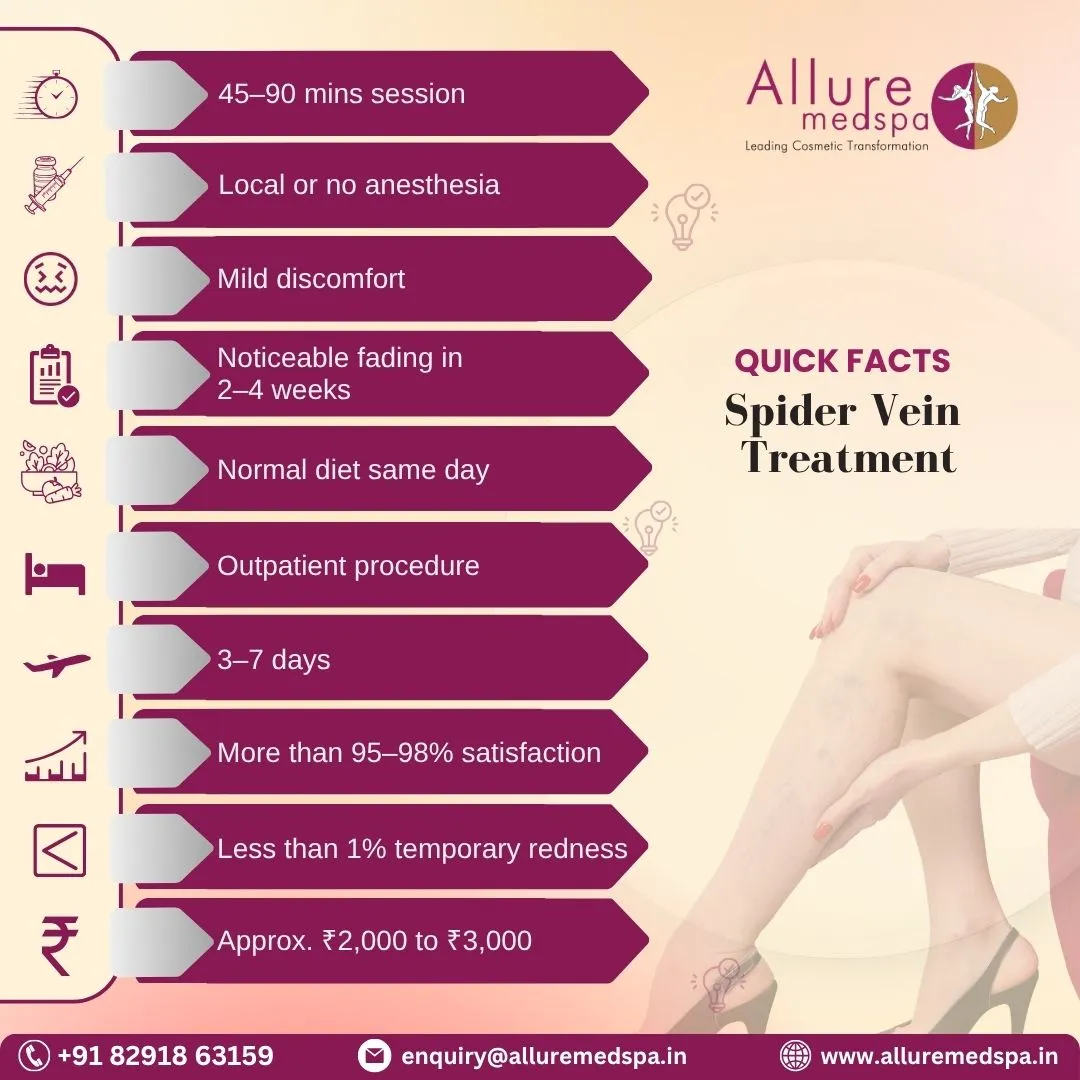
| Time Required | 45–90 mins session |
| Anesthesia | Local or no Anesthesia |
| Pain Level | Mild discomfort |
| Flyback | 3–7 Days |
| Success Rate | 95% to 98% |
| Result | Noticeable fading in 2-4 weeks |
| Diet | No Restrictions |
| Complication Rate | Less than 1% temporary redness |
| Cost in Mumbai | INR 2,000 to 3,000 Approx. |
“Know the basics? Let’s go deeper. ”
What Causes Spider Veins (and How Do They Differ from Varicose Veins)?
Spider veins form when tiny blood-vessel valves weaken and blood pools near the skin surface; they’re usually caused by genetics, hormones, prolonged standing, age, weight and sun exposure — and differ from varicose veins, which are larger, bulging and may signal deeper venous disease.
Genetics — a family history of spider or varicose veins is the strongest risk factor
Hormonal changes — pregnancy, oral contraceptives, HRT and menopause weaken vein walls and valves
Prolonged standing/sitting — jobs with long hours on the feet raise pressure in leg veins
Age & weight — vein walls lose elasticity with age; excess weight adds venous pressure
Sun exposure & injury — UV damage and trauma trigger facial and superficial spider veins
Spider vs varicose — spider veins are small, flat and painless; varicose veins are larger, raised and may indicate underlying venous reflux needing a duplex scan
Source: Telangiectasias, reticular & varicose veins — assessment
"Know More Spider Veins"
What Are the Benefits of Spider Vein Treatment?
Spider vein treatment clears unsightly veins, relieves any aching or heaviness, prevents progression when feeder veins are treated, and restores smooth, even-toned skin — with minimal downtime.
Clearer skin — visibly reduces red/blue thread veins on legs and face
Symptom relief — eases aching, itching or heaviness when veins are symptomatic
Durable results — treated veins are reabsorbed and don’t return; treating feeder veins reduces recurrence
Minimal downtime — most people resume routine the same or next day
Non-surgical options — sclerotherapy needs no cuts; laser needs no needles
Confidence — freedom to wear shorts, dresses and go bare-legged without self-consciousness
“Know More Spider Veins”
What Are the Indications for Spider Vein Treatment?
Consider spider vein treatment for red, blue or purple thread-like veins on the legs, face, nose or ears — especially if they ache, itch, swell, or affect your confidence.
Visible signs — red/blue/purple thread-like veins (telangiectasia), starburst or matting clusters
Symptoms that merit care — aching, burning, heaviness, night cramps, itching, ankle swelling
Common sites — legs (thighs, calves, ankles), face and nose (often rosacea-prone), outer ear
Risk factors — family history, pregnancy/hormones, prolonged standing, obesity, sun damage
Prioritise evaluation if — bleeding, skin discolouration/ulcer, sudden spread, or coexisting varicose veins
Treatment paths — sclerotherapy (gold standard), surface laser/IPL for facial veins, compression support
“Know More Spider Veins”
Why Should You Consult a Dermatologist Before Spider Vein Treatment?
A consultation confirms the cause, screens for deeper vein disease and designs a safe, personalised spider vein treatment plan — which is what protects your skin and gives realistic, lasting results.
Accurate diagnosis — distinguishes spider veins from reticular/varicose veins and identifies triggers
Safety screening — reviews history, pregnancy, allergies and blood thinners; checks skin type to reduce burn/pigment risk
Duplex ultrasound (when needed) — rules out deeper venous reflux that may need endovenous therapy first
Right technique — chooses sclerotherapy vs laser/IPL and the correct agent, concentration and energy
Expectations & sessions — clarifies session count, clearance rates, downtime and recurrence prevention
Aftercare plan — compression, sun protection and follow-up to optimise results
🩺 Dr. Milan Doshi’s note: “For leg spider veins, I first check for feeder veins or signs of deeper venous reflux and advise a duplex scan when needed. Treatment is then planned with the right technique and carefully selected sclerosant strength to reduce recurrence and pigmentation risk in Indian skin.”
“Ready to reshape your body?”
What Are the Different Treatment Options for Spider Vein Treatment?
The main spider vein treatment options are sclerotherapy, laser/IPL and RF/advanced methods — with sclerotherapy the gold standard for leg veins and laser preferred for tiny or facial veins.
Sclerotherapy (gold standard) — micro-injections of polidocanol or sodium tetradecyl sulfate collapse tiny leg veins; also closes feeder veins to reduce recurrence; 1–3 sessions for most
Laser / IPL (surface) — Nd:YAG or IPL targets very small or facial veins without needles; cooling protects skin — shares technology with photofacial treatment
RF / advanced methods — radiofrequency closure or foam techniques treat feeder/reticular veins to cut recurrence
Compression support — medical stockings improve symptoms and post-procedure results (they don’t erase existing veins)
Work-up & safety — duplex ultrasound when leg veins are extensive; sun protection after lasers; avoid heat/exercise 24–48 hours
Sources: Sclerotherapy gold standard; laser for facial/tiny veins, Sclerotherapy closes feeder veins (lower recurrence)
“Ready to reshape your body?”
How Is Laser Spider Vein Treatment Performed?
Laser spider vein treatment uses brief pulses of light to heat and seal tiny vessels; with cooling and numbing it’s quick, precise and has minimal downtime.
Position & prep — skin is cleansed and a topical anaesthetic/gel applied
Eye protection — safety goggles for you and the clinician
Device settings — energy, pulse width and spot size customised to vein size, depth and skin type
Cooling & pulses — contact/air/cryogen cooling protects skin while short pulses track each vein
Closure — heated blood coagulates; the vessel collapses and is reabsorbed over weeks
Sessions — many need 1–3 treatments, ~3–6 weeks apart, for optimal clearance
“Ready to reshape your body?”
What Results Can You Expect After Spider Vein Treatment?
Most people see 60–90% clearance after 1–3 sessions of spider vein treatment, with veins fading over 3–12 weeks and best results supported by compression and sun protection.
Natural timeline — treated veins may darken first, then fade over 3–6 weeks; clearing continues up to 12 weeks
Typical clearance — ~60–90% improvement after 1–3 sessions (varies by vein size, depth and location)
Sessions & spacing — clusters may need repeat treatments every 3–6 weeks
What influences outcome — skin type, sun exposure, hormones/pregnancy, standing jobs, and feeder veins
Maintenance matters — compression (legs), sun protection and treating feeder/reticular veins reduce recurrence
Temporary effects — redness, mild swelling, bruising or matting usually resolve; pigment change typically fades over weeks to months
“Ready to reshape your body?”
What Post-Care Steps Should You Follow After Spider Vein Treatment?
Good aftercare helps veins settle and results last: walk the same day, use compression if advised, avoid heat, and protect the treated area after spider vein treatment.
Walk the same day — light walking supports circulation and healing
Wear compression stockings if advised — especially after leg-vein treatment; reduces swelling AND lowers pigmentation risk
Avoid heavy exercise briefly — skip gym/running/intense workouts for a few days; gentle activity is fine
Avoid heat — no hot baths, steam, sauna or prolonged sun; heat increases redness
Don’t rub the area — let veins settle; follow only your clinician’s instructions
Use sunscreen — essential after facial laser/IPL to prevent pigmentation
Follow up — some clusters need more than one session; review guides the next step
“Ready to reshape your body?”
What Are the Side Effects of Spider Vein Treatment?
Spider vein treatment is generally safe; expect mild redness or swelling, with occasional bruising, matting or temporary pigment change — the last is more likely in darker skin and with stronger sclerosants, and is reduced by compression and sun protection.
Common & short-term — redness, swelling, tenderness, mild itching or warmth at treated sites
Bruising — small bruises can appear and usually settle within 1–2 weeks
Pigment change (key for Indian skin) — brown lines/spots (PIH) can occur in a meaningful minority; more likely with potent sclerosants — compression and SPF reduce it, and it usually fades over weeks to months
Matting — fine new red vessels near the site; often improve with time or a touch-up
Laser-specific — rare surface crusting/blister if aftercare or sun protection is inadequate — SPF is essential
Sclerotherapy-specific — small lumps or ‘trapped blood’ can occur; rare ulceration, thrombophlebitis or allergic reaction
Reduce risk by — vein mapping, correct agent/energy, compression, and strict sun protection
Sources: Post-sclerotherapy hyperpigmentation & sclerosant potency, Compression lowers pigmentation; matting/complications, Skin-type tailoring in darker Fitzpatrick
“Get Safe Spider Veins”
How Long Do Spider Vein Treatment Results Last?
Results of spider vein treatment can last years — treated veins are reabsorbed and rarely return — though new veins may form over time, so treating feeder veins and healthy habits help results last.
Treated veins — sclerotherapy/laser seal targeted veins; the body reabsorbs them, so those specific veins don’t come back
New veins — genetics, hormones, pregnancy, sun and standing jobs can create new spider veins over time
Feeder veins matter — treating reticular ‘feeder’ veins improves durability and reduces matting/return
Typical timeline — clearance evolves over 3–12 weeks; review at 6–12 weeks; touch-ups as needed
Maintenance habits — compression (legs), SPF (face), exercise/weight control, breaks from prolonged standing
“Get Safe Spider Veins”
What Is the Cost of Spider Vein Treatment in Mumbai?
In Mumbai, spider vein treatment starts around ₹2,000 per session; the final cost depends on vein size and number, the technique (sclerotherapy or laser) and the sessions needed. EMI options are on our payment process page.
Starting price — from ~₹2,000 per session (exact fee after examination)
Treatment modality — sclerotherapy vs surface laser/IPL, chosen by vein size, depth and skin type
Extent of veins — number of clusters/length treated affects time and cost
Sessions needed — many need 1–3 sessions, ~3–6 weeks apart
Aftercare extras — compression stockings (legs) and follow-ups add to the total
“Get All Inclusive Spider Veins Cost”
Who Is the Best Doctor for Spider Vein Treatment in Mumbai?
Dr. Milan Doshi is a board-certified cosmetic surgeon with 27+ years of experience, trusted in Mumbai for safe, natural-looking spider vein treatment using sclerotherapy and laser.
Board-certified authority — Indian board-certified Plastic & Cosmetic Surgeon; ISAPS Mentor
Full treatment range — sclerotherapy (gold standard), surface laser/IPL and compression planning
Personalised care — maps veins, rules out deeper reflux, and tailors sessions
Safety & facility — NABH-grade protocols and a trained team
“Book a Online Consultation.”
Which Is the Best Cosmetic Centre for Spider Vein Treatment in Mumbai?
Allure Medspa, led by Dr. Milan Doshi, is a trusted NABH-grade Mumbai centre for spider vein treatment, with gold-standard sclerotherapy, Nd:YAG/IPL lasers and personalised, skin-type-aware plans.
Expert leadership — board-certified Dr. Milan Doshi (ISAPS Mentor) oversees protocols and outcomes
Gold-standard care — micro-sclerotherapy for leg veins; Nd:YAG/IPL for facial and tiny telangiectasias
Safety first — NABH-grade processes, sterile technique and skin-type-specific energy settings
Right work-up — duplex evaluation arranged when extensive leg veins suggest deeper reflux
Comprehensive skin & vascular care — from spider veins to facial redness/rosacea and pigmentation
Outstation and overseas patients are supported end-to-end — see our outstation patients guide.
“Our Holistic Care for Outstation Patients"
Medical Code for Spider Vein Treatment
ICD-10 Codes for Spider Vein Treatment
| ICD-10 Code | Description |
|---|---|
| I83.90 | Asymptomatic varicose veins of unspecified lower extremity |
| I83.91 | Asymptomatic varicose veins of right lower extremity |
| I83.92 | Asymptomatic varicose veins of left lower extremity |
| I78.1 | Naevus, non-neoplastic (telangiectasia / spider veins) |
| I78.8 | Other specified diseases of capillaries |
| Z41.1 | Encounter for cosmetic procedure (aesthetic spider vein removal) |
CPT Codes for Spider Vein Treatment
| CPT Code | Description |
|---|---|
| 36468 | Injection(s) of sclerosant for spider veins (single extremity) |
| 36470 | Injection of sclerosant; single vein |
| 36471 | Injection of sclerosant; multiple veins, same leg |
| 36475 | Endovenous ablation therapy with laser, first vein (for larger varicose veins) |
| 36476 | Endovenous ablation therapy with laser, subsequent vein(s) |
| 36478 | Endovenous ablation therapy with radiofrequency, first vein |
| 36479 | Endovenous ablation therapy with radiofrequency, subsequent vein(s) |
| 17999 | Unlisted procedure, skin (used if cosmetic laser/IPL is applied for telangiectasia) |
(FAQ's) Frequently Asked Question of Thread Vein Removal?
Q1. What is the best treatment for spider veins?
Ans. Sclerotherapy is the gold standard for leg spider veins because it also closes the feeder veins that cause them; laser or IPL is preferred for tiny or facial veins. The right choice depends on vein size, location and skin type.
Q2. How many sessions are needed?
Ans. Most people need 1–3 sessions for leg veins, spaced about 3–6 weeks apart; clustered or widespread veins may need a few more.
Q3. Is spider vein treatment safe for Indian/darker skin?
Ans. Yes, with care. Darker skin has a higher risk of temporary pigmentation, so milder sclerosant strengths, compression and strict sun protection are used to minimise it.
Q4. How do I stop spider veins from progressing?
Ans. Regular exercise, compression stockings, a healthy weight, avoiding prolonged standing and elevating the legs all help; early treatment can also prevent worsening.
Q5. Can I treat my spider veins myself?
Ans. No — compression may ease discomfort, but visible removal needs professional treatment. Avoid DIY injections or unverified creams.
Q6. Are spider vein treatments safe?
Ans. Yes — modern treatments are generally safe with minimal, temporary side effects when performed by a certified surgeon or dermatologist.
Q7. Can spider veins be cured permanently?
Ans. The treated veins are permanently sealed and reabsorbed, but new spider veins can form over time, so occasional maintenance may be needed.
Q8. How do I remove spider veins on my legs?
Ans. Leg spider veins are treated effectively with sclerotherapy, sometimes combined with laser; compression stockings help with prevention and aftercare.
Q9. Can spider veins cause blood clots?
Ans. Spider veins themselves are generally harmless and don’t cause clots. However, if you have swelling, pain or suspected deep-vein problems, seek medical attention.
Q10. What age do spider veins start?
Ans. They commonly begin in the late 20s to early 30s and become more frequent with age, accelerated by hormones, genetics and lifestyle.
Q11. What is the fastest way to treat spider veins?
Ans. Sclerotherapy improves smaller veins quickly with minimal downtime; laser is fast and effective for superficial facial veins.
Q12. Do compression socks make spider veins disappear?
Ans. No — they improve circulation and help prevent new veins, but they don’t remove existing spider veins.
Q13. Can massage help spider veins?
Ans. Gentle massage may aid circulation and reduce swelling but does not remove spider veins. Always consult a professional first.
Q14. When should I worry about spider veins?
Ans. See a doctor if you have pain, swelling, heaviness, bleeding, skin changes, or signs of varicose-vein complications — these may need a duplex scan.
Q15. How do spider veins differ from varicose veins?
Ans. Varicose veins are larger, bulging and sometimes painful and may signal deeper vein issues; spider veins are smaller, flat and painless.
Q16. What is matting after treatment?
Ans. Matting is a cluster of fine new red vessels that can appear near a treated area; it usually fades over 3–6 months and can be touched up if needed.
“Still have questions? We’re here.”
Related Links
Note: The author of this content is Dr. Milan Doshi, An Indian board-certified plastic & cosmetic Surgeon wholly & solely confirms the authenticity of the information & knowledge delivered by this write-up.